Sinking of Battletown
GunsoulThe Sinking of Battletown was the destruction of the settlement and the History Road through a vast Last Rites ritual, turning an act of burial into a regional catastrophe. By collapsing the artificial leyline that sustained the area, Orient and Holster sought to lay the dead to rest and free the Human Pillars bound within it. The ritual achieved that purpose, but its force swallowed monuments, villages, and a substantial stretch of land, while leaving Yuan uncertain whether it could also stop the pursuit of Revolver and the Gun.
Background and the Need for Burial
In this world, funeral rites are more than observance: the dead may return as Hungry ghosts, and the living perform Last Rites to prevent that haunting. Yuan had encountered the custom at the beginning of his own story, when his murderer buried him and his fallen companions and gave them the rites. That early burial joined violence to a grim form of responsibility. At Battletown, the same connection between death and ritual became the foundation for an undertaking on an immense scale.
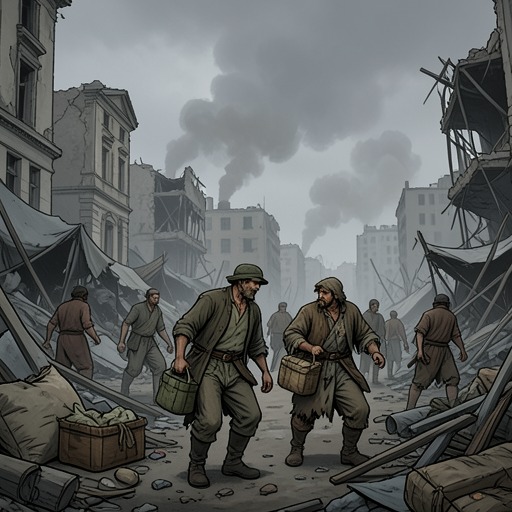
The problem was not simply the number of bodies. After the earlier devastation of Fleshmarket, Yuan had carried corpses to a trench where Holster recited the Last Rites Sutra, while survivors tried to recover what they could. Battletown presented the same labor on a wider scale: there were too many dead to bury individually, and Hungry ghosts were already haunting the ruins of its slave market, striking at Barriers erected to keep them away from refugee camps. The ritual offered a collective answer to a crisis that ordinary burial could not meet in time.
Battletown’s artificial leyline also carried a human cost. Human Pillars trapped within it sustained the system, unable to move on to the afterlife. Orient and Holster proposed altering the leyline so that its collapse would bury Battletown and the History Road together in a single Last Rites ritual. The plan therefore joined three aims: put the dead to rest, release the Human Pillars, and destroy the physical legacy of the Yinyang Khan’s rule.
The Last Rites Ritual
As the ritual approached, Yuan waited among Battletown’s ruins at night, holding Arc’s silver bullet beneath the black moonlight. Pale, emaciated figures still haunted the blasted remains of the slave market. Their presence made the ritual’s purpose immediate: these were not merely ruins awaiting removal, but a place where unresolved deaths continued to press against the living. The proposed collapse would give those dead a shared burial rather than leave them wandering among the broken concrete and iron.
The spirit-train had already left the area when the ritual’s final effects reached it. From his window, Yuan watched Battletown sink, with Holster clapping her hands on his lap. The spectacle began at dawn with fireworks. Then the landmarks along the History Road glowed together, brighter than stars, forming a circle of light around the ruins. An immense surge of qi raced through the circuit and shattered the road on which it had been built.
The ground gave way beneath the ritual. Sand and mud swept over the monuments, burying them underground; a large portion of the region then collapsed into the Oil Sea. A black flood washed away what remained above the waterline. The sequence took only minutes, but it erased years of construction. The spirit-train was far enough away to escape the collapse, though the occupants could still feel the earthquake’s force from miles off.
Rescue, Burial, and Political Consequences
The destruction came after a long effort to save those who could be saved. Orient had transformed three wagons into improvised hospitals, where the wounded received treatment and were purged of lingering radiation poisoning. Survivors had scavenged what they could recover and were evacuated beyond the area threatened by the ritual. By the time the land sank, the train had departed; the people watching from it understood that the settlement’s destruction would not also take the refugees who had already escaped.
The ritual also completed a funerary task that individual graves could not. Burying Battletown and the History Road together meant that the Hungry ghosts in the ruins could rest, while the Human Pillars sustaining the leyline could finally pass into the afterlife. For Yuan, this was not an uncomplicated cause for celebration: he recognized that destroying a settlement carried a terrible weight. Yet he welcomed the prospect that the corpses beneath Battletown’s foundations would at last be at rest, and agreed that the place deserved to be gone.
Its political effect was equally deliberate. Battletown’s destruction erased the Yinyang Khan’s stronghold and the infrastructure associated with his legacy. Yuan had already judged that defeating Slash had not fully satisfied his desire for revenge, particularly given the cost. Still, breaking the Khan’s and the Flesh Mansion Sect’s hold over the region gave him a measure of accomplishment: their ability to terrorize it had been diminished, perhaps permanently. He also expected that in a few years few would remember the Khan’s tyranny.
What the Sinking Could Not Settle
The event’s scale underscored the gulf between Yuan and the most powerful figures around him. The ritual required an engineered leyline, a circuit of landmarks, and a carefully timed collapse to bury a region. Even so, it took only minutes to undo years of construction. Yuan contrasted that elaborate destruction with the capacity of Arc and Manhattan, neither of whom needed such an extensive setup to lay waste to the world. The spectacle was therefore both a victory over a particular regime and a warning about the greater powers still beyond Yuan’s reach.
The sinking also offered no assurance that the Gun had been defeated. From the train, Yuan could see that Mount Rushfort and its nearby village had gone beneath the waves, but he did not assume that Revolver had followed them. He could not know how long his old ally could restrain the Gun within him, or when it might resume its pursuit. The road and the town were gone; the danger that had haunted the survivors remained unresolved. In that contrast, the Last Rites ritual achieved its purpose for the buried dead without providing the living with a lasting reprieve.