Alm
HeidiAlm is the high mountain landscape where Alm-Uncle’s hut and the summer pastures stand above the goatherd’s hut. It is at once a home, a working grazing ground, and a world of open air and changing weather: Heidi’s delight in its flowers and views grows alongside the practical demands of watching the Goats and the danger of sudden wind near the rocks.
Setting and terrain
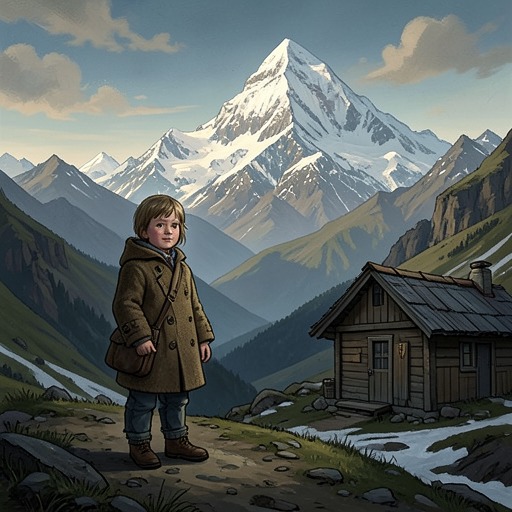
Alm-Uncle’s hut stands on a projection of rock at the top of the mountain, exposed to the wind but positioned to receive every ray of sun. From the hut there is a full view of the valley below. A seat faces the valley, where Alm-Uncle sometimes sits with his pipe, looking out before Heidi, Peter, the Goats, and Dete come into view after their climb.
The landscape rises in distinct bands behind the hut. Three old fir trees stand close behind it, their long, thick branches left untrimmed. Beyond them, another wall of mountain rises: its lower heights are covered with grass and plants, while stonier slopes and scrub lead toward steep, bare rocky summits. The arrangement makes the hut feel sheltered by the mountain’s forms without removing its exposure to wind and height.
Higher up, the pasture where Peter usually stops with the Goats lies at the foot of high rocks. Bushes and fir trees cover part of the ascent, but rugged summits rise above them. One side of the mountain is split by deep clefts, a specific hazard that Alm-Uncle has reason to warn Peter about. The mountain is therefore not an undifferentiated idyll: safe pasture and flowering ground lie within reach of steep rock and dangerous breaks in the terrain.
Arrival and daily routes
The way to the hut is a steep ascent immediately behind the goatherd’s hut. When Dete asks Peter to carry her bundle as far as Alm-Uncle’s, he follows her barefoot, holding the bundle under one arm and swinging his goatherd’s stick with the other. Heidi and the Goats skip and jump alongside them. After a climb of more than three-quarters of an hour, they reach the top of Alm. Heidi gets there first and goes straight to Alm-Uncle to greet him; Peter and Dete arrive behind her. The route establishes the mountain as a place reached by effort, but also as the setting of Heidi’s new daily life.
On later mornings, Peter comes with the Goats and the children climb together to the high meadows. Their route passes from the lower slopes into the pasture and toward the higher plants the Goats seek out. Heidi’s first impulse is to run from one patch of flowers to another, collecting red primroses, blue gentians, and golden cistus in her apron. She wants to bring the flowers home and put them in the hay to make her bedroom resemble the meadows. Peter has to keep the lively Goats together while she wanders; he eventually persuades her to stop gathering when her apron is full and there will be no flowers left for the next day.
At the usual stopping place, Peter carefully puts his wallet in a hollow in the ground so that a gust will not send his belongings rolling down the mountain. Heidi rolls her flowers in her apron and places them beside it. These small acts register how the landscape governs ordinary conduct: wind affects where Peter leaves his things, the slope shapes the route, and the abundance of flowers gives Heidi a reason to roam while Peter remains responsible for the herd.
The high meadow and its views
The pasture opens onto a broad mountain prospect. The valley lies far below in the morning sun; before Heidi rises a broad snowfield against a dark-blue sky, and to her left a huge pile of rocks stands beside a bare, lofty peak. The view combines distant openness with close, severe forms. Heidi sits still to take it in, while Peter, exhausted by the climb, falls asleep and the Goats climb among the bushes overhead.
The scene is also filled with small movements. Light puffs of wind sway the blue flowers and the shining gold heads of the cistus, setting them nodding on their slender stems. The quiet is broken only by that soft wind. Alm is not merely a backdrop to Heidi’s happiness: its particular stillness, flowers, snowfield, valley, and rock formations hold her attention, while the living plants and weather give the place a rhythm of their own.
Seasons, shelter, and risk
Summer brings repeated journeys to the high meadows. Day after day Heidi lives among grass and flowers, grows brown from the sun, and becomes strong and healthy. She is happiest outdoors with Peter and the Goats, where the mountain offers new things to see and experiences among animals with differing characters. Yet Alm-Uncle’s hut also gives her a place to stay when she cannot safely go out. She finds interest in his hammering, sawing, and carpentry, and watches him make the large round goat’s-milk cheese, stirring the cauldron with his bare arms.
The mountain changes as autumn approaches. Wind blows louder and stronger, and Alm-Uncle sometimes keeps Heidi at home because a sudden gust could blow a small child over the rocks and into the valley. The warning makes the height’s danger explicit: the same open slopes that invite Heidi to run among flowers can become unsafe when the weather turns. Peter, sent alone, anticipates a long, dull day and has more trouble managing the Goats, which have grown accustomed to Heidi’s presence.
On windy days, the three old fir trees become a powerful presence around the hut. Their tops bow and sway as the wind rushes through them, producing a deep, mysterious roar that repeatedly draws Heidi away from whatever she is doing. The trees make the change of season audible and give the mountain’s weather a visible and recurring form. As the warm bright summer sun gives way to colder days, Alm remains both Heidi’s favored place of freedom and a landscape whose wind, height, and rocks demand care.