Domleschg
HeidiDomleschg is the place of origin behind Alm-Uncle’s history: it is where he once owned a large farm, where family ruin and bereavement marked his early life, and where, after years away, his attempt to find shelter among relatives failed. Although the novel’s account reaches the reader through Dete’s recollection rather than a scene set in the region, Domleschg gives the old man’s later solitude a history. His life on the mountain begins, in this telling, with a break from the place where he had lost both property and acceptance.
Setting and Place in the Account
Domleschg enters the narrative as a homeland recalled in conversation. Barbel wants to understand why Alm-Uncle lives apart from other people, why villagers speak of him cautiously, and why he is known by a name that seems to imply kinship with everyone in Dorfli. Dete, who says that her mother came from Domleschg and that Alm-Uncle did too, offers a family history to answer those questions. Her account links the region to his earlier life, rather than describing its landscape or presenting it as the setting of the novel’s main action.
The story also places Dete’s knowledge in perspective. She is twenty-six, while Alm-Uncle is at least seventy, and she acknowledges that she cannot claim personal knowledge of his youth. What she tells Barbel is therefore a transmitted history, shaped by family connection and village memory. Domleschg is significant not as a fully depicted place but as the origin around which that remembered past is organized.
The Farm and Family Ruin
According to Dete, Alm-Uncle was once the elder of two brothers and the owner of one of the largest farms in Domleschg. His younger brother is described as quiet and orderly, in contrast with Alm-Uncle’s appetite for grand living, travel, and company Dete characterizes as disreputable. Alm-Uncle drank and gambled away the family property. When their parents learned what had happened, they died one after the other from grief, as Dete relates it.
The loss also divided the brothers. The younger brother, himself reduced to beggary, left in anger for an unknown destination. Alm-Uncle disappeared as well, with little remaining to him, in Dete’s account, beyond his bad name. The contrast between a once substantial farm and the brothers’ subsequent poverty makes Domleschg the starting point of a social fall: wealth and family standing gave way to loss, departure, and estrangement.
Departure, Return, and Rejection
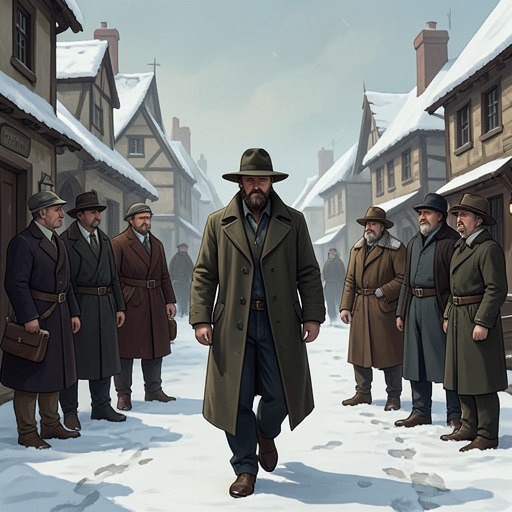
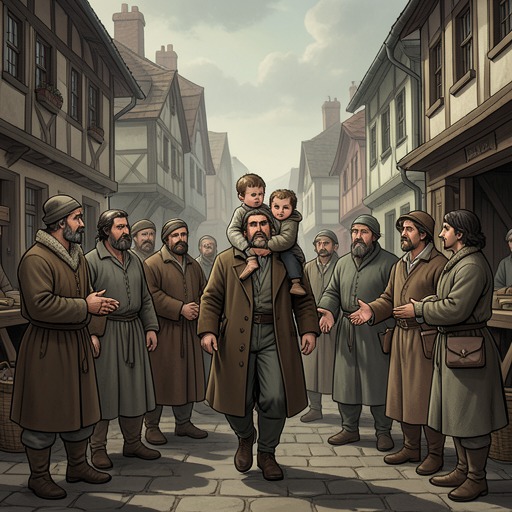
For a time, Alm-Uncle’s whereabouts were unknown. Dete says that people later learned he had gone to Naples as a soldier, after which nothing more was heard of him for twelve or fifteen years. He eventually reappeared in Domleschg with a young child and tried to place the child with his relatives. They refused to take them in. Dete presents this rejection as the immediate cause of his vow never to set foot in the region again; he then went to Dorfli, where he lived with the boy.
The account includes uncertainty as well as reported fact. Alm-Uncle’s wife was probably from the Grisons and died soon after their marriage. Dete also repeats a rumor that he had been forced to flee Naples after killing a man in a brawl. The rumor is not established as fact, and it sits alongside her account of his return with a child and his family’s refusal to help. Domleschg thus appears both as the place he left and as the place where exclusion made his departure permanent.
Kinship and the Name Alm-Uncle
Domleschg remains connected to Alm-Uncle through Dete’s family. Her great-grandmother on her mother’s side was the sister of his grandmother, so Dete’s family acknowledged a relationship with him and called him Uncle. Dete adds that, through her father, her family was related to nearly everyone in Dorfli. This wider network helps explain how the family form of address became a village name: after Alm-Uncle moved to the mountainside, people called him Alm-Uncle.
That naming history complicates the appearance of his complete isolation. His mountain life separates him from the village, but the name by which he is known preserves a social connection rooted in kinship and in the shared history of the two communities. Domleschg supplies the earlier family bond; Dorfli carries the name forward after his return there.
Narrative Significance
Domleschg’s role is chiefly causal and retrospective. It accounts for the scale of Alm-Uncle’s loss, the long disappearance that followed, and the bitterness attached to his return. His later life on the mountain is not presented as an unexplained disposition alone: Dete’s story traces it to a sequence of financial ruin, family deaths, separation from his brother, years away, and rejection by relatives.
At the same time, the history is delivered as village and family testimony, not as an independently verified record. Dete distinguishes what she understands from what she cannot know directly, and some details remain explicitly uncertain or rumored. That framing keeps Domleschg at a distance while giving it narrative weight: it is the remembered homeland whose farm, family ties, and refusal help explain why Alm-Uncle came to be regarded in Dorfli as both a relative and an outsider.