Dorfli
HeidiDorfli is the scattered mountain hamlet halfway between Mayenfeld and the higher slopes, where the steep path from the valley passes through an inhabited world before climbing toward Alm-Uncle’s hut. The village is more than a point on the route: it is a place where private histories become public talk, where Heidi’s education and departure are debated, and where the novel’s journeys repeatedly bring mountain residents and visitors into contact. Its residents’ opinions of Alm-Uncle prove changeable and often unreliable, while the paths through the hamlet connect family life below with the transforming events above.
Setting and Approach
A footpath winds from Mayenfeld through green, shady meadows toward the mountains, whose heights look down over the valley. As the route climbs, the land grows wilder; the way is steep, and the path leads toward the summits. Dorfli lies about halfway up. On a clear June morning, Dete and the heavily dressed young Heidi reach the hamlet after leaving the valley behind. Dete has returned to the place where she grew up, and greetings call to her from windows, open doors, and the street. She does not stop to answer: she continues through the scattered houses toward the upper path, while Heidi releases her hand and sits down to rest.
That first passage establishes Dorfli as both a community and a threshold. It is close enough to the valley for news, work, and visitors to arrive from Mayenfeld and Ragatz, yet the ascent beyond it leads toward a far more solitary household. The route is not merely scenery: people in the hamlet can see who is going up, who is coming down, and who has left. Their voices accompany departures, and their gathering crowds later turn the village into a place where events on the mountain are interpreted before their full meaning is known.
Local Memory and the Reputation of Alm-Uncle
The village’s collective curiosity centers on Alm-Uncle. Barbel, who came to Dorfli after marrying and had previously lived in Prattigau, does not know the older local history. She wants Dete to explain why Alm-Uncle lives alone on the mountain, why he seems to hate people, and why villagers speak of him in lowered voices without either defending him or openly accusing him. She also wonders why everyone calls him Alm-Uncle, although he cannot be the uncle of the whole village. The shared nickname and the half-spoken stories reveal how local custom can preserve a reputation even when the people repeating it do not know its origins.
Dete is better placed to know the village’s past: she was born in Dorfli and lived there with her mother until her mother died the previous year. She has heard accounts of Alm-Uncle through her family, but is reluctant to repeat them for fear that the stories might reach him and cause trouble. Her caution does not settle the rumors; it shows instead how gossip and social unease shape what the community is willing to say. Dorfli’s local knowledge is uneven: longtime residents possess fragments, newcomers seek a complete explanation, and the subject of the stories remains difficult to approach.
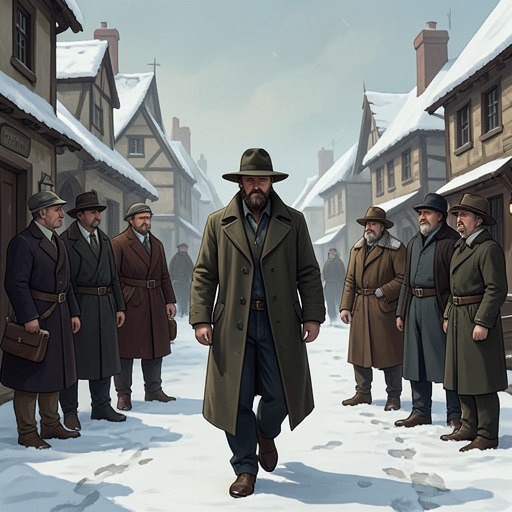
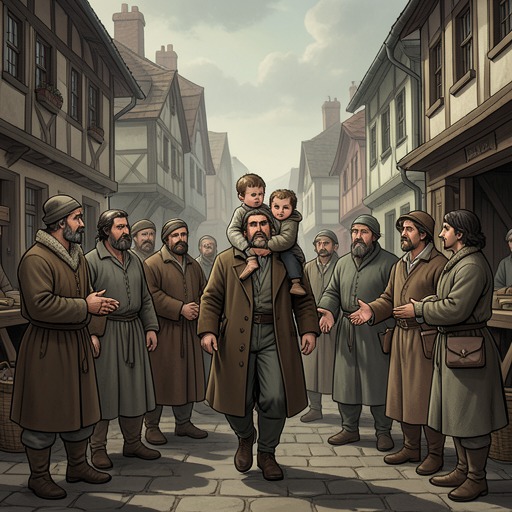
After Heidi is taken away, the villagers see Alm-Uncle pass through Dorfli on his way down to the valley. He carries cheeses on his back and an immense stick in his hand; his frowning expression and silence make him seem more forbidding than before. Women warn their children to get out of his way, and, after he has gone, the villagers gather to discuss his appearance and Heidi’s departure. Many conclude that it is a mercy she has escaped him, reading her haste as fear that he might follow and reclaim her. Peter's Grandmother alone resists this account. She recalls Alm-Uncle’s kindness to Heidi and her daughter, and the afternoons he spent repairing their house. The village dismisses her testimony on the grounds that she is old, blind, and perhaps deaf. Dorfli thus becomes a setting for a revealing contrast: the community treats rumor as common knowledge, while the person who has experienced Alm-Uncle’s care is treated as an unreliable witness.
School, Departure, and Village Judgment
Dorfli’s school also marks the community’s authority over children living beyond the hamlet. During the winter when Heidi is in her eighth year, the schoolmaster sends Alm-Uncle two messages through Peter, insisting that Heidi is over the usual age for beginning school and should already have attended the previous winter. Alm-Uncle replies that the schoolmaster can come to speak with him directly, but that he does not intend to send Heidi. Peter faithfully carries both messages. The repeated exchange makes the school’s demand concrete while showing the distance between village expectations and Alm-Uncle’s decision about Heidi’s upbringing.
Dorfli’s role as a route and a place of judgment becomes especially visible when Dete takes Heidi away. The villagers call out questions as the pair pass, asking whether Heidi is being taken away or running away from Alm-Uncle, and remarking on her rosy cheeks. Heidi hurries forward without answering. The public scene gives the departure a social meaning before anyone in the village knows the circumstances: neighbors interpret the child’s movement through what they already believe about the old man. Afterwards, Alm-Uncle’s silent passage through Dorfli seems to confirm their suspicions, even though Peter's Grandmother’s account offers a different history of his conduct.
Routes of Return and Converging Stories
Later journeys give Dorfli a different function, as a necessary approach to the mountain and a meeting point for news. When visitors from Frankfurt are expected, Peter reacts angrily to the prospect. Heidi, by contrast, is eager to tell Peter's Grandmother who is coming and who is not. She can now make the trip alone, running down the dry mountain path in the May sunshine. At the grandmother’s house, Heidi finds her back at her spinning-wheel, but anxious: Peter has told her about the large party from Frankfurt, and she fears that Heidi may be taken away from her. The journey through and around Dorfli therefore carries news ahead of the visitors themselves, producing expectation and fear before the party arrives.
The village also provides access to the final stages of Clara’s recovery and the visits surrounding it. After Clara begins walking, Peter reaches Dorfli and finds a crowd gathered around the remains of her chair. Pieces of its back and middle, along with red padding and bright nails, lie scattered in the grass. A baker who saw men carrying the chair up estimates that it was worth at least twenty-five pounds, but the onlookers do not know how it was destroyed. The crowd’s attention fixes on the broken object, while the cause and the decisive events have occurred higher on the mountain. Dorfli receives the visible consequence before it has the full account.
On another occasion, Alm-Uncle whistles for Peter and sends him to the post-office in Dorfli with a written paper, promising to settle the payment later because Peter cannot safely be trusted with too much money. Peter arrives pale, fearing that the summons means Alm-Uncle is about to give him up, but is relieved to discover that he is being sent on an errand instead. The post-office makes the hamlet a practical link between the mountain household and the wider world, while Peter’s mistaken fear shows how the earlier destruction of Clara’s chair still shapes his expectations.
Dorfli’s position in the network of routes becomes clear again when Herr Sesemann travels from Ragatz to Mayenfeld and on to the hamlet, then continues on foot because the climb is already long and tiring. He loses sight of the hut and wonders whether he has taken the right path; the mountainside offers branching footpaths but no one nearby to ask. Peter, running down the slope with a telegram, becomes the first person he sees. At the end of the mountain stay, the direction reverses: Peter's Grandmother sees the party descending past her house, with Alm-Uncle carrying Clara, and fears that Heidi is being taken away as well. In each passage, Dorfli and its nearby paths convert movement into an occasion for interpretation. They connect valley and mountain, but they do not guarantee that observers understand what they see.