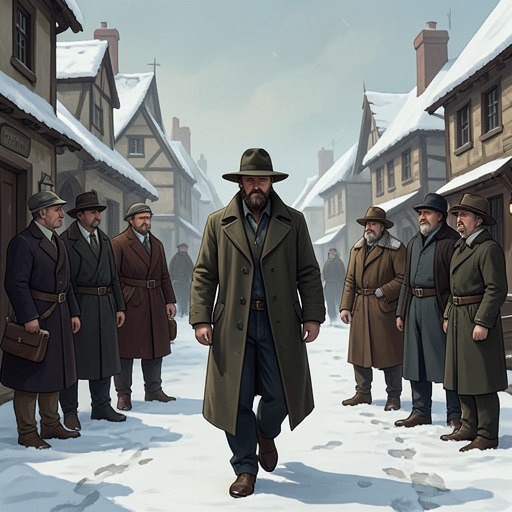
Alm-Uncle moves to Dorfli for the winter
HeidiAlm-Uncle moves to Dorfli for the winter as the practical consequence of his reconciliation with the village and his concern for Heidi’s safety. By leaving his mountain home for the cold season, he makes his return to community life tangible: he rents and repairs a derelict house, settles there with Heidi and the Goats, and accepts the limits that winter places on their movements and visits.
A decision made through reconciliation
The move follows a change in Alm-Uncle’s relationship with the villagers and The pastor. After going to church, Alm-Uncle visits The pastor and asks him to forget the angry words he had spoken when The pastor previously advised him. He acknowledges that the advice was well meant and that he had been wrong to oppose it. His decision to find a place in Dorfli for the winter is not simply a matter of shelter: he explains that Heidi is not strong enough to endure the severe cold on the mountain. He also recognizes that the villagers’ distrust is his own responsibility and asks The pastor not to share it.
The pastor receives him warmly, takes his hand, and welcomes him as a friend and neighbor. He also promises to help find pleasant company for Heidi. When they leave the house together, The pastor walks with Alm-Uncle and Heidi to the door, making his public welcome visible to those waiting outside. The congregation then crowds forward to greet Alm-Uncle. Villagers who had suspected him now interpret his careful treatment of Heidi as evidence that their judgment had been unfair; others recall hearing favorable accounts from Peter and Peter’s Grandmother. Their eagerness to shake Alm-Uncle’s hand, and their requests that he visit when he comes down again, turn a private admission of error into a communal restoration.
Alm-Uncle’s changed circumstances are visible in Heidi’s response. Left with him after their well-wishers have gone, she notices that he looks happier than she has seen him before. He agrees, saying that he is happier than he had thought possible and glad to be at peace with God and people. His gratitude connects the reconciliation to Heidi’s presence in his life, without making the move a reluctant concession: he describes their shared future in the village as something he has chosen.
A winter home made habitable
Alm-Uncle carries that commitment into Peter’s Family Hut, where he visits Peter’s Grandmother. He proposes more patching before the autumn winds arrive. She is overjoyed to see him and thanks him for what he has done for her; then she asks that he not send Heidi away again before her death. Alm-Uncle reassures her that he will not separate them, and that they are together for the present. The exchange makes the winter move part of a wider effort to keep Heidi near the people who depend on her, even as the deepening season will soon restrict travel between village and mountain.
Alm-Uncle keeps his promise when the first snow falls. He shuts up the buildings at his mountain home and goes down to Dorfli with Heidi and the Goats. Rather than take an ordinary, ready-made dwelling, he rents a half-ruined house near the church, an old building with a history of neglect. It had once been built by a distinguished soldier who had served in Spain and returned with treasure, but the soldier soon left again, unwilling to settle into quiet country life. After his presumed death, the house passed to a distant relative who did not repair it. It was later rented cheaply, while sections that fell into ruin were simply left that way. Alm-Uncle himself had rented the place when his son Tobias was a child; since then, its gaps and holes had made it unfit for ordinary occupants.
The building’s disrepair is not decorative background. Wind, rain, and snow could blow through its openings, making it impossible to keep even a candle alight and exposing residents to the winter cold. Alm-Uncle knows how to make the structure usable, so he works through the autumn to secure it. In the middle of October, he and Heidi move in. His skill turns a neglected shell into a home, while the timing shows that the relocation is planned before winter closes in.
The house and its new inhabitants
The house retains signs of its former scale and partial collapse. From the rear, one enters an open space between walls, one of them partly ruined. An ivy-covered old window arches above the remains of what appears to have been a chapel dome. Beyond lies a large hall open to the square, with only fragments of roof remaining, held up by two stout pillars. Alm-Uncle partitions this space with wood and spreads straw over the floor to make a shelter for the Goats. Passages lead onward through gaps open to views of sky, fields, and road, until an oak door reaches a room that is still intact.
That room supplies the contrast between ruin and refuge. Its walls and dark wood paneling remain sound, and an immense stove rises nearly to the ceiling. Large blue paintings on its white tiles depict castles among trees, huntsmen riding with hounds, and a lake bordered by oak trees where a man fishes. A seat runs around the stove, inviting close inspection of the pictures. Heidi is immediately absorbed by them, moving around the seat to examine each part of the decorated surface. The old house becomes, for her, not merely protection against the weather but a place full of things to discover.
Heidi quickly learns the house’s nooks and corners. By the morning after their arrival, she knows it well enough to lead Peter through it, insisting that he see every remarkable feature. Her delight gives the building a second life: what had stood empty because it was too broken for ordinary habitation becomes a home she eagerly explores and shares.
Winter’s limits and village life
Settling in Dorfli does not erase Heidi’s attachment to the mountain hut. On waking, she initially thinks she is still there and wants to go outside to see whether snow has weighed down the fir branches. For several minutes, she must reorient herself; realizing that she is not in the hut brings a feeling of trouble and oppression. Her grandfather’s voice outside, attending to the Goats, and their bleating reassure her that she is still at home. The scene distinguishes the new winter residence from the mountain setting while showing that Alm-Uncle has preserved the companionship and daily routines that make a place feel like home to Heidi.
On the fourth morning, Heidi asks to visit Peter’s Grandmother, worried that she has been alone too long. Alm-Uncle refuses to let her go that day or the next: snow lies fathoms deep, continues to fall, and makes the journey difficult even for Peter. A child as small as Heidi could be buried in it and lost. He tells her to wait until the snow freezes hard enough to walk on. The delay gives the winter move an immediate cost: Dorfli offers safety and schooling, but the weather temporarily bars Heidi from the mountain visit she most wants to make.
Meanwhile, Heidi attends Dorfli school every morning and afternoon and applies herself eagerly to what she is taught. Peter is usually absent. The teacher suggests that the snow may prevent him from getting there, though Peter seems able to make his way through it in the evening and generally visits Heidi after school. The contrast makes the move consequential beyond shelter: it places Heidi within the village’s ordinary educational routine, while Peter’s irregular attendance remains part of their winter life. Alm-Uncle’s return to Dorfli thus joins a repaired relationship with the community to concrete changes in home, schooling, and access to family and friends, all shaped by the season’s severe conditions.