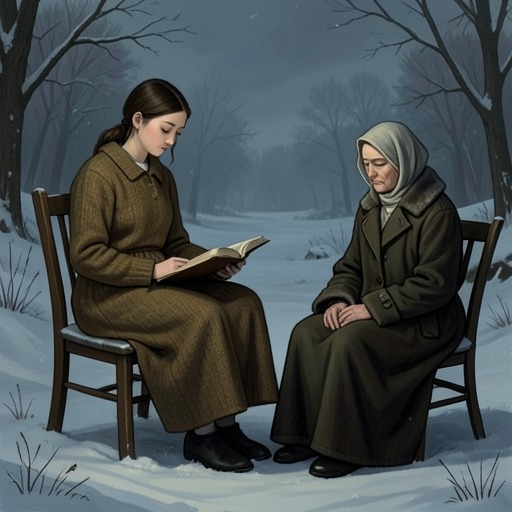
Heidi returns to her grandfather
HeidiHeidi returns to her grandfather after The doctor recognizes that her nightly sleepwalking and physical decline are bound up with intense homesickness. The journey home is more than a change of place: it reunites Heidi with Peter's Grandmother, Alm-Uncle, Peter, and the mountain life from which she has been separated. Its arrival is marked by anxious anticipation, grateful prayer, and a succession of recognitions that make home tangible again—in a familiar voice, a bowl of milk, and the goats crowding around her.
Diagnosis and Decision
The return becomes possible when The doctor tells Herr Sesemann what the household has failed to understand. Heidi is the sleepwalker who has been opening the front door at night, mistaken for the ghost behind the household's alarm. The doctor also reports that she is consumed by homesickness and has become dangerously emaciated. In his judgment, both troubles call for the same remedy: Heidi must go back to her native mountain air. He urges that she start the next day, making homecoming an urgent response to illness as well as the fulfillment of a longing Heidi has been unable to express openly.
Herr Sesemann is shaken by the news that Heidi has grown ill in his own house without anyone noticing. At first, he resists the idea of sending her away in such a poor condition and insists that she must be made whole before she returns. After talking the matter over with The doctor, however, he accepts that an immediate journey is necessary. The decision reverses the apparent direction of Heidi's stay in Frankfurt: the household's efforts to keep her there give way to the recognition that her safety and recovery depend on leaving.
The departure is organized before dawn. At half-past four, Herr Sesemann wakes Fraulein Rottenmeier and orders preparations for a journey; he sends John to ready the carriage, Tinette to dress Heidi, and Sebastian to fetch Dete. He also has Fraulein Rottenmeier pack Heidi's belongings and a share of Clara's clothes so the child can travel home properly provided for. The unusual hour and hurried orders frighten the servants, who initially suppose the ghost has attacked Herr Sesemann. Their confusion makes the household's earlier fear part of the practical machinery of Heidi's return: what had seemed supernatural is now understood as the consequence of her illness.
Departure from Frankfurt
Herr Sesemann explains the decision to Clara, including the danger that Heidi's sleepwalking could take her farther through the house, perhaps even onto the roof. Clara is distressed and proposes ways Heidi might remain, but her father holds to the plan and promises to take her to Switzerland the following summer. Clara then helps prepare a generous outfit for Heidi. Dete, by contrast, is unwilling to take the child back to Alm-Uncle: she remembers that he had said he never wished to see her again and fears that returning Heidi after having once left her with him is unwise. She pleads that she cannot make the journey that day or the next, and suggests she may not be able to go in the days after. Herr Sesemann recognizes her reluctance and dismisses her; Sebastian is assigned to escort Heidi as far as Basle and then take her home the following day.
Because Heidi sleepwalks, Herr Sesemann gives Sebastian a specific precaution for the night in Basle: secure the windows, and lock Heidi's bedroom door from the outside after she has gone to bed. Sebastian understands that these instructions explain the supposed ghost's visits. Herr Sesemann's arrangements thus address both parts of The doctor's diagnosis—the journey takes Heidi back toward the place he considers restorative, while the travel plan accounts for the danger posed by her wandering in unfamiliar rooms.
Heidi learns of the journey only when Herr Sesemann tells her she is going home that day. The news leaves her pale and briefly unable to breathe. At departure, Fraulein Rottenmeier objects to Heidi taking the basket and treats it as an unsuitable thing to bring; Heidi, afraid to pick it up, looks imploringly to Herr Sesemann. He firmly permits her to take whatever she wants, including the kittens and tortoises. Heidi gathers the basket with visible joy and gratitude. Before she leaves, Herr Sesemann asks her to remember him and Clara. Heidi thanks him for his kindness and asks him to convey her thanks to The doctor, whose assurance the previous night that matters would be all right had given her reason to trust the change now taking place.
The Journey and Reunion with Peter's Grandmother
On the railway, Heidi holds the basket tightly because it contains the white rolls for Peter's Grandmother. She keeps it in her hands and peeks inside from time to time, guarding a gift whose importance is practical as well as affectionate. For hours she sits very still, gradually imagining the people and places she is about to see: Alm-Uncle, the mountain, Peter's Grandmother, and Peter. The thought of the journey also brings a fear she cannot settle for herself; she anxiously asks Sebastian whether Peter's Grandmother might have died. He can only try to reassure her that they may hope she is still alive. The question shows how eagerly Heidi anticipates reunion and how much uncertainty accompanies it.
At Dorfli, Heidi hurries through the people who stop her with questions, distressed to get on rather than remain to explain. Onlookers assume she is frightened of returning to Alm-Uncle, whom they describe as more ill-tempered and silent than before. The miller corrects their interpretation: Heidi had told him she had been well provided for and that returning to her grandfather was her own wish. The report surprises the villagers, and news spreads through Dorfli that she has chosen to give up a comfortable home in order to return. Her hurried passage and the villagers' discussion set her private purpose against their assumptions about the man and household to which she is going.
The steep climb makes the reunion with Peter's Grandmother a race against Heidi's worry. Carrying the heavy basket, she has to stop for breath, but her attention stays on whether she will find the old woman in her usual place by the spinning-wheel. When she reaches the house, she is so breathless and trembling that she can scarcely open the door or speak. Peter's Grandmother hears the familiar way Heidi used to run in and longs aloud for her return, not yet knowing who has arrived. Heidi identifies herself and falls on her knees beside the old woman, holding her hands. Peter's Grandmother recognizes Heidi by her hair and voice, strokes her head, and gives thanks that her prayer has been answered; tears fall from her blind eyes onto Heidi's hand.
Heidi reassures Peter's Grandmother that she has truly come back, promises to visit every day, and tells her she will not have to eat hard bread for some days. She then takes the rolls from the basket and piles all twelve into her grandmother's lap. The homecoming therefore answers a need beyond Heidi's own: the provisions she guarded throughout the journey are offered at once to the elderly woman whose hardship had remained in Heidi's thoughts during her absence.
Return to Alm-Uncle and Mountain Life
After seeing Peter's Grandmother, Heidi continues up the mountain with her basket. The evening landscape, which she had remembered and dreamed of while away, appears before her in a renewed form: the snowy heights glow red, the slopes and rocks shine, and golden light spreads across the valley. Heidi stops to gaze, weeps with delight, and thanks God for bringing her home and restoring to her the beauty she had feared losing. She cannot tear herself away until the light begins to fade. The scene gives the return a second recognition: Heidi is reunited not only with people but with a landscape whose loveliness feels more vivid after her separation from it.
She reaches Alm-Uncle's hut and rushes to him before he has time to identify who is coming. Repeating his family title, she throws her arms around his neck. Alm-Uncle says little at first; for the first time in many years his eyes grow wet, and he draws Heidi onto his knee. He asks how she has come back and observes that she does not look like a grand lady, then asks whether she was sent away. His emotion and questions register the gap between her stay in Frankfurt and the child now returned to him, while her embrace answers the separation more directly than an explanation could.
Inside, Heidi searches the familiar corners and climbs to her sleeping place, only to discover that her bed is gone. Alm-Uncle says they can make it up again and explains that he did not know she was coming. The small absence underscores that her return was not expected, even by the person she has come back to live with. At the same time, the household resumes an ordinary intimacy when she sits in her old place on the high stool and drinks her milk eagerly, declaring it better than anything else in the world.
A whistle outside brings another immediate reunion. Peter is among the goats, and he stands speechless when he sees Heidi. She greets him and hurries among the animals, calling Little Swan, Little Bear, and the others by name. The goats crowd around her, rubbing their heads against her and bleating; Greenfinch leaps over companions to get nearer, while Snowflake butts past Great Turk. Heidi embraces Snowflake and strokes Greenfinch as the herd presses close. The journey's ending is thus not a single greeting but a restoration of familiar bonds across the whole mountain community: Peter is there, the goats recognize Heidi's voice, and the life she missed receives her back in motion.