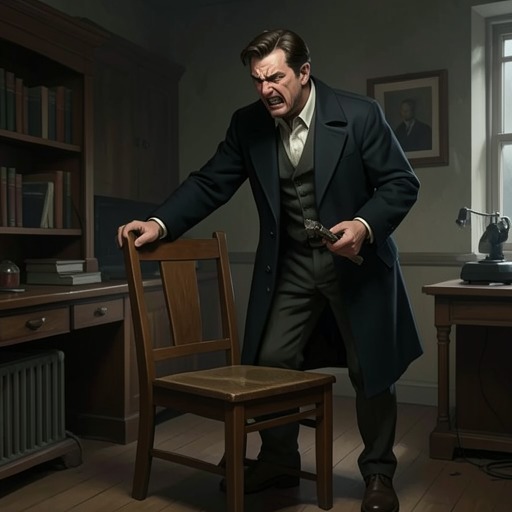
Peter tumbles down the slope, afraid he will be held to account
HeidiPeter’s tumble down the slope, caused by his belief that a stranger is the policeman coming to punish him, makes fear visible as a bodily event. Herr Sesemann, on his way to surprise Clara Sesemann at the mountain home, mistakes Peter’s terror for ordinary timidity; Peter, meanwhile, mistakes Herr Sesemann for the agent of the consequences he dreads. Their encounter sends Peter rolling downhill, but it does not release him from the duties waiting above.
The encounter on the mountain
Herr Sesemann has travelled from Paris to see his daughter after being separated from her throughout the summer. Having reached Ragatz just hours after his mother set out for the mountain, he hires a carriage to Mayenfeld and continues to Dorfli. From there he climbs on foot, expecting to find the hut where Peter lives halfway up the mountain and where the visitors from Frankfurt are staying. The climb proves long and tiring. The paths divide in different directions, and no one is visible to ask for help; in the quiet, only the mountain wind, insects, and a bird singing from a solitary larch interrupt the silence.
Peter appears running down the slope with a telegram in his hand. Rather than following the path, he descends directly over the steep ground. Herr Sesemann beckons him closer and asks whether the route leads to the hut where the old man and Heidi live. Peter answers only with a low sound of fear, then turns to flee. The contrast is immediate: Herr Sesemann is seeking directions to reach his daughter, while Peter sees the stranger as a danger from whom he must escape.
Panic and the fall
Peter’s flight becomes an uncontrolled tumble. He falls head over heels several times, rolling and bumping down the slope in a manner likened to the broken wheelchair; he himself, fortunately, does not come to pieces. The telegram does. It tears into fragments that scatter away, a small but concrete casualty of his panic. Herr Sesemann watches him descend and assumes that the mere sight of a stranger has frightened an unsophisticated mountain child. His interpretation misses the real cause, which the narration soon makes explicit.
Peter believes the stranger is the policeman who has come from Frankfurt for him. Certain of this mistaken identification, he feels fear and horror as he rolls toward the valley. Near Dorfli, a bush catches him at the edge of the last high slope and finally stops his descent. He lies still for a few seconds, recovering and trying to think. The sudden stop marks a pause in the physical commotion, but not in the fear that has driven it: the danger Peter imagines remains, even though Herr Sesemann is actually climbing toward the family home.
The return uphill
A baker who has watched Peter’s fall laughs at the sight and compares it to the earlier tumble of the wheelchair. Peter gets to his feet at once, startled afresh. He does not look behind him; instead, he hurries back up the slope. The direction of his movement reverses, but his distress does not. He would rather go home and hide in bed, where he feels safest, yet the goats remain above and Alm-Uncle has strictly ordered him to return quickly so that the animals are not left alone too long.
That obligation determines what Peter does next. He stands more in awe of Alm-Uncle than of anyone and would not dare disobey him, so he has to climb back despite his wish to hide. After the fall and the anguish it has caused, he can no longer run. He groans and limps upward with lagging steps. Herr Sesemann, meanwhile, passes the first hut and confirms that he is on the right path, then continues toward the home above. The two journeys thus move in opposite directions: Peter returns to his duty, while Herr Sesemann advances toward the reunion he hopes to make a surprise.
Narrative significance
The scene is built around a dramatic misunderstanding. Herr Sesemann correctly reads Peter’s hurried descent as a sign of fear but attributes it to the wrong cause; Peter, in turn, reads an unfamiliar question as confirmation that his feared pursuer has arrived. The reader is given the truth behind Peter’s panic, so the tumble is at once comic in its physical reversals and painful in its source. His terror is not settled by reaching the bottom: the telegram is lost, his body is shaken, and his conscience-driven fear remains with him as he climbs back.
The repeated comparison with the wheelchair links Peter’s fall to the act for which he fears being held responsible. Yet the mountain slope is not simply an escape route: his duties to the goats and his obedience to Alm-Uncle send him back toward the very place where the consequences he fears may catch up with him. The episode ends not with a confrontation or an explanation, but with his slow, groaning ascent and Herr Sesemann’s continued approach. Their paths are converging, while Peter still does not know that the stranger is Clara’s father rather than the policeman he imagines.