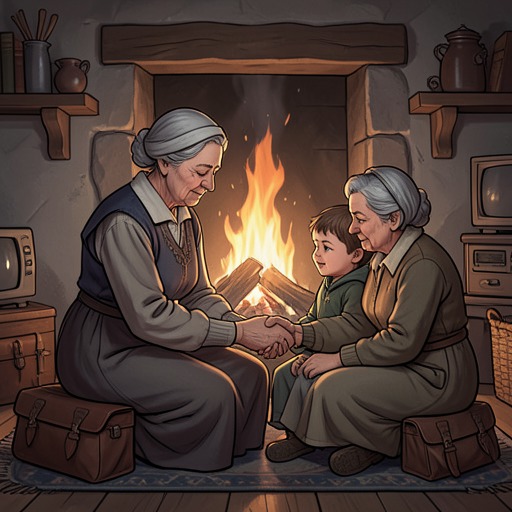
Heidi brings white rolls to the blind grandmother
HeidiHeidi brings White Bread Rolls to Peter's Grandmother in a reunion that joins the immediate joy of her return to a continuing plan for the old woman's care. The twelve rolls Heidi carries from Frankfurt answer a promise she had made to her grandmother; afterward, Heidi turns the gift into a regular supply, insisting that her money be used to buy fresh bread in Dorfli. The episode makes her return tangible: she brings not only food, but also the reading and determined companionship that help restore her grandmother's strength and happiness.
The gift prepared in Frankfurt
Before the journey, Clara Sesemann shows Heidi the open trunk and the things packed for her: dresses, aprons, handkerchiefs, and working materials. Most important to Heidi is the basket Clara proudly presents. Inside are twelve round White Bread Rolls, all intended for Peter's Grandmother. The children become so absorbed in the gift that they forget, for a moment, that they are about to part; when the carriage is announced, there is little time for a prolonged farewell.
Heidi adds two personal things that have not been packed for her. She retrieves her beloved Illustrated Storybook from beneath her pillow, where she has kept it night and day, and puts it in the basket with the rolls. She also finds that Fraulein Rottenmeier has left behind her old red shawl, which she wraps around another item and lays conspicuously on top. The basket thus carries both the promised food and things Heidi herself has chosen to take. Herr Sesemann is waiting to put her in the carriage, while Fraulein Rottenmeier waits at the top of the stairs to say goodbye.
The reunion at the mountain house
Coming up the steep path from Dorfli, Heidi has to stop from time to time because the basket is heavy. As she climbs toward the house in the mountain hollow, one anxious thought occupies her: whether she will find Peter's Grandmother alive in her usual place by the spinning-wheel. When she reaches the house, she is so breathless and trembling that she can scarcely open the door or speak.
From her corner, Peter's Grandmother hears someone arrive and recalls how Heidi used to run in. Heidi answers by rushing to her, dropping to her knees, and clinging to her hands. The old woman recognizes her by her curly hair and voice, strokes her head, and gives thanks that her prayer has been granted. Tears fall from her blind eyes onto Heidi's hand. The reunion is recognition through touch and sound as much as sight: the grandmother cannot see Heidi, but confirms that the child she has longed for has truly come back.
Heidi reassures her that she is really there, promises that she will not go away again, and says she will come every day. Then she takes the twelve White Bread Rolls from the basket and piles them onto her grandmother's lap. Peter's Grandmother feels the heap, delighted by how many there are, but calls Heidi herself the greater blessing. Heidi explains that while away she had feared her grandmother might die before receiving the rolls and before they could see each other again. The gift therefore answers a particular fear, not merely an ordinary need for food.
From a gift to daily provision
On a later visit, Alm-Uncle accompanies Heidi down to Peter's Grandmother's cottage and onward to Dorfli to fetch her box. It is Saturday, and he has spent the morning making everything clean and tidy so he can go with her in the afternoon. Heidi is eager to hear how the rolls have been received. At the cottage, Peter's Grandmother takes her hand and holds it tightly, still afraid that Heidi might be taken away again. She says that the White Bread Rolls have made her feel stronger, but that she has eaten only one: she fears the supply will run out. Brigitta adds that a week of eating well might help her mother regain strength, while explaining that the family can barely afford its usual black bread.
Heidi first thinks of asking Clara Sesemann to send more rolls, recalling that she had left a large quantity in the wardrobe and that Clara had promised to replace them. Brigitta points out the practical difficulty: rolls sent from a distance would become hard and stale. Heidi then remembers that she has money and proposes a fresher arrangement. Peter can bring one roll from Dorfli each day, and two on Sunday. The plan makes the gift sustainable and gives Peter a specific part in delivering the bread.
Peter's Grandmother objects that the money was not given for this purpose and says Heidi should hand it to Alm-Uncle to decide how it is spent. Alm-Uncle raises another possible use: Heidi could have a proper bed, leaving enough money for bread as well. Heidi insists that she sleeps better on her bed of hay than on the fine pillowed bed she had in Frankfurt. At last Alm-Uncle agrees that the money is hers to use as she chooses, and that it can buy bread for Peter's Grandmother for years. Heidi's insistence turns a short-lived parcel of food into an ongoing provision, while making clear that she values her own familiar bed less than her grandmother's daily comfort.
Significance of the return
The episode develops through a change in scale: twelve rolls first make Heidi's return visible and give Peter's Grandmother immediate joy; the repeated visits and the arrangement for fresh bread extend that care into the future. The grandmother's fear of losing both Heidi and the food is met by two forms of reassurance, Heidi's promise to return daily and the practical plan for regular deliveries. The rolls matter as nourishment, but their arrival also restores contact between the two, while the grandmother's report of greater strength gives the gift a consequence beyond the reunion itself.