Royal Academy of Sciences
HomunculusThe Royal Academy of Sciences is the institutional force seeking to investigate Dr. Randal Birdlip’s extraordinary craft, but its interest is not simply an open-ended search for knowledge. Through its pressure on Langdon St. Ives, its demand for access to William Keeble’s engineering knowledge, and its response to Shiloh’s public spectacle, the Academy emerges as an authority trying to make unruly discoveries legible and controllable. Its language of rationality sits beside practical bargaining, reputational concerns, and the prospect of an approaching public crisis.
Institutional Interests and Scientific Authority
The Academy enters the story through St. Ives’s professional orbit. On April 4, 1875, he has attended a dinner with its secretary, an obligation that has brought him into formal clothes he dislikes and left him waiting in the rain in Leicester Square. The scene establishes the Academy as a source of professional contact, but also as an institution whose social expectations sit awkwardly beside St. Ives’s preference for independent laboratory work in Harrogate.
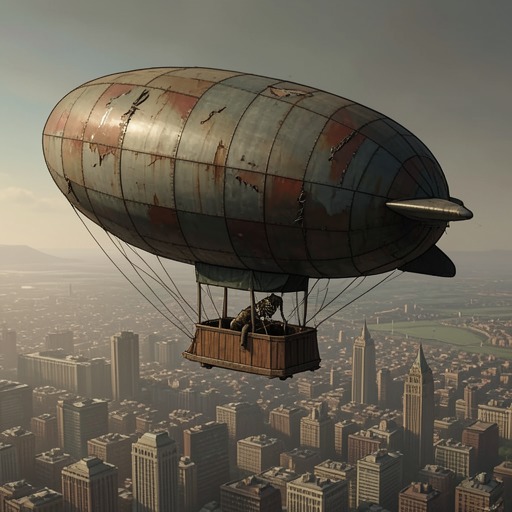
Its institutional reach becomes more consequential when the Academy invites St. Ives to participate in programs studying Birdlip’s craft. The invitation follows reports that the airship has been sighted high over the Denmark Strait, traveling toward Iceland and then on a course that may carry it back over Greater London. Balloon expeditions are being prepared in Reykjavik, and observers anticipate that the craft may descend or land in the coming weeks. The Academy treats St. Ives’s knowledge of Birdlip and his friendship with the uncommunicative Keeble as useful channels into the problem.
That approach is also a form of leverage. The Academy asks St. Ives to suspend his own work, close his laboratory, and send his assistant Hasbro away, while offering in return to reconsider its dismissive view of him as a merely eccentric figure. The arrangement ties recognition to cooperation: scientific standing becomes a possible reward for making another person’s work accessible. St. Ives experiences the approach as interference rather than disinterested collaboration, especially as requests and mysteries continue to intrude on his time.
Birdlip’s Craft and Keeble’s Engine
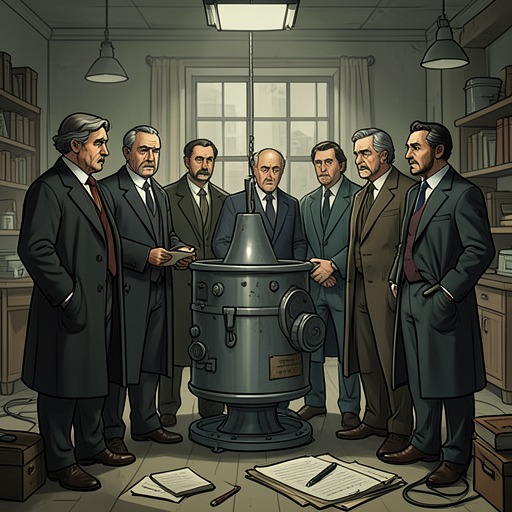
The Academy’s view of Birdlip distinguishes the visible pilot from the technical source of the craft’s power. At a meal at the Bayswater Club, which belongs to the Academy, Parsons describes Birdlip as a speculative thinker rather than the productive engineer behind the perpetually propelled airship. He knows Birdlip’s papers on fog and on spectacles that might reveal successive layers of time, but treats their poetic, theoretical character as evidence that Birdlip did not build the engine. In the Academy’s account, Keeble is the person whose technical knowledge matters most.
This judgment shapes the Academy’s request that St. Ives use his influence with Keeble. Parsons presents cooperation as a way to advance scientific inquiry and avert danger, but also offers to have the Academy reconsider the circumstances of St. Ives’s earlier projectile launch, which had broken through the roof of Lord Kelvin’s barn. St. Ives says that he will raise the subject with Keeble, but does not promise to make the toymaker cooperate. His response exposes the difference between the Academy’s plan and his own loyalties: Keeble is not simply a source of information to be delivered to an institution.
St. Ives also suspects that the Academy’s interest is narrower than its language suggests. In his view, it wants Keeble’s engine; if it obtained it, it might lose interest in Birdlip, whose pursuit of truth cannot be charted and graphed. The contrast is not between science and ignorance so much as between different standards of value. The Academy seeks a mechanism that can be examined and claimed as technical knowledge, while St. Ives sees meaning in Birdlip’s less measurable search for mysteries.
The Academy, Shiloh, and the Coming Airship
The Academy regards Shiloh’s movement as part of the danger surrounding the returning craft. Parsons reports that Scotland Yard has infiltrated the cult and that its members regard a device in a curious box as sacred. The Academy does not know whether they mean to destroy Birdlip’s craft or turn it into a temple, but Parsons insists that neither outcome can be allowed. His account links the group’s religious claims to rumors of blood sacrifice, vivisection, and other alarming practices, presenting the airship’s return as a convergence of technological uncertainty and public unrest.
The institution’s argument is also a bid to define credible knowledge. Parsons invokes scientific rationality against the passions of the crowds, while warning that the airship is losing altitude and that mathematical estimates place its eventual descent within Greater London. He imagines the craft crashing into the suburbs or falling into the Atlantic, either outcome ending the chance to learn what it is and what it intends. The appeal to public safety is real within his account, but it also strengthens the case for Academy intervention and for securing Keeble’s cooperation.
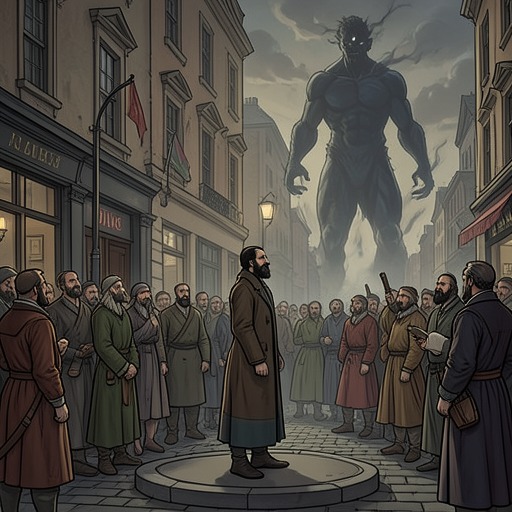
That institutional framing meets a different spectacle when Shiloh exhorts a crowd with a glass cube containing a partially mummified head. The object appears as a holy relic to the assembled onlookers, though its significance is unclear to St. Ives. Later, on the Heath, Parsons and the collected scientists witness Shiloh raise a cube before the crowd as a bright object descends from the sky. Shiloh identifies the falling star with Wormwood; the arrival of the glowing spheroid ship overwhelms the religious performance. The Academy’s scientific gathering is therefore present at an event that neither its predictions nor Shiloh’s display fully commands.
Institutional Limits and Significance
The Academy can organize study, enlist St. Ives, invoke mathematical forecasts, and press for access to Keeble’s engineering knowledge. It can also frame religious enthusiasm as a threat to rational inquiry and public order. Yet the evidence shows no simple mastery of the forces it seeks to manage: Birdlip’s craft follows an obscure course, the cult’s purposes remain uncertain, and the final arrival of the ship disrupts the terms of the spectacle. The Academy’s authority is substantial, but its explanatory reach is not the same as control.
Its role gives the novel a sustained institutional counterpoint to private experiment and religious conviction. The Academy speaks for organized science, yet its behavior is shaped by prestige, access, and risk as well as by abstract reason. In seeking to classify Birdlip as a mystic, identify Keeble as the true engineer, and bring the airship within the bounds of investigation, it exposes how scientific authority is made through both knowledge and negotiation. The returning craft, however, remains an object that the institution can study only after it has arrived on terms of its own.