Trismegistus Club
HomunculusThe Trismegistus Club is a small, informal association whose meetings in Captain Powers’ shop give a loose circle of allies a place to compare discoveries and plan against threats. Its work grows from uneasy discussion into coordinated action: the members protect their investigations from intrusion, weigh what to do with dangerous knowledge, and eventually draw Nell Owlesby into their plans. The Club’s authority is personal rather than institutional, and its modest success at the close does not make its problems disappear.
Identity and Meeting Place
The Club’s defining setting is Captain Powers’ shop, a space Langdon St. Ives feels at home in despite its sharp contrast with the restrictive household of his childhood. The shop’s atmosphere—tobacco smoke, pipes, drink, and conversation—suits an association that does not separate inquiry from the eccentric, material details of daily life. Captain Powers is not merely a host: his shop is a place where trusted companions can meet away from public scrutiny and where the group’s investigations take shape.
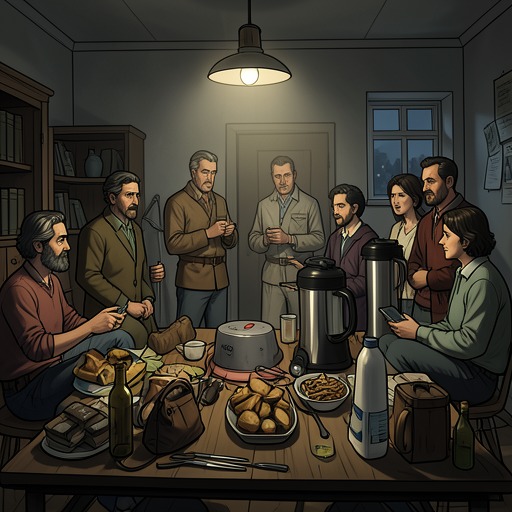
At the first meeting described, the seven present regard the gathering as private. When someone knocks, Captain Powers signals for silence, Bill Kraken slips into a rear chamber, and Theophilus Godall puts a hand beneath his coat. The precautions reveal the Club’s basic condition: its members believe that their business is dangerous enough to demand discretion, and that no outsider has a legitimate claim to take part. The scene presents an association held together by confidence among its participants, not by a public charter or a visible hierarchy.
Meetings and the Exchange of Evidence
The early gathering is notable for what it cannot resolve. Langdon St. Ives asks whether the unfamiliar visitor is Ignacio Narbondo, and Captain Powers confirms the suspicion. The recognition opens a fresh set of questions about the Captain’s knowledge of the doctor and his attention to Narbondo’s schemes. Jack Owlesby, meanwhile, is furious at the prospect that Dorothy Keeble might be drawn into the surrounding intrigue; his personal fears sharpen the meeting’s already unsettled mood. By nearly one in the morning, the members have accomplished little. They agree to meet again in a week, or sooner if something significant occurs, and disperse with the mystery enlarged rather than solved.
The Club’s next recorded meeting makes the exchange of information more explicit. Captain Powers’ shop is thick with smoke while the group waits for Godall, who arrives carrying beer. At eight o’clock the members begin their business by mutual agreement. St. Ives produces part of Sebastian Owlesby’s notebooks, a disclosure that immediately changes the room’s mood: William Keeble leans forward, Jack appears apprehensive about what the papers might reveal concerning his father, and Kraken responds with a weary shake of his bandaged head. Evidence is not abstract to this group; it bears directly on family histories, loyalties, and the dangers the members are trying to understand.
Cooperation and the Expanding Circle
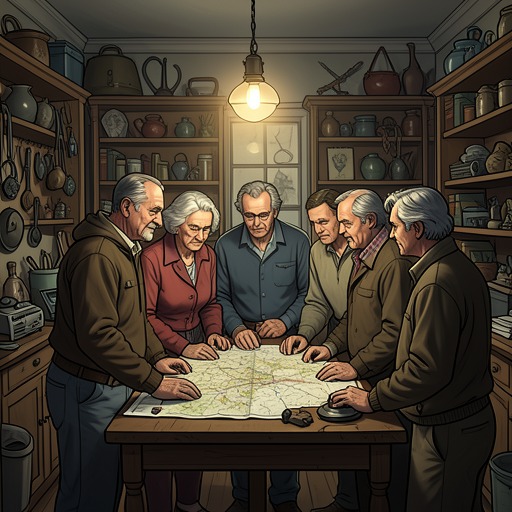
The Club’s practical importance becomes clearest when its members have to coordinate their knowledge. As the effort to recover the box from Narbondo’s premises is planned, Godall sketches the doctor’s cabinet, the nearby building, his own room opposite, and the intervening courtyard. Nell, who knows parts of the laboratory that Godall cannot see from his window, supplies details to complete the plan. The strategy is conditional: if Narbondo is away, they will force entry and search for the box; if he is present, they will consider using a disguise to gain access. The discussion shows the group combining observation, local knowledge, and improvisation rather than relying on a single investigator’s expertise.
The same planning marks a change in who can be trusted with the Club’s affairs. Captain Powers recognizes that the Keebles must be told of Nell’s presence. He argues that there can be no more secrets or disconnected pieces of the puzzle, and that only the vigilance of the whole group may be enough to withstand their opponents. Nell watches Jack and Dorothy leave hand in hand, longs to call out to him, and fears he would hate her for what happened to his father. The Captain reassures her that Jack understands more than she assumes, then returns to the practical business of the planned visit to Narbondo. Personal reconciliation and collective action remain intertwined, but the Club’s willingness to share information is presented as necessary to both.
Nell’s position also shows that the Club’s circle is not simply identical with its original seven-person gathering. She is not among those who disperse after the first meeting, but she later contributes directly to a plan with Godall and Captain Powers. When Winnifred Keeble arrives at the shop after dawn with news that Jack is coming round, the Club members put on their coats and follow her across the street. Their readiness to move together makes the association visible as an active group, even as its membership and responsibilities extend beyond the earlier meeting room.
The Club and Scientific Authority
The Club’s independence is tested by the Royal Academy. In conversation with St. Ives, Parsons describes the Academy’s interest in Dr. Birdlip’s flight and presses St. Ives to persuade William Keeble to cooperate over the engine. The Academy dismisses Birdlip as a speculative mystic rather than the true inventor of the mechanism, while treating Keeble’s technical knowledge as something it might obtain through St. Ives. Parsons also warns of Shiloh’s following and its reported interest in a sacred device associated with Birdlip’s dirigible. His appeal combines scientific urgency, institutional reputation, and fear of religious fanaticism.
St. Ives does not accept the Academy’s priorities as the Club’s obligations. He agrees only to speak with Keeble and see how he responds; if the toymaker refuses, St. Ives will leave the matter there. His own intended work is to pursue Willis Pule and investigate the rumored spacecraft of the homunculus. He judges that the Academy wants Keeble’s engine more than it wants to understand Birdlip’s purpose, which he sees as a search for truth that cannot be reduced to institutional measures. This contrast gives the Club a position distinct from the Academy: its members’ inquiries are driven by immediate relationships and unsettled mysteries, not simply by the prospect of acquiring a device or protecting scientific prestige.
Outcome and Continuing Work
After the night’s final disorder, St. Ives looks back on what he calls the Club’s earnest endeavors and allows that they have met with a measure of success. The remark gives the association a provisional ending, not a definitive victory. Godall immediately qualifies it: their wealthy adversary may not have been seen for the last time, although he believes that man’s influence has largely run its course and intends to call on him. St. Ives is exhausted, expects to be in Harrogate the next day, and acknowledges that work remains.
The Club’s significance lies in this combination of temporary refuge and unfinished business. It can bring disparate information into one room, make a plan from partial views of a hostile laboratory, and expand trust when secrecy has become a liability. Yet its members do not command events, and their investigations do not neatly conclude with the last meeting. The shop remains the center of a cooperative effort whose achievements are real but deliberately described as limited, leaving room for further work beyond the apparent close of the Club’s immediate campaign.