Larry Vaughan
JawsLarry Vaughan is the mayor of Amity and the senior partner of Vaughan & Penrose Real Estate, a man whose public image of understated chic and effortless social mobility masks a deep financial dependency on organized crime. His desperate campaign to suppress news of the shark attacks and keep the beaches open is not motivated by civic boosterism but by a secret debt to Mafia figure Tino Russo, a relationship that ultimately destroys his reputation, his business, and his place in the community.
Identity and Background
Lawrence P. Vaughan is a handsome man in his early fifties, with a full head of salt-and-pepper hair and a trim body maintained by exercise. A native of Amity, he made a great deal of money in postwar real estate speculation and is the senior partner—some thought the only partner, since no one had ever met anyone named Penrose—in the most successful agency in town. He dresses with elegant simplicity, in timeless British jackets, button-down shirts, and Weejun loafers. Unlike Ellen Brody, who descended from summer folk to winter folk and was unable to make the adjustment, Vaughan ascended smoothly from winter folk to summer folk, adjusting each step with grace. He is not one of them, for he is technically a local merchant, so he is never asked to visit them in New York or Palm Beach, but in Amity he moves freely among all but the most aloof members of the summer community. He is asked to most of the important summer parties, and he always arrives alone; very few of his friends know that he has a wife at home, a simple, adoring woman who spends much of her time doing needlepoint in front of her television set. Brody likes Vaughan, and after Labor Day, when things calm down, Vaughan feels free to shed some of his social scales, and every few weeks he and his wife ask Brody and Ellen out to dinner at one of the better restaurants in the Hamptons. Vaughan seems to understand Ellen, always acting most graciously, treating her as a clubmate and comrade.
The Suppression of the Shark News and the Threat to Brody
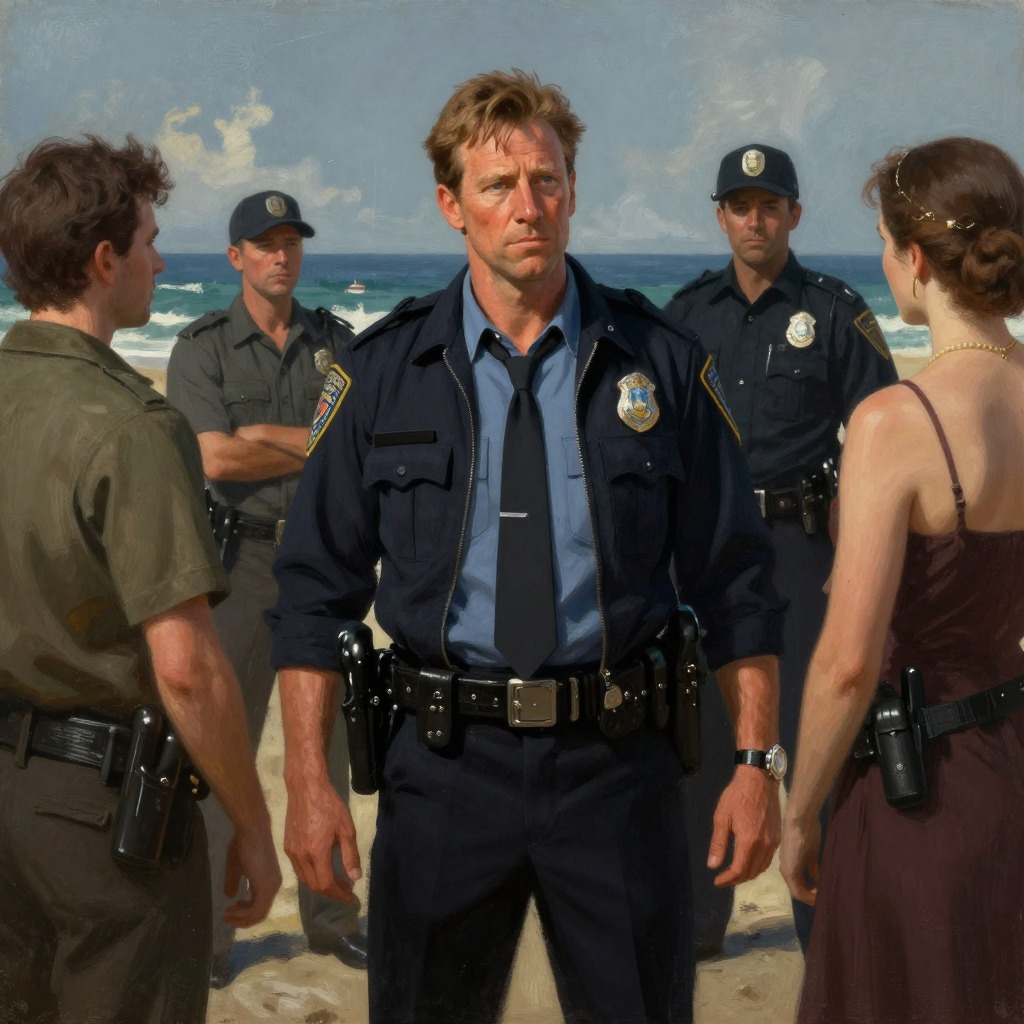
When Brody first decides to close the beaches after the death of Christine Watkins, Vaughan immediately intervenes. He visits Brody in his office, obviously upset, and demands to know where Brody will get the authority to close the beaches. Brody explains that officially he is not sure he has it, but unofficially he figures it is his responsibility to keep people safe. Vaughan argues that the Fourth of July is the make-or-break weekend and that closing the beaches would cut their own throats. When Brody refuses to back down, Vaughan produces a copy of the corporate charter of the town of Amity and shows Brody that the selectmen have the power to remove him from his job. "If you won't do what's right," Vaughan says, "we'll put someone in your job who will." Brody, shaken by Vaughan's aggressive ugliness, reluctantly agrees to keep the beaches open. Vaughan then visits the Footes to appeal to their public-spiritedness, noting that Christine Watkins was a nobody, a drifter with no family or close friends, so she won't be missed.
The Caskata Estates Scandal and the Mafia Connection
After the second and third attacks, Harry Meadows investigates Vaughan's finances and discovers the truth. Twenty-five years earlier, when Vaughan's wife was sick, he received a loan from a man named Tino Russo. A few months before the shark attacks, a company called Caskata Estates was formed, with Vaughan as president and Russo as executive vice-president. As real estate prices fell due to the shark attacks, Caskata began buying properties aggressively, with very little money down and short-term promissory notes signed by Vaughan. Meadows explains that Vaughan is way overextended, probably with over half a million dollars in cash down payments. The only way he can avoid ruin is if the market turns around and prices go up, which requires the beaches to be reopened. If the shark kills someone else, Vaughan is the only one who gets screwed; Russo doesn't have a nickel in cash in the outfit. When Vaughan overhears Meadows telling Brody this on the phone, he shrieks, "You print one word of that crap and I'll sue you to death!"
Confrontation and Collapse
After the Fourth of July weekend incident, Vaughan calls Brody, drunk and in tears, muttering wildly about the ruination of his life. Brody confronts Vaughan at his home, holding the dead cat that one of Russo's men killed in front of Brody's son, and Vaughan denies any involvement, but Brody knows the truth. Vaughan admits that a man once did a favor for him and now wants him to repay it, and that he is probably out close to a million dollars. He begs Brody for help, but Brody can only offer to put him in touch with the D.A., which Vaughan refuses, fearing he would be killed. Vaughan eventually visits Ellen Brody to say farewell, telling her that his business is gone and that he plans to move away, perhaps to Vermont or New Hampshire. He tells her, "You know something? Sometimes I think—and I've thought this from time to time over the years—that you and I would have made a wonderful couple." He kisses her on the top of the head and leaves, a broken man.
Thematic Significance
Vaughan's arc embodies the novel's critique of the corrupting power of money and the moral compromises that result from economic desperation. His initial success as a self-made man who ascends from winter folk to summer folk is undone by a single debt, revealing the fragility of his social position and the ruthlessness of the forces that control the town's economy. His willingness to sacrifice public safety for private gain, and his ultimate ruin, serve as a cautionary tale about the dangers of placing profit above principle. Vaughan's fate also underscores the novel's broader theme of the town's vulnerability: just as the shark attacks expose the precariousness of Amity's tourist-dependent economy, Vaughan's downfall exposes the hidden networks of power and debt that sustain it.