The Shark
JawsThe Shark is the unseen, implacable antagonist of Peter Benchley's novel, a force of nature that descends upon the summer community of Amity, Long Island, and shatters its complacency. It is a great white shark of extraordinary size and power, a creature whose actions defy the conventional wisdom of fishermen and scientists alike, transforming a local nuisance into a full-blown existential crisis. The shark is not merely a predator; it is a catalyst that exposes the town's economic fragility, the corruption of its leaders, and the deep-seated fears and inadequacies of the men who must confront it. Its presence turns the ocean from a source of recreation and livelihood into a realm of primal terror, and its eventual destruction comes at a terrible cost, leaving a trail of death and a community forever changed.
Biology and Instinct
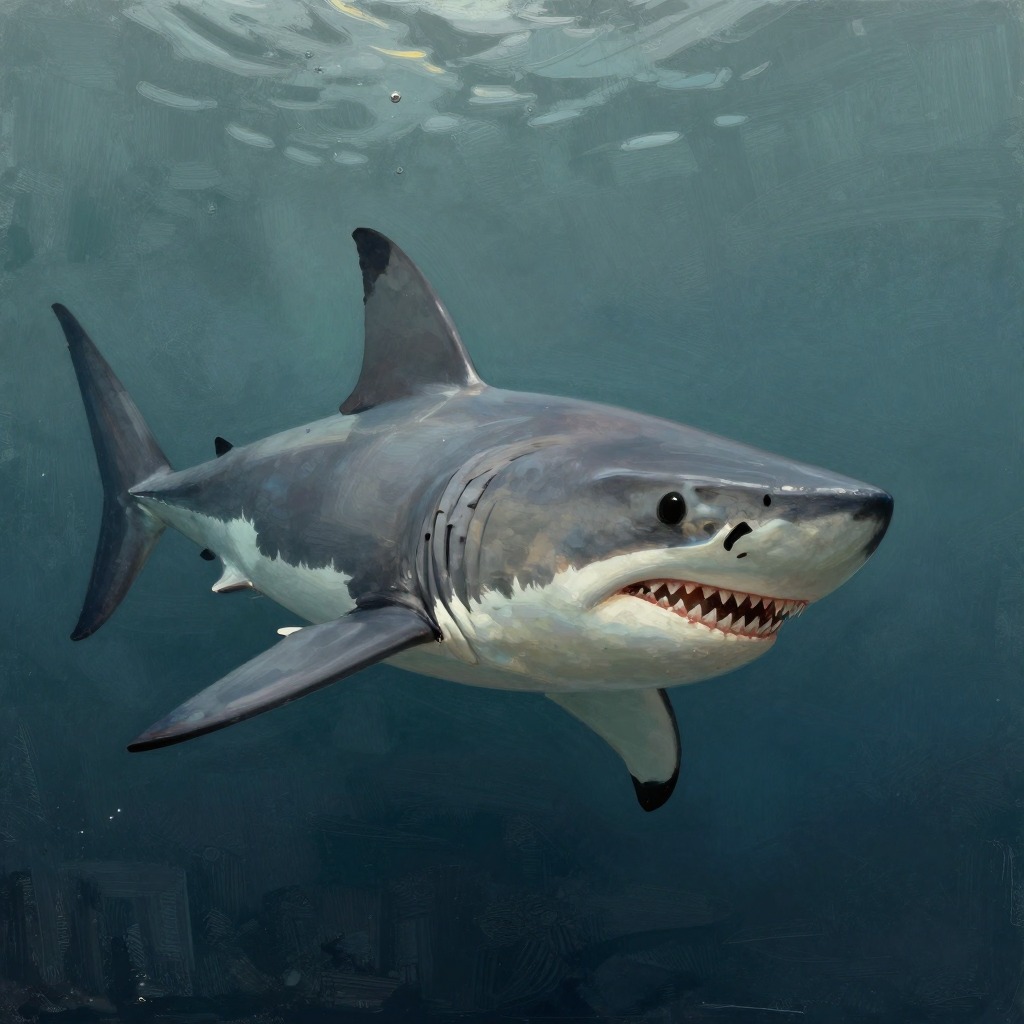
The shark is introduced as a purely instinctual being, a "great fish" moving silently through the night water, propelled by its crescent tail. Its existence is a matter of relentless motion; lacking a flotation bladder, it must swim constantly to survive, driven by "countless millions of years of instinctive continuity." Its senses are portrayed as both primitive and exquisitely tuned: its eyes are "sightless in the black," but it detects the vibrations of prey through a series of thin canals filled with mucus and dotted with nerve endings that run the length of its body. This sensory system allows it to lock onto the erratic, sharp signals of a swimmer in distress, homing in on the "beacon as clear and true as a lighthouse" of blood from a femoral artery. The shark's attack is not born of malice but of an impersonal, biological imperative. It does not see the woman it first kills; it registers her as prey through vibrations and scent. Its feeding is a mechanical process: it swallows a limb without chewing, then returns to crush the torso in its jaws, shaking its head to saw through sinew with its serrated, triangular teeth. The shark's brain, described as "small" and "primitive," registers only the signals of nearby prey, unable to sort signal from substance in a cloud of blood and flesh. This portrayal establishes the shark as a perfect, amoral engine of destruction, a creature of pure appetite.
Intelligence and Malevolence
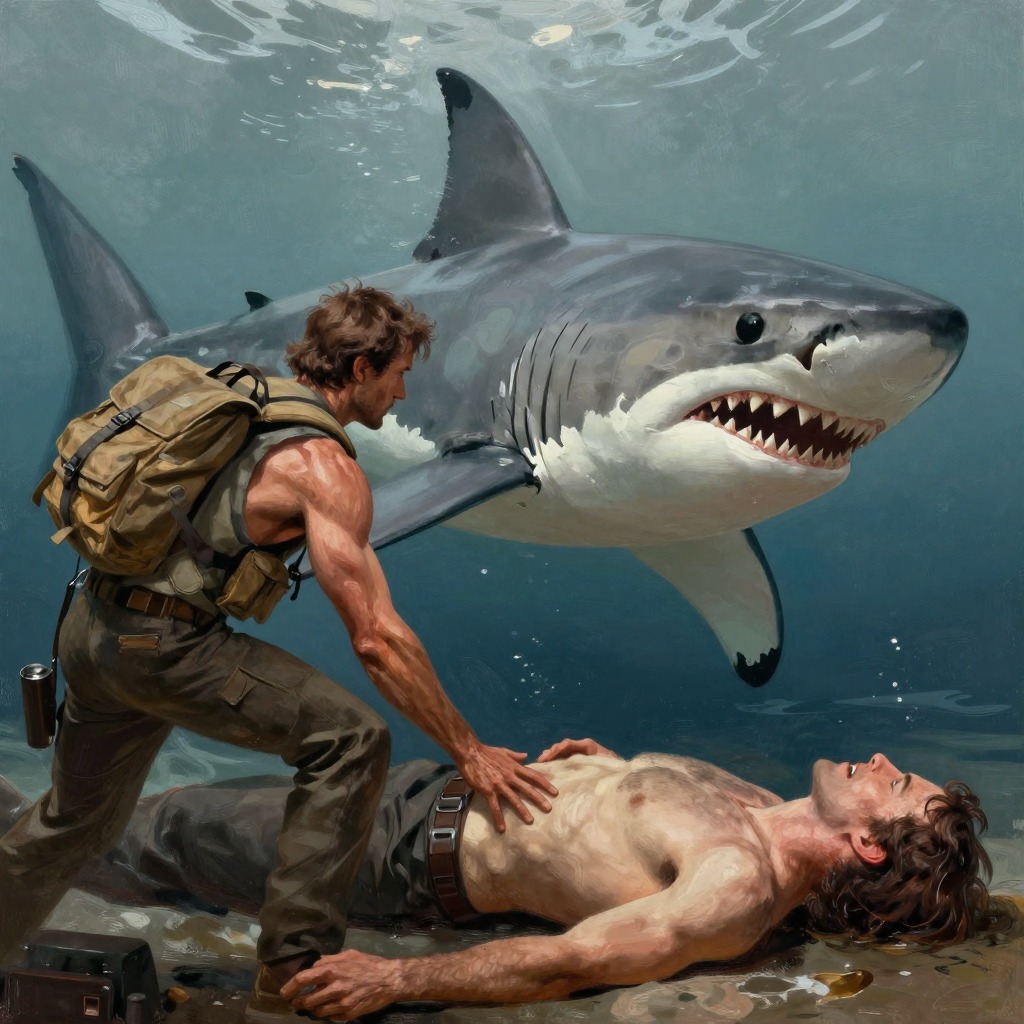
As the novel progresses, the shark's behavior begins to transcend simple instinct, suggesting a disturbing, almost conscious intelligence. It does not leave the Amity area after its first kill, as experts predict it should, but instead remains, attacking a child on a raft and an elderly man in the surf. This pattern of behavior leads Brody to feel he is dealing not with a fish but with a "maniac running around loose." The shark's actions become increasingly strategic and unnerving. It learns to avoid the baited hooks, neatly severing wire leaders with a single bite. It circles the boat, the Orca, and seems to understand the trap set for it, attacking the vessel itself to knock Quint off balance and steal the porpoise bait. When Hooper descends in a shark cage, the shark does not merely investigate; it rams the cage, bending the bars, and then thrusts its head through the gap to seize and kill the man inside. This calculated, violent assault is described as an "angel of death gliding toward an appointment foreordained." The shark's final act is to breach onto the stern of the sinking Orca, its massive body blocking out the light, its black eye reflecting Brody's own image. This is not the behavior of a dumb animal; it is the action of a creature that has become a personal nemesis, a "white death" that seems to revel in the hunt.
The Hunt and Its Consequences
The hunt for the shark becomes an obsession for the three men aboard the Orca, each driven by his own demons. For Quint, it is a matter of professional pride and a personal vendetta; he declares, "I am going to kill that fish," even after Hooper's death and the sinking of his boat. For Brody, it is a quest for redemption, a desperate attempt to atone for his earlier failure to close the beaches and prevent the deaths of a child and an old man. The shark, however, proves to be a foe that defies all their expertise. It withstands multiple harpoon strikes, dragging three barrels beneath the surface, and relentlessly attacks the boat, punching holes in its hull. The final confrontation is a scene of apocalyptic violence. The shark breaches onto the Orca, driving it beneath the waves. In the chaos, a rope coils around Quint's leg, and he is pulled to his death, dragged down into the dark water. Brody, clinging to a seat cushion, watches as the shark, seemingly mortally wounded, begins to sink in a "slow and graceful spiral," trailing Quint's body behind it. The shark's death is not a triumphant victory but a grim, pyrrhic conclusion. It fades from view, a shadow "twirling slowly in the twilight," leaving Brody alone in the water, kicking toward a distant shore. The shark is destroyed, but the cost has been everything.
Critical reception of the novel often singled out the shark as the most compelling element. Michael A. Rogers of Rolling Stone declared the shark his favorite character and suspected Benchley felt the same. Steven Spielberg initially found the human characters so unsympathetic that he wanted the shark to win, a perspective he later altered for the film adaptation. John Spurling of the New Statesman praised the shark's depiction as executed with exhilarating and alarming skill, noting that every scene featuring the creature was imagined at a special pitch of intensity. In contrast, many reviewers criticized the human characters and Benchley's writing. Time's John Skow dismissed the novel as cliché and crude, while Donald Newlove of The Village Voice called the plot rubber-toothed and trite. Andrew Bergman of The New York Times Book Review acknowledged the book as fluid entertainment but noted hollow portentousness and manipulative narrative connections. The Listener remarked that the novel only had bite at feed time, with naive attempts to whip along a flagging storyline.