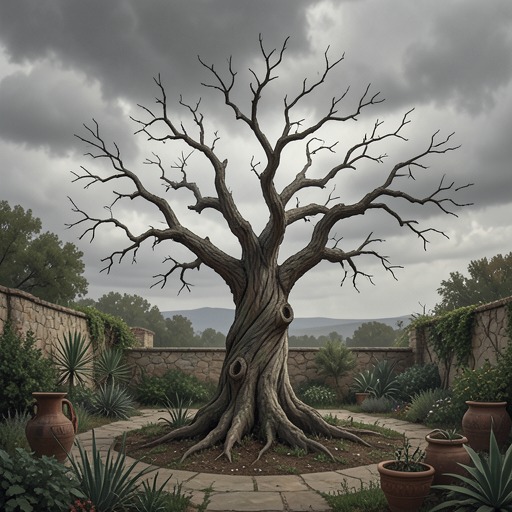
Higuera maldita por Jesús
JudasThe fig tree cursed by Jesus is both the scene of a remembered warning and the place of Judas’s death. In his account, its withering exposes a moment when he could have questioned Jesus’s course toward Jerusalem; at the story’s end, Judas returns to the same tree and ties his rope to a branch, binding his failed intervention to his final act.
The tree on the road to Jerusalem
Judas recalls that, a few days earlier, Jesus stopped at a leafy fig tree on a hillside because he was hungry. Finding no fruit among the leaves, he cursed it. The tree’s leaves immediately dried and fell, leaving its trunk and branches bare. The episode is striking because Judas sees the tree as having done nothing wrong: it was not yet the season for figs, which could not ripen before Passover.
A warning Judas did not follow
The tree’s destruction prompts Judas to question Jesus’s response. If Jesus wanted figs, Judas reasons, he could have made the tree bear fruit through a miracle, as he had turned stones into bread and water into wine. Instead, he sees the curse as a moment of cruelty that should have revealed Jesus’s human fallibility. Judas imagines that he ought to have held Jesus back and urged the group to return to Galilee, where they could continue helping the unfortunate and spreading a message of love and charity rather than going to Jerusalem, where Jesus would be killed.
Judas admits that he did not act on this realization. He persisted in leading Jesus toward Jerusalem. The fig tree therefore marks, in Judas’s retrospective account, both a missed chance to change their direction and his own responsibility for failing to take it. His memory of the episode becomes inseparable from his conviction that he helped bring about Jesus’s death.
The dead tree and Judas’s end
After Jesus’s death, with Passover and the Sabbath beginning, Judas imagines that he might still turn back and seek an ordinary life, caring for a pregnant servant and her child and taking in a stray dog. But he finds the inn closed and deserted, and that possible future remains out of reach. At the bend in the road, the dead fig tree awaits. Judas inspects its branches, chooses one, and ties his rope to it before hanging himself.
The tree thus connects Jesus’s curse to Judas’s belated recognition and death. Its bareness first confronts him with the possibility that Jesus is human, not beyond error; its branch becomes the means by which Judas ends his life after recognizing that he did not turn back when he believed he should have. The novel makes the tree a concrete recurrence through which Judas’s remembered failure and final act converge.