Forced labor system at Roland’s castle
JustineThe forced labor system at Roland’s castle is a mechanism for extracting work from captive women while denying them freedom, security, and any claim to reciprocity. It is introduced when Roland takes Therese to his remote stronghold, identifies himself as the head of a counterfeiting operation, and assigns her to a labor gang already working a wheel. His declaration that she will never regain her freedom makes explicit what the setting and its organization enforce: confinement is not temporary employment but a regime of control, exploitation, and threatened disposal.
Setting and Entry into the System
Roland’s castle stands on a mountain near the Dauphiné border and within the bishopric of Grenoble. The journey has taken Therese more than four leagues uphill, beyond habitations and traveled roads, before the isolated stronghold appears. Roland dismisses the boy who had accompanied them with the mules; only then does he explain where he has brought her. He says that he is leading her into the service of counterfeiters, of whom he is chief, and takes her across a small drawbridge into the fortress.
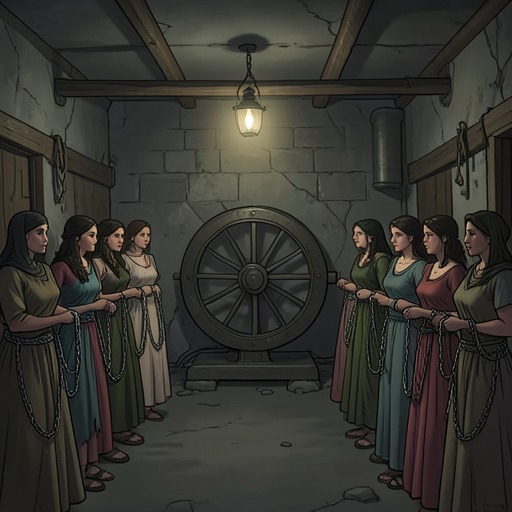
The contrast between the word service and what follows is immediate. In the courtyard, Roland points to a deep grotto, where four women, naked and manacled, are turning a wheel. He names them as Therese’s companions and sets out her assignment: she must turn the wheel for ten hours each day and submit to the demands he chooses to impose on the women. Her daily food is specified as six ounces of black bread and a plate of kidney beans. Roland also identifies the pit beside the well as the place where workers will be thrown when they die from overwork, and says that between sixty and eighty others are already there. A dead worker, he tells her, will simply be replaced.
The account of the castle’s concealed buildings elsewhere in the narrative offers a revealing contrast with this exposed labor scene. At the monastery where Therese had previously been confined, a hidden passage beneath a moat and multiple enclosures concealed the captives’ quarters from outsiders. Roland’s women, by contrast, are placed in a grotto within his fortress and assigned to visible, repetitive work under his authority. Both settings isolate their captives, but the castle’s forced labor system is defined especially by the wheel, the ration, and the explicit threat of replacement.
Labor, Rations, and Punishment
The wheel establishes the central routine: captive women perform prolonged labor, and Roland retains the authority to determine the conditions under which they live and work. His description of ten hours at the wheel sets a daily measure for Therese’s work from the moment she arrives. The limited ration is not presented as a negotiated wage or a means of subsistence freely chosen; it is what Roland says the women will be granted for their labor.
Punishment enforces the arrangement. On arrival, two servants seize Therese, strip her, and shackle her beside the other women, putting her to work without a rest after the journey. Roland then beats her with a bull’s pizzle, explicitly framing the blows as a warning about how he will treat workers who fall behind. He calls it a demonstration of the punishment for future mistakes, not a penalty for a failure she has already committed. The function is prospective as well as retaliatory: the threat is meant to govern her work before any alleged fault occurs.
The labor regime extends beyond the wheel into the women’s shelter and daily confinement. At night, six dark kennels beside the well serve as cells. After Therese has begun work, the women are released from their fetters, given the bread and other food Roland had specified, and locked away. The system therefore divides the day between compulsory work and confinement rather than permitting rest or movement at the workers’ discretion.
Therese’s later account makes the regimen concrete across time. During a two-hour respite around midday, the women go to their cells for individual rest and food; at two o’clock they are attached to the wheel again and made to work until nightfall. They are never allowed to enter the castle. In summer, they are kept naked, a condition Therese connects not only with heat but with the ease of administering beatings; in winter, they receive trousers and a light sweater that does not protect them from punishment. After a week in which Therese sees no sign of Roland, he returns on the ninth day, accuses her and Suzanne of working improperly, and gives each thirty cuts from the instrument he uses to punish them. The episode shows how the system combines a fixed labor schedule with a master’s unchecked power to decide that work is inadequate.
Captivity and the Denial of Obligation
The forced labor system begins as the consequence of a personal betrayal. Therese had rescued Roland when he was in distress, and he had seemed to offer her a prospect of happiness. At the castle she appeals to that history, asking him to remember her assistance and to recognize the injustice of repaying it with captivity. His response turns the appeal itself into an argument against obligation: he claims that she acted from the pleasure of following her own impulse, and therefore that he owes her no recompense.
Roland then presents domination as a natural hierarchy. He tells Therese that strong beings and weak beings were made unequal, that the lowly are meant to remain subordinate, and that wealth has become the measure of power in a society where physical force alone no longer determines rank. His doctrine gives a rationale to the material organization of the castle: he owns the fortress, controls the food and punishment, and claims the right to command the workers because he is richer and more powerful. The arrangement does not merely exploit Therese; it is supported by an argument that denies her standing to demand justice.
He develops the same position by rejecting gratitude as a binding duty. In his view, receiving help is itself humiliating, and the person who gives assistance may already enjoy the satisfaction of superiority. Ingratitude, he argues, can be a virtue for the proud, while gratitude belongs to the humble. This is the ideological counterpart to forced labor: the person who has power refuses to recognize the debt that might limit its use, while the captive’s prior kindness offers no protection from enslavement.
Relation to Therese’s Earlier Vulnerability
The episode echoes the economic insecurity that has shaped Therese’s earlier efforts to survive. Orphaned after her parents’ bankruptcy, she is left with a small inheritance and seeks support and work as her resources run out. When she tells Monsieur Dubourg that she is a poor orphan not yet fourteen, she asks for help finding a way to live. Later, after another exploitative encounter, she learns that the man who has mistreated her has received a lucrative government appointment, while she remains dependent on the possibility of finding a position. These earlier experiences establish the material inequality that leaves Therese exposed to people who control access to money, shelter, or employment.
The economic violence in Roland’s fortress is more overt. Therese is not merely offered a position on terms she can accept or refuse: she is seized, shackled, denied release, and assigned to work under threat. The broader narrative also connects criminal exploitation to poverty. A wealthy trafficker describes seeking victims in places where the need to live and the lack of means to do so weaken resistance; he says that economic fluctuations and scarcity enlarge the population vulnerable to recruitment. Roland’s regime gives that pattern a different form: instead of recruiting the poor through an apparent offer, he takes Therese directly into captivity and imposes labor by force.
The narrative’s earlier description of the secluded monastery provides another institutional parallel. There, a concealed underground route, high enclosures, locked rooms, and a controlled schedule make escape difficult and keep outsiders from seeing the captives. The comparison does not make the institutions identical: the evidence describes different occupants and routines. It does, however, place Roland’s castle within a recurring pattern in Therese’s story, in which isolation and controlled access allow those in authority to turn people’s vulnerability into a system of confinement.
Significance and Continuing Consequences
The system’s significance lies in the way it makes exploitation at once practical and ideological. The wheel measures labor; the small ration marks what the captives are permitted to consume; the kennels and shackles restrict movement; and punishment backs the command to work. Roland’s promise that Therese will never recover her freedom, together with his account of those who have died and been replaced, presents the workers as disposable parts of an operation rather than people with claims or futures.
The regime also exposes the conflict between Therese’s understanding of gratitude and Roland’s refusal to acknowledge it. She sees her rescue of him as a service that ought to count; he reinterprets it as an act performed for her own satisfaction and denies that it creates any obligation. That reversal helps explain why her earlier virtue affords no safety in the castle. Roland can accept her intervention when it benefits him, then use his wealth and command to insist that her kindness entitles her to nothing.
The account continues beyond Therese’s arrival and first punishment. She describes the repeated hours of work, the midday break, the return to the wheel, the restricted conditions of shelter, and the punishment imposed on her and Suzanne on the ninth day. Together, these details establish that the forced labor system is not a single threat made during an encounter, but a continuing routine of captivity and coercion. Its starkest promise is also its organizing principle: workers may be made to labor until they die, and another captive will take their place.