Kullervo's Revenge and Suicide
KalevalaKullervo’s revenge brings Untamo’s people to ruin, but it cannot restore the family or home that his violence is meant to avenge. Armed by Ukko and victorious in battle, he returns to find an empty cabin and deserted forests; the sequence ends when he asks his sword about the lives it takes and uses it to kill himself. Victory and homecoming meet not in reconciliation, but in the recognition of loss.
Causes and Stakes
The episode’s revenge grows from an unresolved history of family violence. Untamo is identified as the destroyer of Kullervo’s people, and Kullervo sets out with his mother’s tortures and the wrongs done to him still unavenged. His campaign is therefore presented not as an isolated battle for territory, but as an attempt to answer a past that continues to govern his life. The tale’s earlier episodes establish the scale of that injury: Untamo massacres Kalervo’s kin, while Kullervo survives attempts to kill him as an infant and later endures disastrous service in another household. In the final campaign, personal grievance expands into collective destruction.
The poem makes the limit of revenge visible before the fighting begins. Kullervo’s stated purpose is to punish Untamo, whom he regards as the fell destroyer of his people. He advances toward combat still rejoicing, and his confidence is expressed in the expectation that he can overcome even a thousand armies. That assurance gives the battle a sense of momentum, but it also sharpens the contrast with what awaits him at home: victory can destroy the enemy’s settlements, yet cannot make his own family present again.
The Campaign and Its Outcome
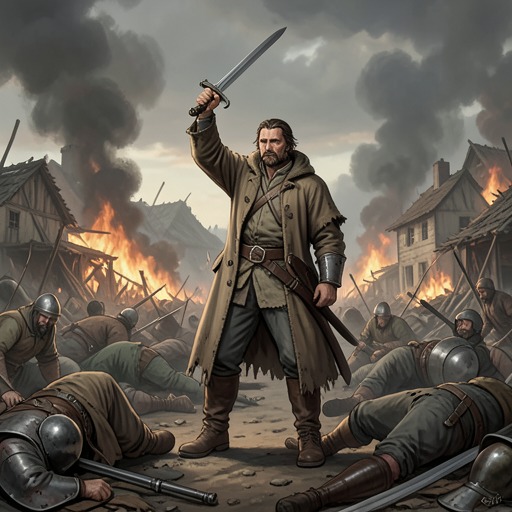
As Kullervo rushes through glens and forests, he sounds his bugle and calls war into the landscape. The detail makes his approach both physical and declarative: he does not simply arrive at the conflict but announces it as he passes through the country. A messenger appears soon afterward, and the narrative turns from his forward charge to a song of supplication. In this heroic world, the transition matters. Kullervo’s progress toward battle is voiced through song as well as action, and his appeal precedes the divine aid that changes his capacity to fight.
Ukko gives him a broadsword endowed with magic power. The gift makes the outcome decisive: equipped with the god’s blade, Kullervo slaughters Untamo’s people and burns their villages to ashes. The destruction is rendered through its remnants. Stones, ovens, and chimneys are all that remain of the hamlets, so the account measures victory by the emptied settlements and the survival of their masonry. Kullervo has avenged the destruction of his own people by producing another scene of communal devastation.
The Failed Homecoming
After the conquest, Kullervo turns toward his homeland, specifically the cabin of his father and the ancient fields and forests associated with his family. His direction reverses the movement of the campaign: having gone out to punish Untamo, he now seeks the place where the consequences of the original violence should have been answered. Instead, the cabin is empty, the forests deserted, and no one comes to greet him. The expected return to a living household does not occur. The homecoming gives him a destination, but not a recovered family or a community able to receive him.
The episode sets that emptiness against the promise of welcome and shelter. The text speaks of food, lodging, and joyful greetings as possibilities, while Kullervo continues through the forest with his watchdog, across fields and fallows. Those assurances cannot change the scene he finds at his father’s dwelling. The dog accompanies him onward, but the promised human welcome has no counterpart in the deserted home. His return thus repeats the episode’s governing contrast: he possesses the means to destroy an enemy’s settlements, but not the means to restore his own.
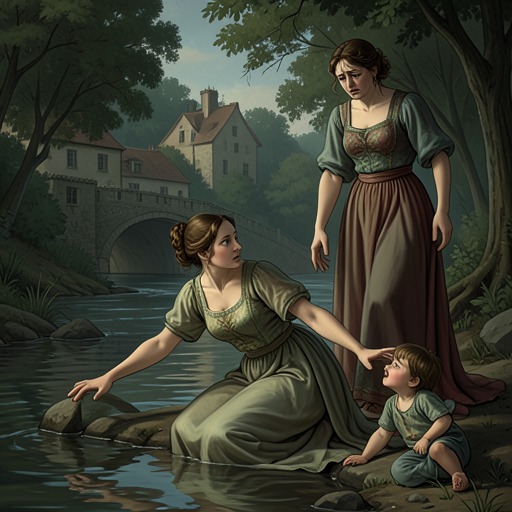
The landscape registers the loss surrounding his sister: the meadow-flowers themselves are described as weeping over her ruin. The passage does not turn this into a reunion or a repair of the family’s past. Rather, it brings Kullervo’s journey back to the consequences of that past at the moment when revenge has already been accomplished. The ruined sister and the abandoned home make the limits of his triumph concrete; the dead and absent cannot be recovered by defeating Untamo’s people.
The Sword and the Ending
At the end, Kullervo grasps the handle of the broadsword and addresses the blade, asking whether it is eager to feast on the worthy and drink the life-blood of the righteous. The question makes the instrument of victory the focus of his final reckoning. Earlier, Ukko’s gift enabled Kullervo to carry out revenge; now the same weapon becomes the means by which he ends his own life. The sword’s power has not changed, but its target has.
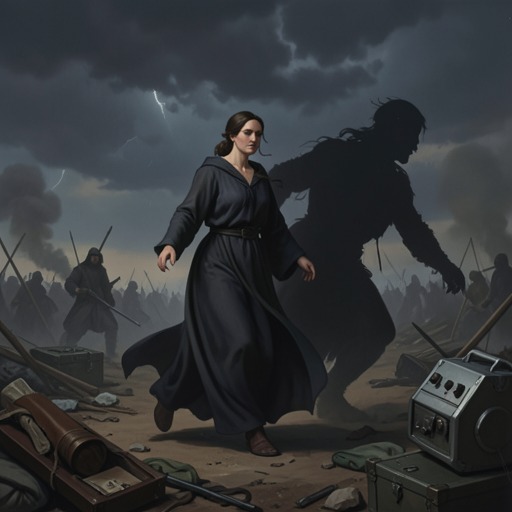
Kullervo lifts Ukko’s mighty sword and pours out his life-blood before he journeys to Manala. The narrative identifies this as his destruction and the end of Kullervo, summing up his fate as one born in sin and nursed in folly. Revenge therefore closes not with restored kinship or a secure return, but with the avenger’s death. The episode completes the movement from grievance to conquest to self-destruction, while leaving the central absence untouched: Untamo’s defeat cannot undo what has already been lost.