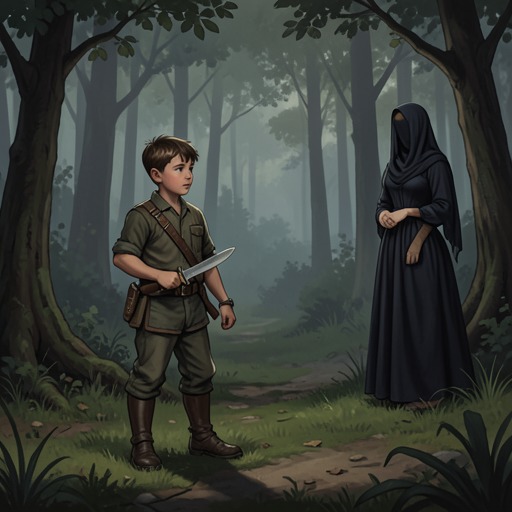
Kullervo's Revenge on Ilmarinen's Wife with Bears and Wolves
KalevalaKullervo’s revenge on Ilmarinen’s wife transforms a small act of deception into a fatal ambush. In Rune XXXIII, a hard oat-loaf, a stone hidden inside it, and a broken knife set the action in motion. Kullervo then turns the cattle entrusted to his care into wolves and bears, so that the woman waiting for the herd is killed when she comes to milk it. The episode makes his retaliation literal: the domestic herd becomes the instrument of the grievance that has taken shape during his work as a herdsman.
The herdsman and the cheat-cake
Kullervo has been placed in a herdsman’s keeping, and the cattle are under his care. He carries his luncheon in a basket, a detail that links the ordinary demands of his work to the episode’s central insult. The food seems inviting on the outside but is described as chaff and tan-bark within. When Kullervo tries to cut his oat-loaf, the knife meets a stone embedded in its centre and breaks.
The concealed stone turns the meal into more than a poor provision: the episode presents it as deception. Kullervo asks how he should avenge the woman’s malice and what recompense deception deserves. His grievance is therefore made explicit before he acts, and the broken knife gives it a concrete object and consequence. The scene moves from a damaged tool and an apparently false meal to the question of retaliation, establishing the cause of what follows without separating it from the conditions of his service.
From grievance to preparation
A raven answers Kullervo from a tree. The exchange marks a transition between his complaint and his response, but the episode’s action is not simply a direct attack. Kullervo cuts a birch wand and a juniper whip-stick, then drives the herd across the lowlands. The implements are those of a herdsman; in his hands, the familiar work of guiding cattle becomes part of the preparation for revenge.
The change in the herd gives the plan its decisive form. Kullervo calls the wolves his children and the bears his standard-bearers, then magically changes all the cattle into those animals. The animals are not a separate force arriving from elsewhere: they are the herd itself, altered under his command. That transformation converts the property entrusted to him into a hidden danger and makes the coming attack depend on the very role he has been assigned to perform.
The ambush at milking
Ilmarinen’s wife and hostess has been waiting for Kullervo and the herd to return. When the animals come, she begins to milk them, completing the ordinary task that brings her into close contact with what she believes to be cattle. The episode dwells on the contrast between that expectation and the reality of the transformed herd: wolves conceal what they are, and bears join the attack.
The timing is central to the revenge. Kullervo has not merely changed the animals and left the danger abstract; the disguised wolves attack while the hostess is milking, and the bears assist them. Her place in the household and her practical work with the herd bring her directly into the danger he has arranged. The waiting for the herd, its return, and the beginning of milking form a clear progression from routine expectation to sudden consequence.
Death and narrative significance
The attack ends with Ilmarinen’s wife falling and perishing among the hurdles. The episode’s outcome is not a warning or a near miss: Kullervo’s retaliation kills the woman whose deception he has invoked. The sequence connects the concealed stone, the broken knife, the spoken demand for vengeance, and the transformed herd to that death, while leaving no uncertainty about the cost of his response.
The action also turns the imagery of animal care against itself. The herd is supposed to be under Kullervo’s charge, and the birch wand and juniper whip-stick belong to its management; through transformation, those responsibilities become the means by which he sets the ambush in motion. The cattle’s change into wolves and bears is both the practical mechanism of the attack and the episode’s central reversal. What begins as a meal carried by a herdsman ends with the destruction of the household’s sense of safety around its own animals.