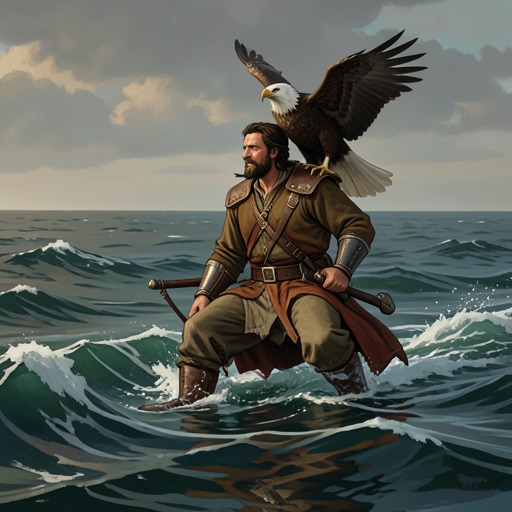
Youkahainen's Attack on Wainamoinen
KalevalaYoukahainen's Attack on Wainamoinen is the moment when Youkahainen's envy becomes armed violence, abruptly transforming rivalry between minstrels into a mortal threat. Its three-shot sequence builds from intention to failure to consequence: two arrows go astray, but the third strikes Wainamoinen's horse and sends him headlong into the water. The attack ends not with a settled outcome but with a storm wind carrying Wainamoinen away, opening the way for his perilous passage at sea.
Causes and Preparation
Youkahainen's hostility is rooted in envy. He nurses a grudge against Wainamoinen and resents the older minstrel's distinction as a wonderful enchanter. The narrative thus gives the attack a personal motive before showing its violence: this is no sudden accident or impersonal danger, but a choice directed against a particular rival.
That choice takes material form in a cruel crossbow made of steel and other metals, which Youkahainen paints in many colors. The contrast between the bow's ornament and its purpose sharpens the scene's menace: an elaborately prepared weapon is being made ready for a killing. The weapon also changes the terms of the conflict. Where the antagonism is associated with minstrels and enchantment, Youkahainen now chooses to meet his rival with a projectile weapon.
At daybreak, Youkahainen is near the holy stream, whirlpool, and sacred river's waterfall. This setting places the planned attack beside powerful waters before Wainamoinen himself falls into the sea. The scene's movement from river margin to open water gives the eventual plunge a physical and narrative preparation, without making the setting a substitute for Youkahainen's deliberate agency.
Warning and Decision
Youkahainen's aged mother asks whom he intends to slaughter. Her question identifies the purpose of the weapon plainly and introduces a moment in which the attack might be challenged before it begins. The narrative does not turn that warning into a change of course: Youkahainen declares his intention to shoot his rival minstrel and says he will pay little heed to what follows.
The exchange makes the assault more than an outburst of anger. Youkahainen has been questioned, and the danger of his intention has been named, yet he proceeds. His disregard for the outcome is particularly consequential: the scene establishes his willingness to act violently without mastering the consequences that will follow for either man.
The Three Shots
Youkahainen bends his fire-bow, rests the weapon on his left knee, and plants his right foot firmly. The concrete arrangement of body and weapon slows the scene before the arrows fly, making the attack deliberate rather than instantaneous. His first shot passes over Wainamoinen's head and scatters the flock of lamb-clouds as it speeds skyward. It is a miss, but its path carries the violence into the sky and leaves the target untouched.
Undeterred, Youkahainen quickly selects and adjusts another arrow. The second misses as well, piercing into the lower regions and splitting the old Sand Mountain in two. The difference between the shots is not simply that neither reaches Wainamoinen: the arrows travel in opposing directions, one upward and the next downward, striking clouds and mountain instead of the man. Their failures make the final shot more tense, while the damage they cause shows that a missed aim is not harmless.
Youkahainen makes a third attempt. This arrow strikes Wainamoinen's swift horse near its golden girdle, passing through the animal's shoulder. The precise target matters: the horse is hit, and Wainamoinen is brought down from its saddle. The attack succeeds in removing the minstrel from his mount, even though the account describes the arrow striking the horse rather than Wainamoinen's body.
Fall and Aftermath
Wainamoinen falls headlong into the waters and plunges beneath the rolling billows. The rapid reversal—from mounted rider to submerged figure—gives Youkahainen's third shot its decisive consequence. What began as an attempt to kill a rival has, at minimum, driven Wainamoinen into immediate danger at sea.
A mighty storm wind then rises, roaring over the waters, and bears Wainamoinen away. The attack therefore concludes with separation rather than a witnessed death or a settled confrontation: the shot removes Wainamoinen from the scene, and the storm carries him beyond it. This unresolved ending turns Youkahainen's act into the beginning of a larger peril for Wainamoinen, while preserving the distinction between the attacker's intent and the outcome actually shown.
Narrative Significance
The scene is structured as a compact escalation. Envy supplies the motive; the mother's question makes the intended violence explicit; the three arrows move from two conspicuous failures to a successful strike with an unforeseen consequence. That pattern gives the action its suspense without obscuring its cause: Wainamoinen is endangered because Youkahainen chooses to pursue him with a weapon.
The attack also shifts the rivalry out of the arena of song and into bodily peril. Youkahainen's bow does not settle which minstrel is greater; instead, its final arrow strikes the horse and casts Wainamoinen into the sea. The storm wind then takes the outcome out of Youkahainen's control. Violence has interrupted the contest between rivals, but it has not delivered a clear victory: Wainamoinen's fate is left to the dangerous waters into which he has fallen.