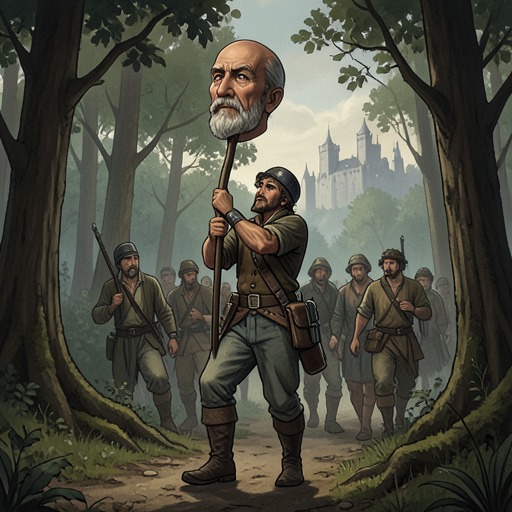
Bran’s head
MabinogionBran’s head is the enduring presence carried from the aftermath of the Irish war to its burial at the White Mount in London. It is more than a relic: during the journey it keeps the company of the survivors, remains uncorrupted through eighty years at Gwales, and is bound to a prohibition whose breach restores their awareness of loss. Its concealment also has a political consequence, for the account says that no invasion came from across the sea while it lay buried.
Command and Custody
After the battle, only seven men of the Island of Britain escaped. Their wounded lord, Bendigeid Fran, instructed them to cut off his head and carry it to the White Mount, with its face toward France. The command gives the head a destination before the journey begins: the survivors are not simply to preserve a keepsake, but to complete a burial that their king has specified.
The seven who undertake the journey include Manawyddan, Pryderi, and Heilyn son of Gwynn. Branwen accompanies them as an eighth. At first the head’s continued presence links the survivors to the lord they have lost. Bendigeid Fran promises that it will be as pleasant company on the road as it was when joined to his body. At Gwales, too, the travelers find that having it with them is no more burdensome than if he were present in person. The narrative thus makes the head a companion, not merely cargo, while keeping its eventual interment as the journey’s purpose.
The Journey and Its Enchanted Feasts
The first long halt is at Harlech. Three birds sing there, and their song seems to come from far across the sea while remaining as distinct to the listeners as if the birds were near. The company feasts for seven years, with the birds’ music as part of an interval that suspends the ordinary measure of travel. The head remains with them throughout; its promised companionship is realized in the strange duration of the feast.
At the end of those seven years, the survivors go to Gwales in Penvro, where they find a fair place above the ocean and a spacious hall. Two doors stand open; the third, which faces toward Cornwall, is closed. Manawyddan identifies it as the door they must not open. The company feasts and rejoices, but the passage emphasizes an unusual absence as well as pleasure: they remember neither the food set before them nor any sorrow. They remain there for eighty years without knowing that time has passed, and they are no more weary than when they first arrived. Through all of this, Bran’s head stays uncorrupted and remains a source of companionship.
This long stay is called the entertaining of the noble head. The name turns the episode into a practice of hospitality extended around a dead ruler: the travelers feast in his company while the usual pressures of memory and time recede. The head’s presence is central to that experience, but the hall’s closed door sets a limit on it. Their ease depends on not looking toward what the prohibition excludes.
The Door Opens and Memory Returns
The interval ends when Heilyn opens the forbidden door to see whether the warning about it is true. The sight toward Cornwall and Aber Henvelen brings back the evils the travelers have suffered, the companions they have lost, and the misery that has befallen them. Their lord’s fate weighs especially heavily. What the feast had kept from consciousness returns at once, and the survivors can no longer remain at Gwales.
The opening does not change the head itself; it changes the company’s relation to the past. For eighty years they have carried their loss without feeling its full weight, in a place where they do not even register the passage of time. Once the door is open, grief and knowledge return together, and the journey resumes. The head is therefore both a steady companion through the suspended years and the focus of a mourning that those years had temporarily held at bay.
Burial and Political Significance
The survivors carry the head onward to London and bury it at the White Mount, as Bendigeid Fran instructed, facing France. The burial completes their charge and becomes the third goodly concealment named in the account. Its counterpart is the third ill-fated disclosure: when the head is later disinterred, the protective condition ends. The narrative states that no invasion from across the sea came to the island while the head remained concealed there.
The object’s story therefore moves from royal command, through companionship and prolonged concealment, to burial with consequences beyond the bereaved travelers. The head preserves the presence of a lost ruler in the company’s daily experience, yet its protective force is linked to its remaining hidden. Its final significance lies in that double role: it helps the survivors endure a journey defined by loss, and its burial marks a period of security for the island.