Math’s magic wand
MabinogionMath’s magic wand is a recurring instrument of transformation: a blow can change a person’s body and nature, while another use reverses that change or makes an identity test visible. In the episodes preserved here, it serves Math’s authority over Gwydion and Gilvaethwy, figures in the appearance of Arianrod’s children, and becomes the means by which Gwydion restores Llew from eagle form. Its significance lies not in any described appearance or stated limit, but in the sharply different consequences that follow its use.
Form and Function
The text gives no description of the wand’s material, size, or construction. It is defined instead through action. Math takes it up and strikes; those struck assume animal forms, and a later strike can return them to human form. When Arianrod is brought before Math, he bends the wand and tells her to step over it, making it part of an ordeal rather than simply an instrument of force. Gwydion also uses a wand to strike Llew when he is an eagle. Across these scenes, the wand links bodily change to authority, judgment, and restoration.
The outcomes are not uniform. The wand can initiate a prolonged punishment in which the transformed people are required to live as the animals they resemble. It can also be used as part of a test, after which a child appears. In Llew’s case, a single blow ends his animal shape, but reveals how weakened he has become. The recurring object therefore does not erase the circumstances around its use: the same basic gesture—striking—can impose a sentence, reverse a transformation, or expose a vulnerable condition.
The Punishment of Gwydion and Gilvaethwy
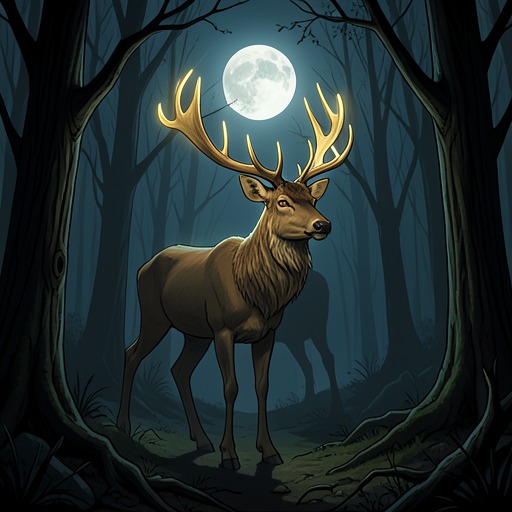
After Gwydion and Gilvaethwy return to Math and submit themselves to his will, Math says that their conduct has cost him warriors and arms, as well as bringing dishonour; he also names Pryderi’s death among the losses that cannot be compensated. He takes up the wand and strikes Gilvaethwy, then strikes Gwydion. Both become deer. Math orders them to go together, share the nature of the animals whose form they bear, and return after a year. In this first use, the wand makes punishment physical and lasting: the men must experience the animal existence assigned to them, not merely wear its outward appearance.
At the year’s end, the barking of the palace dogs announces the pair’s return beneath the chamber wall. They have a fawn with them. Math strikes them again, changing them into wild hogs for the next year, but takes the young animal to be baptized and names him Hydwn. The wand thus advances the sentence through a repeated annual cycle while Math separates the offspring from the parents’ imposed animal life.
A year later, two wild hogs return with a well-grown young one. Math again uses the wand: he changes the pair into wolves and turns the young animal into a fair, auburn-haired youth named Hychdwn, whom he also has baptized. At the end of the following year, two wolves appear with a strong cub. Math identifies the cub as Bleiddwn and says that a name has been prepared for him. After this, he strikes the transformed pair, who resume their own nature. The wand has carried the punishment through deer, wild hogs, and wolves, while the three young animals—Hydwn, Hychdwn, and Bleiddwn—are successively removed from animal form and baptized.
A Test Before Arianrod
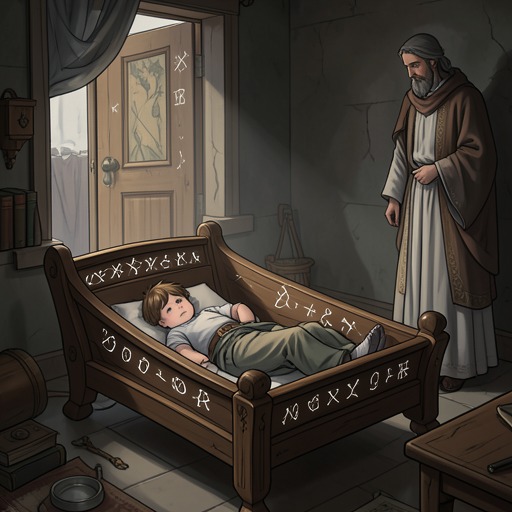
When Arianrod comes before Math, he bends the wand and asks her to step over it, saying that this will reveal whether she is the maiden. As she steps over it, a fine, chubby, yellow-haired boy appears. Arianrod turns toward the door at the child’s cry; a second, small form is glimpsed, but Gwydion catches it before anyone can see it clearly and hides it in a chest at the foot of his bed. Math names the boy Dylan, and he is baptized. The account then describes Dylan’s plunge into the sea and his immediate adoption of the sea’s nature, in which he swims like a fish; it is the sea, not the wand, that the text associates with this transformation.
Here the wand’s role differs from its use against Gwydion and Gilvaethwy. Math bends it and makes crossing it the condition of a test; the boy’s appearance follows the crossing. The episode connects the wand with the revelation of Arianrod’s maternity while leaving the second child’s identity concealed at that moment. Gwydion’s swift intervention and the hidden form in the chest introduce secrecy into a sequence otherwise marked by public, visible transformations.
Llew’s Restoration and the Wand’s Narrative Role
Later, Gwydion finds Llew in eagle form. After calling him down from the tree with a song, Gwydion strikes him with his magic wand, and Llew returns to human form. The restoration is not a return to health: Llew is described as nothing but skin and bone. He is taken to Caer Dathyl, where physicians in Gwynedd treat him, and he is completely healed before the year ends. Once healed, Llew tells Math that the time has come for retribution against the person responsible for his suffering.
The wand’s action is therefore decisive but incomplete. It ends Llew’s eagle form, yet the visible damage remains and requires the care of physicians. This contrasts with the punishment of Gwydion and Gilvaethwy, where repeated transformations are themselves the sentence, and with Arianrod’s ordeal, where the wand structures a test. Across the episodes, the object makes changes of identity bodily and legible; what follows—continued punishment, concealed birth, or recovery—depends on the people and circumstances surrounding its use.