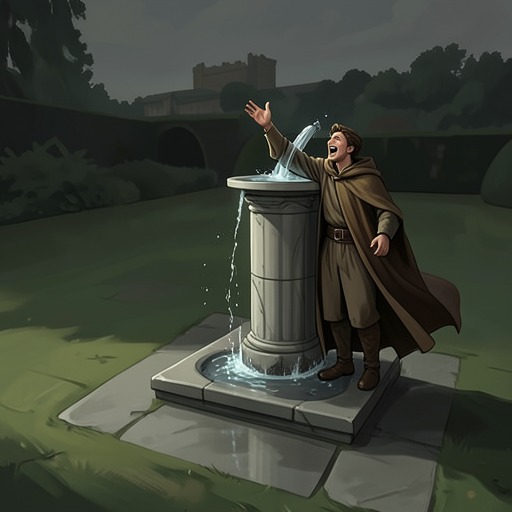
Owain’s wild condition
MabinogionOwain son of Urien’s wild condition is the consequence of a public reminder that he has broken faith with the Countess of the Fountain: after a damsel takes his ring and denounces him, he withdraws from human society and lives among wild beasts. The episode turns shame into visible bodily ruin, then begins his return through the care of a widowed Countess and her household.
The Ring and the Withdrawal
Owain is dining at Caerlleon upon Usk when a damsel arrives on a foam-covered bay horse with a curling mane, its bridle and visible saddle fittings of gold. Dressed in yellow satin, she removes the ring from his hand and declares that this is how the deceiver, traitor, faithless, disgraced, and beardless shall be treated. Her words recall Owain’s adventure and make his breach of faith impossible to ignore.
Sorrowful, Owain finishes his meal, returns to his own lodging, and prepares that night. The next day he does not go to court. Instead, he wanders into distant, uncultivated mountains. His retreat follows the public rebuke directly: the ring is taken from him, and he turns away from the company and expectations of court.
Life Among the Wild Beasts
Owain remains in the mountains until his clothes are worn out, his body wasted, and his hair grown long. He goes about with wild beasts and feeds with them, until they have become familiar with him. This familiarity does not spare him from the physical cost of his isolation: eventually he grows too weak to keep their company and descends from the mountains into a valley.
There he reaches a park belonging to a widowed Countess. The movement out of the mountains brings him back within reach of human care, but he arrives in a state that makes him scarcely recognizable as a courtly figure. The account measures his estrangement through concrete losses—clothing, strength, and ordinary human company—rather than through any description of his thoughts beyond his sorrow and shame.
Discovery and Treatment
One day the Countess and her maidens walk beside a lake in the park and see what appears to be a man. They are frightened, but approach, touch, and examine him; they find that he is alive, though exhausted by the sun’s heat. The Countess sends a maiden with a horse, clothing, and a flask of precious ointment. She instructs her to apply the balsam near Owain’s heart and watch to see whether its efficacy will make him rise.
The maiden pours the entire flask over him, leaves the horse and garments nearby, and hides at a short distance. Owain begins to move his arms, rises, and looks at himself; ashamed of his unseemly appearance, he creeps toward the garments, draws them from the saddle, dresses, and mounts the horse with difficulty. When the maiden reveals herself, he rejoices at seeing her and asks what land he has reached. She explains that a widowed Countess owns the castle, and that a neighboring young Earl has taken all but this one dwelling from her because she refused to marry him.
The maiden conducts Owain to the castle, where she leads him to a pleasant chamber, kindles a fire, and leaves him. When she returns the empty flask, the Countess protests that the ointment was worth seven-score pounds and that it has been wasted on a stranger she does not know. Even so, she orders the maiden to wait upon Owain until he is fully recovered. The episode thus ends not with a completed account of his recovery, but with his removal from the wilderness into shelter and the beginning of sustained care.
Narrative Function
The wild condition is both a punishment and a turning point: the ring’s removal and the damsel’s accusation are followed by an exile that strips Owain of clothing, strength, and courtly appearance. His return begins through a sharply contrasting sequence of gestures—he is first approached cautiously as a frightening figure, then anointed, clothed, and led indoors. The costly balsam makes the rescue concrete, while the Countess’s complaint and her order to continue caring for him hold together material loss and compassion. His wilderness life therefore marks the interval between estrangement from the courtly world and the possibility of re-entering human society.