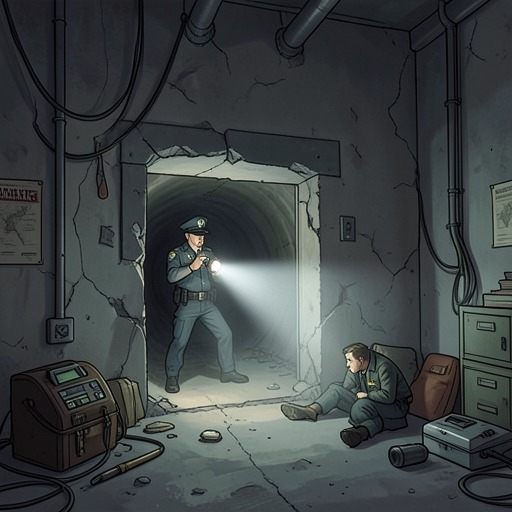
The Discovery of Robert Rothman’s Torture Chamber
MasqueradeThe discovery of Robert Rothman’s Torture Chamber exposes the hidden scale and duration of his crimes: beneath the surface, investigators find bodies spanning very different periods of time, including a young woman Dan Stevens recognizes as a missing student. The chamber turns suspicion into a physical record of repeated violence, and its oldest remains force Stevens to consider that the activity may have continued for years, possibly decades, before he calls in the Federal Bureau of Investigation.
Descent and Setting
The investigators are directed down into what is called the crypt, where the rest of the bodies are said to be. The passage is low enough that they have to stoop as they walk. Ahead, Dan Stevens can make out artificial light and hear the subdued voices of his deputies, signs that the search has already reached the underground space before he enters it. The descent therefore brings him toward a scene being examined by his own officers, rather than toward an unknown chamber entirely untouched by the investigation.
The passage’s cramped dimensions make the discovery a movement from ordinary search into concealed interior space. The investigators proceed through a tunnel to a chamber holding bodies and equipment. One of them asks whether this is where Robert Rothman kept the women, but the evidence presented here does not supply an answer to that question. What the scene does establish is that the underground room contains both human remains and devices Stevens understands as instruments of torture. The crypt is not merely a hiding place for bodies; it is evidence of a place where violence was carried out.
The Victims and Physical Evidence
Among the dead is Heather Alue, an eighteen-year-old missing student from a college two towns away. Stevens had received an alert about her disappearance a week earlier and had memorized her face. Recognizing her gives the chamber an immediate connection to an active missing-person investigation: the missing student is no longer only a name and image in an alert, but one of the victims in the room. Her death also makes the scale of the scene personal for the officer who had been searching for her.
Stevens finds the condition of Heather’s body deeply upsetting and turns his attention away from it to survey the rest of the chamber. On a table, he sees an assortment of devices whose design suggests an earlier era and whose apparent function is unmistakable to him: torture. The implements supply a different kind of evidence from the bodies. The remains show that people have died there; the tools point to deliberate suffering as part of what happened in the chamber. Together, they make the room evidence not just of concealment but of an organized setting for abuse.
The Barrels and the Timeline
The investigators’ examination of the barrels extends the case backward in time. One, identified as number forty-two, holds the remains of a young woman who died only a few weeks earlier. Another, barrel number one, contains a body so old that an investigator initially mistakes its appearance for that of a mummy; the estimate is that it had been inside for years. The contrast between these two containers is crucial. The recent death shows that the chamber’s use was not confined to a distant past, while the oldest remains make it impossible to treat the latest discovery as an isolated episode.
Stevens asks whether each barrel contains a body. That question registers the discovery’s accumulating scale: the barrels are not incidental objects around a single victim but part of a larger collection of remains. The available evidence establishes both the presence of multiple bodies and a wide difference in their apparent ages, though it does not establish a complete count or identify every victim. The chamber thus offers a partial chronology rather than a full account. Its contents show that the crimes reach back years, while leaving the precise beginning and extent unresolved.
Recognition, Consequences, and Significance
The scene changes the meaning of the investigation for Stevens. Before descending, the case concerns reports and missing people; within the chamber, those reports connect to identified remains, physical tools, and containers holding bodies from different periods. Heather’s recognition links one victim to a specific alert Stevens received only a week earlier. The older remains then widen the frame beyond that recent search, suggesting a pattern that had remained hidden over a much longer span.
Stevens reflects that what lies below may have been happening for years, perhaps decades, directly under the community’s notice. His conclusion is an assessment prompted by the evidence, not a confirmed account of the crimes’ full duration. The distinction matters: the oldest body supports a history of years, while the possibility of decades remains his broader inference. Faced with a case that exceeds what his local investigation can address, he decides that the next step is to call the Federal Bureau of Investigation. The discovery’s decisive consequence is therefore institutional as well as evidentiary: a concealed chamber becomes the basis for escalating the investigation beyond the local authorities.