The glass of water with the salamander
MatildaThe glass of water with the salamander is the immediate focus of a classroom upheaval and the first object Matilda moves with her mind. At first it holds an unfamiliar, writhing animal that startles Miss Trunchbull; moments later, Matilda’s furious concentration tips it over onto the headmistress. When Matilda later makes an empty glass fall again in front of Miss Honey, the object links a spectacle that others might dismiss as an accident to a deliberate, repeatable demonstration.
The Salamander in the Glass
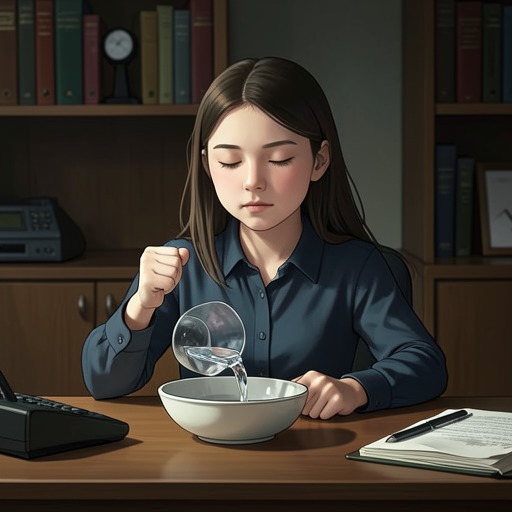
Miss Trunchbull lifts a large blue water jug and pours water into her glass. The long, slimy salamander slips out with the water and splashes into the glass, where it wriggles in a space too small for it to be at ease. Its sudden appearance changes an ordinary classroom object into the center of everyone’s attention. The children jump and cry out, imagining that the creature might be a snake, a baby crocodile, or a little dragon. Lavender warns Miss Trunchbull that it may bite.
Miss Trunchbull’s alarm is especially striking because she prides herself on being afraid of nothing. She has never seen a salamander and does not know what it is; biology is not her strongest subject. Though she slowly settles back into her chair, her fright turns to hatred and fury. The glass thus exposes a vulnerability in the headmistress’s fearsome public authority: she can be made to jump and scream by a creature she cannot identify.
The Glass and Matilda’s First Feat
Miss Trunchbull calls Matilda to her feet and insults her, while Matilda insists she has nothing to do with what is in the glass. Already angry at being blamed and facing punishment for something she did not do, Matilda watches the salamander wriggle and imagines tipping the glass and its contents over the headmistress. She also fears what Miss Trunchbull would do in response. The glass makes that conflict visible: it is both the object of Matilda’s wish for retaliation and the instrument through which she can act without approaching the headmistress.
As Matilda stares at the glass, she feels power gathering in her eyes, like an electrical charge and then lightning. She imagines countless tiny, invisible arms reaching from her eyes towards it. At first the glass only wobbles and briefly leans; Matilda concentrates harder, and it slowly tips backwards until it balances on the edge of its base. After a few seconds it falls, striking the table with a sharp chime. Water and salamander spill over Miss Trunchbull’s chest. The animal clings to her jacket, and after she brushes it away, it lands beside Lavender’s desk. Lavender retrieves it and puts it in her pencil case to keep for another time.
The fall reverses the scene’s balance of power without removing the danger Matilda faces. Miss Trunchbull has been startled and drenched, but she remains furious, and Matilda has not escaped her authority. The glass’s movement, however, cannot be explained by Matilda having walked over and tipped it: she has acted from a distance, with her eyes fixed on it. In the aftermath, Matilda tells Miss Honey that she did not touch the glass or even go near it, and asks whether Miss Honey saw it spill over Miss Trunchbull.
A Test Object for Miss Honey
Miss Honey first puts the incident into words with Matilda, who wants to discuss the glass and the salamander rather than another subject. Later, to test whether Matilda can repeat what happened, Miss Honey places an empty glass in the middle of a table. She asks whether water is needed; Matilda thinks it makes no difference. Miss Honey invites her to try, allowing as much time as she needs. The changed setup matters: the salamander, water, and immediate confrontation with Miss Trunchbull are all absent, while the glass remains.
Matilda sits in the second row, about three metres from Miss Honey. With her elbows on the desk and her head in her hands, she concentrates and silently commands the glass to fall. This time the charge builds more quickly. She directs her mind, brain, and will towards her eyes; the invisible arms seem to reach the glass, which wobbles, leans to one side, and falls with a chime. It lands less than thirty centimetres from Miss Honey’s folded arms. The repeated fall confirms that Matilda’s first feat was not dependent on the salamander or on water in the glass.
Significance
The glass’s role changes from container to evidence. In the classroom, its contents provoke a commotion, and its fall gives physical form to Matilda’s anger. In Miss Honey’s room, an empty glass makes it possible to separate the movement itself from the startling circumstances of the first incident. What began amid accusation and fear becomes a controlled test witnessed by someone willing to consider what Matilda can do.
The object also gives the narrative a precise measure of Matilda’s developing control. The first attempt requires visible effort and repeated commands; during the second, she begins at once, gives no audible order, and makes the glass fall more quickly. Yet the demonstration has a bodily cost: afterward Matilda is pale, trembling, and staring ahead with glassy eyes. Miss Honey is so shocked that she cannot speak, but she waits for Matilda to recover. The glass therefore marks both the reality of Matilda’s power and the strain involved in using it, while carrying the story from an apparent classroom mishap to a witnessed, repeatable ability.