Chalk
MatildaChalk is the small, ordinary-looking object at the center of the blackboard miracle: it floats without a visible hand, writes a message addressed to Miss Trunchbull, and then drops and breaks. Its movement interrupts the headmistress’s violent lesson and turns the classroom’s attention from the child she is tormenting to the words appearing before them. Through the chalk, Matilda makes an unseen power legible—and makes a public demand that the school’s authority cannot simply ignore.
The chalk enters the scene
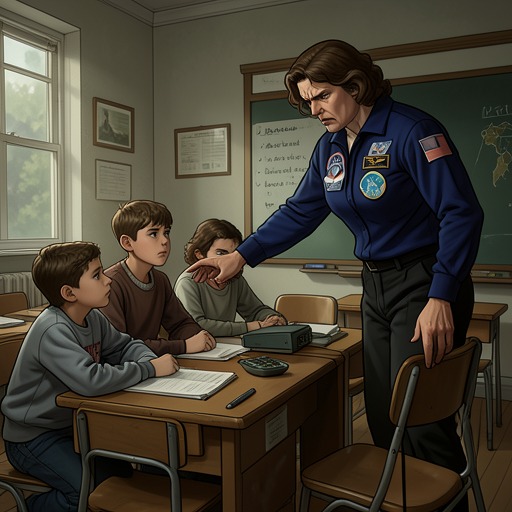
Before the chalk attracts notice, Miss Trunchbull is holding Wilfred upside down by one ankle and shouting a multiplication question at him. Nico suddenly points to the board and cries out that the chalk is moving by itself. His alarm redirects the whole class: even Miss Trunchbull looks toward the board, where a new stick of chalk is suspended in front of the gray-black surface. The object’s first effect is therefore not yet its writing, but the interruption of the lesson and the abrupt transfer of attention from the headmistress’s display of physical control to an unexplained movement.
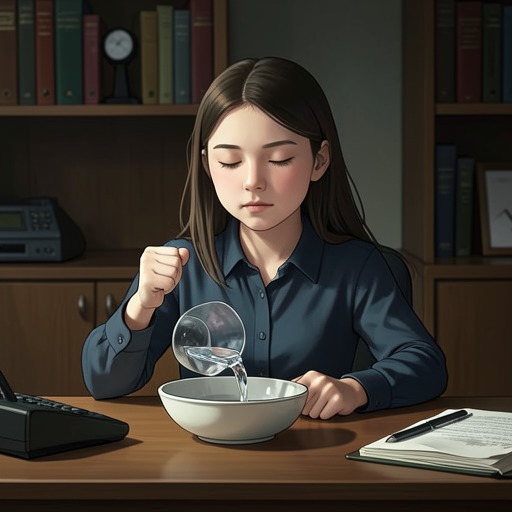
Nico then calls out that the chalk is writing. The narration confirms what he sees, while withholding any visible writer: the chalk itself remains in the air as words form on the board. The scene’s suspense depends on this separation between action and agent. The class can watch each new mark appear, but the person causing the chalk to move is not presented as an ordinary hand at work. Miss Honey glances toward Matilda, who sits upright at her desk with her head raised, lips pressed together, and eyes shining. The contrast between the apparently self-moving object and Matilda’s controlled stillness gives the chalk’s movement a human source without making that source visible to the rest of the class.
A message made public
The first written word is Miss Trunchbull’s given name, Agatha. The chalk does not begin with an explanation; it begins by naming the person addressed. Miss Trunchbull is visibly shocked to find her own name appearing in writing by an unseen hand. She drops Wilfred and demands to know who is writing. The reversal is immediate: the teacher who had been directing a child’s body and speech is now reacting to a message whose author she cannot see or command.
The chalk continues, identifying the speaker as Marcus and repeating that identification. It then demands the return of a woman’s home and salary, before warning Miss Trunchbull that she is being watched. These statements make the board more than a surface for an unexplained trick. They present a claim and a specific grievance in the name of Marcus, linking the spectacle to the recovery of home and wages. The repeated identification gives the writing a persistent voice, while the warning turns the board’s public address into a direct confrontation. The text is visible to the entire class, but its asserted speaker remains absent; the chalk supplies the presence that the unseen Marcus cannot supply in person.
The movement ends
The chalk does not vanish when its message is complete. It pauses in the air, then falls with a clatter to the floor and breaks in two. That physical ending makes the episode’s supernatural action sharply material: the instrument that had seemed to write without a body becomes a broken object among the class’s ordinary belongings. Its fall comes just before Wilfred calls attention to Miss Trunchbull lying on the floor unconscious. The class rises to see her, completing the reversal begun when Nico first pointed to the board. The chalk’s writing has stopped, but the authority it challenged has been displaced from the center of the room.
The scene establishes the chalk as the instrument Matilda uses to make her telekinetic power speak in Marcus’s name. The writing and Miss Trunchbull’s collapse occur in close succession, but the episode does not show the chalk striking or physically touching her; its force lies in the message, the disruption it causes, and the reversal of who commands the class’s attention. Its broken state closes the spectacle without undoing what has been communicated: the demand has been made publicly, and Miss Trunchbull has been confronted before the pupils she had been frightening.
Narrative significance
Chalk ordinarily belongs to the school’s system of lessons and authority: it marks the board, where a teacher can present information for pupils to read. Here that familiar classroom medium is commandeered. The board carries a message the headmistress did not choose, and the chalk writes while no visible person holds it. The object therefore converts hidden power into public evidence. Pupils do not need to understand how it moves to see that the lesson has been interrupted and that Miss Trunchbull is no longer the only person who can make the class respond.
The sequence also gives the chalk a precise dramatic progression: unexplained movement, recognition as writing, the naming of Agatha, a claim spoken for Marcus, a demand for restitution, a warning, and finally a fall and break. Each stage adds information or changes the balance in the room. The chalk is not merely a sign of Matilda’s ability; it is the means by which that ability produces an accusation and a demand. Once it breaks, the message remains in the scene’s consequences, while the object itself can no longer continue writing.