The Chokey
MatildaThe Chokey is a punishment cupboard in Miss Trunchbull’s room whose design makes stillness painful and movement dangerous. Hortensia describes being confined there six times, while Miss Trunchbull later threatens to send a boy there if he stops eating before finishing his cake, making the cupboard both a place of actual punishment and an instrument of intimidation.
Design and Conditions
Hortensia describes The Chokey as very tall but so narrow that its floor measures only twenty-five centimetres square. A prisoner cannot sit or crouch and must remain standing. Three cement walls are studded with protruding glass shards, leaving no safe surface to lean against; the door is no refuge either, since thousands of sharp nails have been hammered through it from the outside. Hortensia suspects Miss Trunchbull put them there herself. The cupboard is completely dark. Its arrangement forces a prisoner to hold a perfectly upright posture for the duration of the confinement: wobbling risks contact with the glass or nails. The danger lies not only in the cramped space but in the impossibility of resting or shifting position without risking injury.
Hortensia’s Confinements
Hortensia says that during her first half-year she was put in The Chokey six times. Twice she had to remain there for a whole day; the other confinements lasted two hours each. She emphasizes that even two hours is a long time under those conditions. Her firsthand account gives the cupboard’s dimensions and hazards the weight of lived experience rather than leaving them as a schoolyard rumor. Hortensia also recounts one of the pranks that led to her punishment: she poured half a pot of treacle onto Miss Trunchbull’s chair. When Miss Trunchbull sat down, the chair made a loud, sucking sound, which Hortensia remembers as funny. The story sets the ingenuity of the prank against the severity of its consequence: a mischievous act was answered with repeated confinement in a space designed to make even minor movement hazardous.
Threat and Function
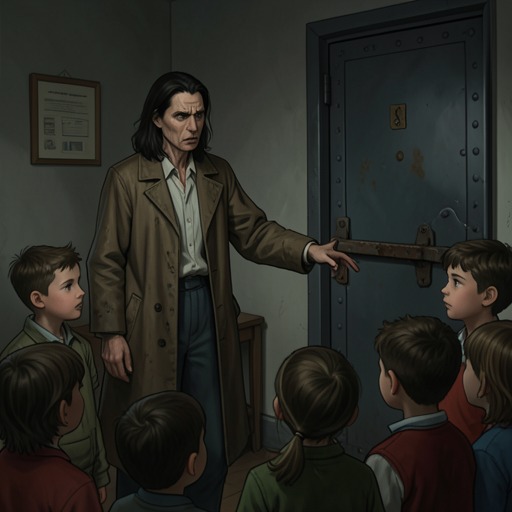
During the cake-eating episode, Miss Trunchbull orders the boy to eat faster and warns that if he stops before the cake is finished, she will put him in The Chokey, lock the door, and throw the key into a ditch. The threat is explicit, but the passage does not say that he is actually sent there. Instead, the cupboard’s reputation is used to pressure him to continue eating. The Chokey’s construction and its role in Miss Trunchbull’s threats make punishment part of the school’s everyday discipline: the prospect of being trapped, hurt, and unable to rest is invoked to control children’s behavior. Its darkness and hazards are not incidental details; they are the means by which the cupboard turns confinement into a credible threat of pain.