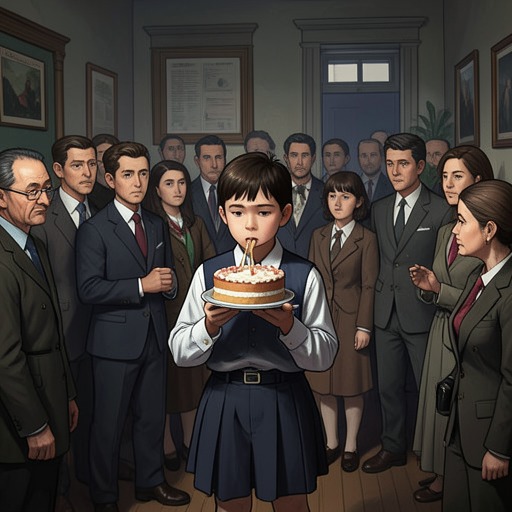
Trunchbull's chocolate cake
MatildaMiss Trunchbull’s chocolate cake turns a disputed stolen slice into a public test of appetite and endurance. First presented as the headmistress’s private luxury, cake becomes a tool of coercion when she orders Bruce Bogtrotter to eat an enormous one in front of the assembled children. His eventual success reverses the intended humiliation into a victory, but Miss Trunchbull answers it by bringing the platter down on his head.
Private luxury and accusation
Miss Trunchbull describes the original cake as part of her personal stores, set out for her morning snack on a tea tray prepared by the cook. She stresses its ingredients—real butter and cream—and distinguishes it from the food served to the boys. In her telling, Bruce crept into the kitchen during the previous morning’s break, stole a slice, and ate it. The cake is therefore more than food in the accusation: its personal ownership and quality make the alleged theft an affront to the headmistress’s privilege.
Bruce denies the charge, while Miss Trunchbull insists that the cook saw him both take and eat the slice. The scene establishes the cake through a clash of claims before the replacement cake appears. Miss Trunchbull treats her account as settled fact and addresses Bruce as a thief; his denial does not halt the public proceeding. The object at stake is small at first—a slice from a private cake—but the accusation gives it an outsized consequence.
The oversized replacement
At Miss Trunchbull’s instruction, the cook leaves and returns almost immediately, staggering beneath a huge, round chocolate cake on a porcelain platter. It measures nearly half a metre across and is covered in dark-brown chocolate icing. Its size makes the supposed offense visible in an exaggerated form: a stolen slice is answered not with a discreet reprimand but with a whole cake displayed on a table at the center of the stage.
Miss Trunchbull adopts a soft, inviting tone as she offers Bruce the entire cake. She says she had the cook bake it especially for him because he enjoyed the slice the day before. The offer sounds generous, and Bruce, bewildered, thanks her. She redirects his thanks to the cook. Yet the scale of the gift and its public setting leave little room for it to function as an ordinary treat. The cake is placed before Bruce as both a reward-shaped spectacle and a demand whose terms Miss Trunchbull controls.
Food turned into compulsion
The apparent kindness gives way to an explicit order. When Bruce says he does not want another piece, Miss Trunchbull’s voice sharpens; she strikes her thigh with her riding crop and commands him to eat. She links the punishment directly to the accusation: he wanted cake and stole it, so now he has cake and must finish it. She declares that Bruce cannot leave the stage, and that no one may leave the hall, until the whole cake is gone.
The cake’s abundance thus becomes the means of confinement. What might ordinarily promise pleasure is made compulsory, and the audience is kept in place to witness the demand. Miss Trunchbull’s repeated commands make eating a performance under threat, not a matter of appetite. The cake’s original association with private privilege has been transformed into a public instrument: Bruce must consume, while the headmistress dictates both the task and its endpoint.
Completion and reversal
Bruce continues eating even as his pace slows. The narration compares his persistence to that of a long-distance runner who can see the finish line but knows he must keep going. When he swallows the final mouthful, the children erupt in cheers, leap onto their chairs, and celebrate him. The cake’s completion changes the meaning of the spectacle: Miss Trunchbull had made the whole cake a measure of her power, but Bruce’s endurance carries him through the ordeal and earns the crowd’s acclaim.
Miss Trunchbull remains motionless, furious, as Bruce sits overfull and sweating but grinning triumphantly. She then rushes forward, lifts the large, empty porcelain platter, and smashes it down on his head with enough force to send shards across the stage. The cake is gone; the plate, no longer a vessel for it, becomes the next object in the punishment. Bruce merely shakes his head and keeps grinning. Miss Trunchbull curses and marches off the stage, followed by the cook.
The cake’s changing role gives the episode its sharp structure: private property becomes accusation, an oversized offering becomes an order, and forced consumption ends in Bruce’s public triumph. The broken platter makes clear that finishing the cake does not soften Miss Trunchbull or end her violence. But her attempt to turn the cake into an instrument of humiliation instead produces a visible reversal: the children cheer Bruce, and his grin outlasts the shattered dish.