Eternidad
MayaEternity is the book’s measure of the human fear of death: an immense, unreturnable duration against which a finite life can seem unbearable. For Frank, the terror lies not only in disappearing but in never being able to return to experience reality again. The story tests that longing against counterexamples: an existence that may be vanishingly improbable, a legendary woman trapped by immortality, and the continuing bonds through which the bereaved give the dead a place in life. Eternity is therefore both a desired escape from death and a troubling horizon that makes love, choice, and loss matter.
The finite life against immeasurable time
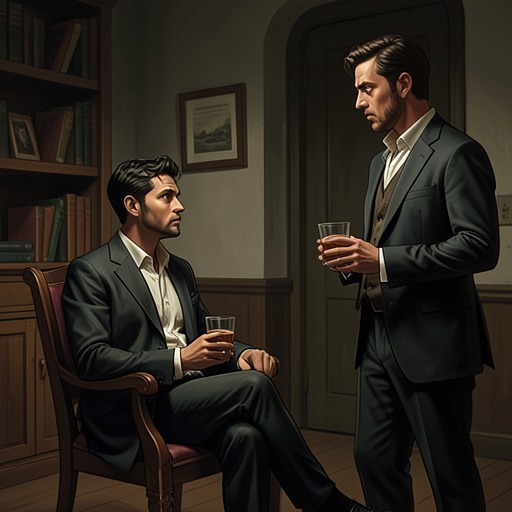
In conversation with Gordon, Frank measures his brief remaining life against intervals so vast that even one hundred million years would be only a span of absence. He imagines that, after dying, he will not be able to return and learn what happens in the universe. The thought turns ordinary mortality into a problem of exclusion: he is not merely leaving the world, but losing every future chance to witness it. His comic willingness to accept another galaxy, provided it had a bar and a form of reproduction he could tolerate, makes the longing vivid without diminishing its seriousness. The joke circles a stark desire—to be present somewhere, somehow, again.
Frank distinguishes this fear from simple reluctance to die. What torments him is the impossibility of coming back. He says that reason itself can turn against a person, with the two or three supposedly surplus brain convolutions biting their own tail. The image gives existential reflection a physical, self-injuring form: consciousness can grasp the limit that it cannot overcome. Gin may numb the attacked synapses for a few hours, but Frank recognizes that this relief is temporary and does not solve the underlying dilemma. His drinking belongs to the conflict between a mortal body and a mind that cannot accept mortality as a sufficient answer.
Gordon offers a counterpoint to Frank’s agitation. Frank reflects that awareness of death may be historically new to human beings, just as the idea that life must end never occurred to the reptilian creatures Gordon invokes. Gordon then turns the question around: the existence of a world at all approaches the limit of the impossible; if there were nothing, nobody would be present to ask why. The exchange does not settle whether existence has a purpose. Instead, it places Frank’s longing within a larger paradox: life is astonishingly improbable, yet the awareness that it may end makes that astonishing fact a source of anguish as well as wonder.
The fallen angel and the mortal body
Frank gives his condition the shape of a fallen angel who has become lost in the swamp of flesh and discovered that return to heaven is impossible. The figure is explicitly a parable, not a claim that angels exist. Its force comes from the imagined reversal of status: a being that presumed its existence would continue forever discovers that it is a human, a protein-based death machine, no more exempt from mortality than a fish or a toad. Faced with a mirror, this imagined angel sees itself reduced to the level of a gecko. The comparison makes the shock of human finitude feel like a demotion from an expected eternity.
Frank calls himself descended from salamanders and describes the extra convolutions in his brain as a consequence of the short time he has in the world. His protest is emotional and moral as much as intellectual: it feels unfair to recognize how brief life is just as he is preparing to say goodbye to so many things. Gordon, by contrast, is not troubled by his own ontological status. Their disagreement exposes the loneliness of Frank’s position. The awareness that distinguishes him is also the source of a distress that he cannot simply reason away or share with a companion who does not feel the same deprivation.
This conflict surfaces again when Gordon suggests that drinking could shorten Frank’s life. Frank accepts the paradox, but insists that he is talking about eternity, not old age: in that scale, a year more or less seems insignificant. Gordon replies that he is spared concern about eternity; Frank cries that he is not, tears up his note, and leaves the cabin, slamming the door. The physical exit gives the abstract dispute a consequence. Eternity is no detached philosophical subject for him: it is the pressure behind his impatience, his reliance on drink, and his frustrated conversations with Gordon.
Immortality as a burden of choice
The legend of Verana gives the desire for endless life a cautionary form. A beautiful young woman, unable to choose among her many suitors, receives a magical drink from a sorcerer. Drinking half will make her live forever; when she finds the man with whom she wants to share her life, she can give him the remaining half so that he too will be immortal. The gift appears to solve her problem by giving her unlimited time in which to decide. Instead, it magnifies the problem: time multiplies her choices and raises their stakes, since any chosen partner would share not merely a lifetime but eternity.
After a hundred years, Verana remains young and beautiful but finds the decision harder. By two hundred years, she has met so many suitors that she can no longer love any of them. She is condemned to wander the earth forever, and the legend warns that a man who falls for a woman unable to decide may have succumbed to the charms of this cold, unhappy figure. Her admirers give their hearts and youth, but none will ever possess her. When Frank tells the story to Laura, she responds that it is a terrible predicament. The response keeps the myth close to ordinary human feeling: eternal life does not automatically preserve the capacity to love; endless possibility can wear it away.
The story’s legend resonates with Frank’s own reflection on Vera’s magical drink. Even after reviewing the past, he says he would have taken it without hesitation, despite not being sure he could find someone to receive the other half. But it is too late for Sheila: during the last year of her life, she received little beyond chemotherapy. Frank’s willingness and Sheila’s lost chance set longing beside the irrevocability of death. The drink offers no repair for a particular loss once the person who might have shared it is gone, while Verana’s fate warns that an infinite future could itself become a prison.
Grief, memory, and a life that continues
The book places Frank’s fear of not returning beside the more intimate experience of continuing to live with the dead. After rereading his letter to Vera, he is finally able to sort Sheila’s clothes. People from the Salvation Army are due to collect them the next morning, including old dresses he doubts they can sell. He compares the task to removing a swallow’s nest that has had no birds in it for years. The image holds absence and habit together: the nest remains as a trace of a life once housed there, just as Sheila’s clothing makes the work of parting from her tangible. Looking at her large color photograph no longer makes him shudder as much as it once did, and he anticipates becoming accustomed to widowhood as another form of existence.
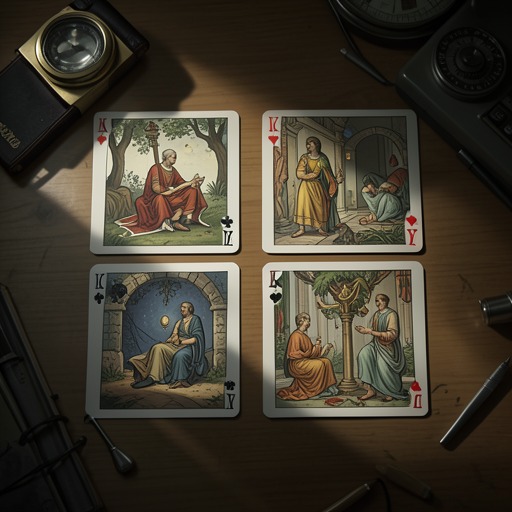
That accommodation is not the same as ceasing to love or remember. Frank says that he still misses Sheila’s body, but much of their companionship remains in their conversations and shared memories. He answers aloud when an imagined reply from her upsets him, and recognizes phrases that belonged to her in other people’s speech. He even misses being asked to shuffle the cards for her solitaire. A neighbor’s observation that Frank talks to himself marks the outward appearance of this continuing bond, while Frank privately understands the voice as part of the resonance Sheila left behind.
The solitaire becomes a precise emblem of love’s change after death. Sheila had enjoyed the game throughout her life; the eccentric habit first helped make Frank fall passionately in love with her, and later could irritate him. He resented the afternoons she spent playing and was annoyed when he caught her cheating to make the solitaire come out. Now he misses exactly what once exasperated him. Frank calls this the closing of a circle, though not a vicious one: the absent person cannot be reached, yet the remembered texture of living together persists. Eternity here is not literal survival. It is the transformed duration of shared habits in the memory of the living.
Sonia and retrospective meaning
Frank and Vera’s grief for Sonia offers another way the past remains active. During their walk through Salamanca, Vera tells Frank small anecdotes about their daughter that he had never heard. The stories hurt him because he regrets not sharing every minute of Sonia’s life, but they also give him a chance to know her better. He notices Vera turning away to dry her tears; when he hides his own face against the old university façade, where she has pointed out a toad and a skull, he knows it is not to inspect the carvings. Their mourning moves through a living city and its old structures, but it is the exchange of memories that allows Sonia to accompany them.
Frank insists that Sonia was four and a half when she died, while her parents continue to age. They will live with their daughter at that age for the rest of their lives. He tells Vera that she remains Sonia’s mother and he remains Sonia’s father. This continuing relationship does not deny that Sonia is dead; it identifies what death has not erased. Only Frank and Vera can create a living space in which their daughter’s memories continue to have an effect.
The couple’s reconciliation also changes how Frank understands their separation. Vera had left not because he had failed to forgive her for the accident, but because she could not bear to live with his pain while carrying her own. Frank admits that, absorbed in his unhappiness, he could not distinguish her grief from old reproaches. He describes her departure as dividing the pain in two. After they have reconciled, he considers whether something occurring in the present can point backward and give a past event new meaning. The question does not reverse Sonia’s death or make their suffering disappear. It makes the meaning of what followed open to change through what the parents do together now.
The book’s use of eternity thus holds two different hopes in tension. Frank yearns for a return to the world and recoils from the finality of nonexistence; the legend of Verana shows that endless duration can destroy decisiveness and love. In the lives of the bereaved, what endures is neither bodily immortality nor an escape from grief. It is memory, conversation, shared stories, and a relationship that can take on new meaning without pretending that death did not occur. Against the cosmic scale of endless time, these finite continuities are not a solution to mortality, but the forms in which a life remains consequential.