Selección natural
MayaSelección natural is the process by which environmental pressures shape which inherited variations survive and reproduce. In the novel, it is both a biological explanation and the ground of an argument: the narrator describes evolution through chance mutation and differential survival, while José and John ask whether that account can also explain the apparent direction of life and the emergence of consciousness. The debate becomes personal when the narrator recognizes himself as the first childless generation in an immense lineage whose continuation depends on reproduction.
Mechanism and evolutionary continuity
The narrator describes evolution as driven by the fact that only a small proportion of each generation can grow and multiply. Without that unequal survival and reproduction, he argues, there would be no natural selection and therefore no evolution. The process is not a smooth ascent but a persistent succession of offspring dying and organisms struggling to live; the rare individuals that leave descendants carry the lineage forward.
He sets this mechanism against the long continuity of his own ancestry. His present existence depends on countless generations surviving long enough to reproduce, from ancient ancestors such as amphibians in the Devonian and reptiles in the Permian to organisms far earlier in the history of life. A single fatal mutation in one particular bacterium billions of years ago, he imagines, would have prevented his birth. The lineage’s improbable survival resembles a relay: each generation passes the genetic baton to the next, with occasional small adjustments to the inherited material.
That continuity is inseparable from contingency. The narrator’s image of a specific ancestral cell gives the abstract history of selection an almost dizzying particularity: he traces his existence back to one bacterium and one unbroken chain of cellular divisions, rather than to a repeatable personal opportunity. The chain has survived innumerable hazards, but survival does not guarantee its continuation. The same mechanism that explains the persistence of a lineage also makes its extinction, or its failure to reproduce, consequential.
Variation, environment, and adaptation
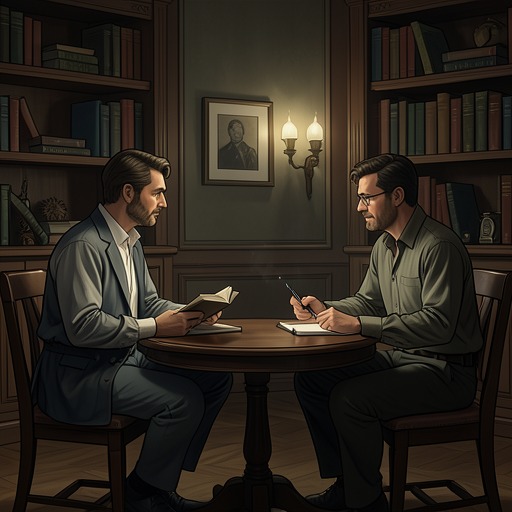
In conversation with José, the narrator distinguishes random mutation from the sorting action of the environment. Mutations occur without foresight; environmental conditions determine which variations have a better chance of surviving and passing on their genes. This account does not require nature to anticipate a future use for a feature. It explains adaptation retrospectively, through the success of organisms whose inherited differences prove advantageous under particular conditions.
The narrator supports this view with examples of traits that appeared repeatedly in evolutionary history. Eyes and vision developed independently many times; flight and upright walking also arose more than once. He notes that insects evolved wings more than a hundred million years before reptiles did. The pterosaurs were the first vertebrates capable of flight, but they were not ancestors of modern birds: they had no feathers, resembled large bats in the way they flew, and disappeared alongside the dinosaurs. The much later archaeopteryx was a small dinosaur, and the development of bird wings and feathers took place independently of the pterosaurs.
For the narrator, repeated emergence does not itself establish a predetermined destination. He accepts that similar capacities can arise more than once, but explains their development as a sequence of mutations across many generations. The operative rule is differential inheritance: an individual with even a small advantage in the struggle for existence is more likely to pass on its genes. José presses the difficulty of this explanation by asking what benefit rudimentary wings could confer many generations before they became useful, drawing attention to the problem of explaining the gradual beginnings of a complex adaptation rather than only its eventual function.
The purpose debate
José challenges the narrator to consider whether life’s evolution might involve a mechanism beyond casual mutation, and whether questions of intention or purpose are unreasonable. He argues that human consciousness should not be treated as an arbitrary trait among many in the struggle for existence, but as the possible aim of the evolutionary process. In his account, life repeatedly develops more specialized ways of sensing its surroundings: eyes and vision arise independently, as do flight and upright movement, while nature may also be advancing toward intellectual comprehension of the whole.
The narrator recognizes the pull of this argument. As a child, he had entertained similar thoughts under the influence of Pierre Teilhard de Chardin; his later biological training led him to reject evolution with a purpose. In the discussion, he feels obliged to defend the scientific position, even as José’s questions expose uncertainties he had not previously examined. The exchange therefore distinguishes a mechanism from an interpretation of its larger meaning: natural selection explains how inherited traits spread, while the claim that consciousness is evolution’s destination goes further than the mechanism alone establishes.
John develops the purpose argument on a still larger timescale. He says it would have been premature, three hundred million years ago, to call life absurd or purposeless, because its purpose might not yet have had time to flower. The apparent destination could only become visible much later, perhaps after a hundred, a thousand, or a billion years. On this reasoning, the future can become, in a retrospective sense, the cause of what happens now. The narrator objects that causes ordinarily point backward in time and cannot belong to the future; John replies that the perspective itself may need to be reversed.
The disagreement turns on how to interpret the history that selection produces. The narrator’s account looks backward from present organisms to the conditions and mutations that made them possible. John asks whether the later appearance of life and consciousness can give an earlier stage meaning that was not yet visible. His claim is not simply that organisms adapt, but that the long process may have a purpose discernible only in retrospect. The conversation leaves this tension open rather than making the scientific mechanism and the teleological proposal interchangeable.
Life, observers, and cosmic scale
The novel extends the debate from biological evolution to the conditions that permit observers to exist. John asks whether the universe could have been much smaller or fundamentally different and still produced human beings. He points to the complexity of the human brain and to its material history: its atoms were forged in stars, while the large universe was needed to make stars and planets, and ultimately the conditions from which even microorganisms could arise.
José adds Jupiter to this chain of conditions. Its immense gravitational field, he argues, draws in meteorites and asteroids that might otherwise bombard Earth continually and prevent the development of a biosphere and human consciousness. He compares Earth to a Fijian chiefdom and the meteorites to mosquitoes, with Jupiter acting as the person who protects the chief from the swarm. Yet the protection is not absolute: José notes that Jupiter itself has suffered impacts, and that one such collision could have ended nearly all life on Earth.
From these dependencies José draws a purpose-oriented conclusion: the universe may have just the right scale and mass to produce a consciousness capable of contemplating it, a process that took billions of years rather than seven days. John similarly argues that the Big Bang’s purpose may have been to make possible the observers who look back on it. Laura challenges the human-centred emphasis, asking why the argument always privileges human beings rather than a toad or a panda. The objection exposes a key distinction: the fact that conscious observers can only exist in conditions compatible with their emergence does not by itself settle whether those conditions were intended for them.
John’s answer makes the claim explicitly retrospective. He believes the Big Bang had a purpose, but concedes that the act of contemplating that purpose comes after the event. The narrator objects that a future observer cannot serve as an ordinary cause of an earlier explosion. Elsewhere in the exchange, the narrator also maintains that all life on Earth is equally valuable, resisting a simple hierarchy that treats humanity as the only meaningful outcome. The argument thus moves between evolutionary explanation, observer-dependent reflection, and a stronger claim of cosmic intention without erasing the differences among them.
Reproduction and the limits of a lineage
For the narrator, natural selection is not merely a subject of debate at a tropical gathering. He has begun to see his personal history as the end of a genetic relay. After tracing his ancestry through millions of generations, he realizes that he has no children and is the first generation in a lineage extending hundreds of millions of generations not to reproduce. The realization arrives as a blow precisely when he has been admiring the family’s ancient inheritance.
The biological asymmetry sharpens his distress. Childlessness, he observes, is not inherited: it is an unfavourable quality that removes itself from evolutionary succession. Only those who have children can have grandchildren, and without grandchildren no one becomes a great-grandparent. The narrator is nearly forty and sees no prospect of descendants. Though he feels rich in the lineage’s accumulated past, he believes he has no future and feels profoundly alone.
This personal consequence gives the relay image its final weight. For innumerable generations, the genetic baton passed on, with small adjustments and survival against repeated danger; in the narrator’s own life, that continuity may stop. His recognition does not disprove natural selection or turn reproduction into a conscious goal of evolution. Instead, it brings the impersonal process into intimate focus: the lineage that has carried life forward for billions of years depends on individual lives that can end without successors. The novel’s debate about purpose therefore remains shadowed by a more immediate fact—the difference between a past that reaches back almost inconceivably far and a future that may not continue at all.