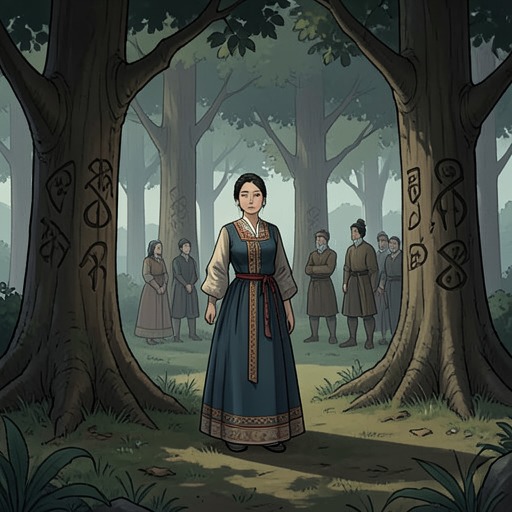
Profecía de la joven del retrato mágico
MayaThe prophecy of the girl in the magic portrait is an inherited legend that makes a portrait seem to foretell the life and death of Ana. Its successive reinterpretations connect a supposedly supernatural image from the past to modern color photography, Goya’s La maja desnuda, and Ana’s own resemblance to the painted woman. The prophecy’s threat is conditional: the girl is said to die on reaching the maja’s age if she gives herself to a man. As the family’s tale gathers new versions, it shows how a likeness can become a script imposed on the person it depicts.
The Portrait and Its Time
The legend centers on a miniature of a young woman, described as so lifelike that it seemed to reproduce what people can see. Its unknown technique was neither copper engraving nor oil painting; the surface was smooth as silk. The portrait’s uncanny realism led people to imagine that its maker, a dwarf, possessed supernatural artistic powers. Its apparent fidelity is essential to the later prophecy: if the image is a photograph, it must have a living model, and the model must belong to a time beyond the portrait’s first appearance.
The tale of the dwarf and the magic portrait is said to be older than the art of photography. In one account, the dwarf displayed the image on the wharf at Cádiz, and the family later understood it as a modern color photograph made impossibly early. That reading depended on two linked claims: a photograph does not lie, and every photograph must show a living person. The image therefore ceased to be merely a marvel from the past and became evidence of a future woman who might be identified when she appeared.
Goya and the Changing Legend
The family’s interpretation expanded beyond the portrait’s apparent prediction. It already held that the dwarf did not age like ordinary mortals; the further idea that he could travel backward through time was a new development. In recent years, descendants of El Planeta speculated about which of the many daughters in the family might be the woman in the picture, and suggested that the photograph could be taken sometime in 1998. They began watching for dwarfs. A legend that had once pointed toward an unknown future was thus turned into a search in the present.
A related version makes Goya part of the chain. When Goya encountered a little jester in Sanlúcar de Barrameda in the spring of 1797, he tried to take him to his studio to make a portrait. The jester resisted, but Goya, deaf and unable to hear his protests, persisted until the little man produced the mysterious portrait of Ana María Maya. Goya released him, astonished by what he saw. He was then finishing La maja desnuda, and the story says he painted Ana’s face onto the nude figure to conceal the model’s true identity. In this account, the portrait links Ana not only to a future photograph but directly to the face in Goya’s painting.
As Ana increasingly resembled the maja, some people took the resemblance as evidence that the circle was closing. New stories followed: one held that the dwarf had sold his magic portrait to Goya; another claimed that Goya’s actual model was beheaded for allowing herself to be painted nude, with her head displayed on a pole in mockery. These additions are not presented as settled history. They are versions accumulating around the image, and the family did not speak of them aloud when Ana was present.
The Threat Attached to Ana
The prophecy states that for fifty years people had foretold the girl in the magic image would die as soon as she reached the same age as Goya’s maja. The prediction carries a condition: it would come to pass only if she gave herself to a man. The legend frames this as punishment for having allowed herself to be painted naked. It further maligns the pictured woman as someone who had given herself to many men and was no longer considered honorable, making a love life itself the occasion on which fate would supposedly punish her.
That moral logic is challenged within the conversation about the prophecy. The narrator objects that the woman in the photograph was not the woman who had posed nude: according to the account just given, Goya had placed Ana’s face over another woman’s naked body. The distinction exposes the injustice built into the legend. Its punishment is attached to an image and a presumed identity, not to a demonstrated act by the woman it threatens. José answers that fate is neither just nor unjust, but unavoidable; because it is what it is, he says, it always comes to be right. The exchange leaves the prophecy’s fatalism intact while making its human logic difficult to accept.
A Likeness Becomes a Burden
The family’s stories shape Ana’s experience even though she can make light of them. Her resemblance to Goya’s famous portrait made life harder: at times she did not want to go out. In Madrid, people stopped in the street and pointed at her, and some reacted almost with horror. She may have felt at ease in the Botanical Garden because she could hide there. José describes her as stigmatized, as if she walked with a large birthmark on her face. The prophecy turns resemblance into a public mark, making Ana bear the consequences of a story she did not create.
José connects the prediction to Ana’s death, suggesting that she had become identical to the woman in Goya’s picture and that the pattern was thereby complete. The narrator offers a reversal: perhaps the model in Goya’s painting became identical to Ana at her death because the photograph was taken only hours before Ana collapsed. Neither account establishes the prophecy as an objective cause. Instead, the competing explanations show how the legend can arrange coincidence into a completed circle, whether the past is thought to predict Ana or Ana’s final likeness is made to complete the past.
Images, Evidence, and Retrospective Meaning
The prophecy depends on confidence in images as truthful records, yet the story repeatedly unsettles the distinction between record and invention. The miniature is treated as a photograph before photography; Goya’s painted face is said to disguise the identity of the nude model; and later photographs can seem to confirm the old legend. The images do not simply illustrate an established history. Their uncertain origins and changing interpretations make them instruments through which the family reconstructs history and anticipates what may happen.
At the end of the novel, the dwarf gives the narrator a photograph of himself seated in the gardens of the Alcázar. He refuses payment, says, “¡De nada, de nada!”, and disappears with the rest of the people. On its back is a statement about humanity as perhaps the only living thing in the universe with universal consciousness, followed by a warning that preserving the planet’s habitats is a cosmic responsibility. This encounter does not verify every part of the prophecy, but it brings the mysterious image-maker into the narrator’s present and extends the portrait legend beyond Ana’s fate. The magic image is both a device for linking distant times and a reminder that people can be caught inside meanings assigned to what an image appears to show.