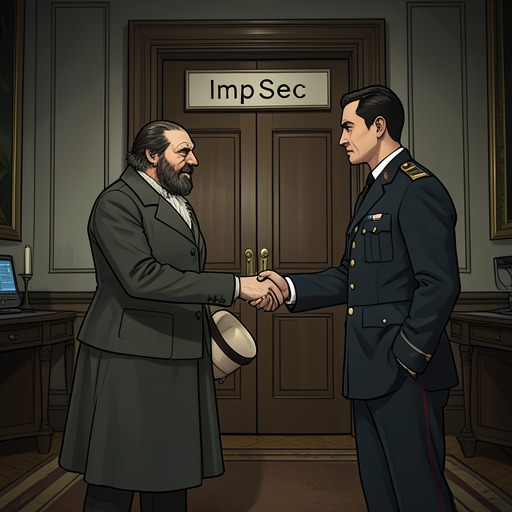
Ban on Vor Lords Owning Private Armies
MemoryThe Ban on Vor Lords Owning Private Armies is a political and legal constraint that turns Miles Vorkosigan’s possible future as a mercenary into a choice between identities. He considers abandoning his Vor name and making a living with the Dendarii Free Mercenary Fleet, but understands that a Vor lord who commands a private military force commits high treason, faces a capital crime, and cannot return to Barrayar. The rule therefore binds military ambition to dynastic duty: leaving would not simply mean changing employment, but severing his way home.
Scope and Consequences
Miles thinks through the prohibition while imagining a permanent break from Vorkosigan obligations. He could, in theory, leave ImpSec, go renegade, and earn his living with the Dendarii Free Mercenary Fleet. But the prospect is explicitly one-way. The ban makes the distinction between a state military career and a private force decisive: whatever freedom the mercenary life might offer, a Vor lord could not pursue it and still return as a member of Barrayaran society.
The rule also intersects with family responsibility. Miles cannot take that path while his father lives and hopes for him to fulfill his Barrayaran future. After his father’s death, Miles expects to inherit the title of Count Vorkosigan, a District, and an important vote in the Council of Counts, along with the duties attached to them. The prohibition thus reinforces rather than replaces the pressure of succession: the imagined escape from public obligations would carry its own final legal and political cost.
Fealty Alongside Military Service
The novel distinguishes the rules of military employment from obligations arising from Vor fealty. Elena Bothari-Jesek explains that she and Baz Jesek can resign as Dendarii officers by giving appropriate notice, but, as Miles’s liege-sworn vassals, they must also petition him for release as an Extraordinary Favor. Their request shows that leaving an organization and ending a feudal bond are separate acts. The ban on Vor lords maintaining private armies forms part of this same layered order, in which military roles do not erase obligations attached to rank and allegiance.
Miles’s own claim to see Simon Illyan further illustrates how Vor status can operate outside a military chain of command. Although Haroche has blocked him, Miles invokes not his former position in ImpSec but his standing as his father’s son and a Vor, asserting an obligation that passes around the agency hierarchy. The episode does not define the private-army ban, but it shows the wider system in which inherited ties create routes of responsibility and authority alongside formal service.
The Vor Order and Imperial Authority
Miles describes the tension between the military’s effort to promote merit over blood and the high Vor’s insistence that Vor status is real as a clash between competing fantasies. Whatever his reservations about the system, he regards it as the order both he and Haroche are sworn to uphold. In this account, the ban is not an isolated restriction: it belongs to a political structure whose inherited ranks remain consequential even when institutions try to set them aside.
The distinction between inherited status and formal office is also visible in Miles’s later appointment as an acting Imperial Auditor. Gregor gives him broad but bounded authority to investigate Illyan’s breakdown: his actions must relate to the assigned matter, he cannot order executions, and any arrests should be supported by evidence sufficient for prosecution. During the investigation, Miles orders General Allegre, the acting chief of ImpSec pending Gregor’s approval, to arrest Haroche on the capital charge of treason. That action concerns the Auditor’s investigation, not the private-army prohibition; its relevance is the contrast it makes visible between authority conferred by imperial office and obligations grounded in Vor status.
Significance
The rule gives concrete force to the conflict between Miles’s mercenary identity and his place in Barrayaran society. The Dendarii offer a possible life beyond ImpSec, but the ban means that for a Vor lord the choice cannot be treated as a temporary posting or uncomplicated career change. Fealty, inheritance, and military service impose different kinds of claims, and Miles’s imagined departure would collide with all three. The law’s decisive consequence is not merely that he must remain; it is that leaving would mean choosing a life from which return is barred.