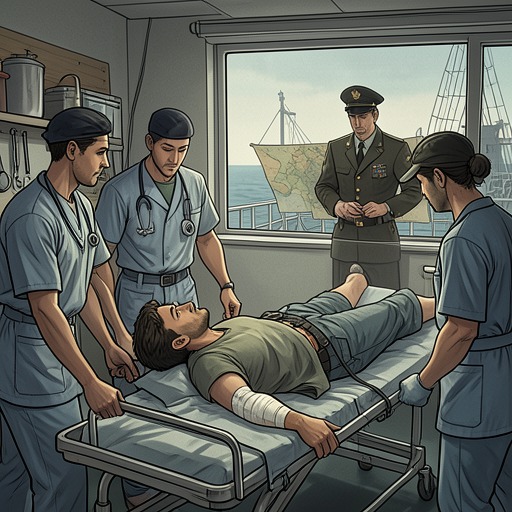
Rescue as freedom
MemoryRescue as freedom describes a distinction between getting someone out of danger and restoring the possibility of choosing what comes next. The distinction takes shape in Miles Vorkosigan’s work as Admiral Naismith and in his conversation with Sergeant Taura: rescuing others is a source of personal exhilaration, but Sergeant Taura interprets it as an expression of the freedom Miles may want for himself.
A rescue practice built around access
Miles’s work depends on moving where the Barrayaran Imperium’s regular forces cannot. Political barriers and the distances between wormhole jump routes can limit official intervention; an ostensibly independent mercenary force can appear without the same impediments. For a decade, Miles has cultivated Admiral Naismith as the leader of the Dendarii Free Mercenary Fleet, a cover identity that lets him act across those boundaries. Its motto, Daring Rescues Our Specialty, makes rescue both a practical activity and a defining public face.
The Zoave Twilight mission shows the stakes of that practice. Hijackers seize an unarmed freighter and discover that their captive is Lieutenant Vorberg, a Barrayaran courier carrying credit chits and diplomatic information. Instead of releasing him and his packets, they attempt to sell him. Simon Illyan delegates the response to Miles after condemning the hijackers’ actions. The Dendarii Free Mercenary Fleet’s official sponsor is the insurer of the freighter, but the Barrayaran Imperium also backs the operation. That backing makes the rescue a public warning to anyone who might threaten another courier, as well as an intervention for the captive. Here, freedom begins with ending someone else’s control over a person and his information.
From an assignment to a rescue
The conversation with Sergeant Taura looks back to one of Miles’s early personnel retrievals. Its origin was not benevolent: Miles says he was hired to terminate the experiment. The decisive change was what he did with that assignment. Sergeant Taura tells him that he turned it into a rescue, recognizing a pattern in the way he approaches danger. In her view, he becomes especially cheerful during rescues, even when events are perilous.
Miles remembers the retrieval as one of his first, and still one of the best, although he describes it as crookedly so. The retrospective framing matters: rescue is not presented as the mission’s original purpose, but as a redirection of what he had been asked to do. That conversion gives the idea moral force without making rescue an uncomplicated vocation. Its significance lies partly in the choice to change the outcome of an assignment, not merely in carrying out an authorized plan.
Freedom and the rescuer’s reward
Sergeant Taura gives Miles’s behavior a larger meaning. In her account, rescue is not the ultimate gift; it is the means, and freedom is what the rescued person receives. She asks whether he gives that freedom because it is something he wants for himself. The question places the rescuer’s motives beside the rescued person’s regained agency, without equating them.
Miles answers that he craves the adrenaline high. He does not accept Sergeant Taura’s suggestion that his rescuing is driven by a lack he cannot remedy. His explanation is direct: pulling a desperate person out of a deep hole gives him an emotional kick, particularly when others think the feat impossible. He also admits to enjoying the display and the audience’s appreciation. His account therefore mixes service with appetite and performance. The beneficiaries may gain freedom; the rescuer receives excitement, satisfaction, and recognition. Those rewards do not erase the rescue’s value, but they prevent the motif from reducing Miles to selfless benevolence.
Rescue, vulnerability, and limits
The conversation’s warmth is shadowed by uncertainty about who will live longer. Miles recalls that when people are rescued, they ought to remain rescued, then questions whether Sergeant Taura or Admiral Naismith will be the first to go. The prospect of medical discharge hangs over him, and he wonders whether Admiral Naismith may be the one who ends first. The exchange gives rescue a limit: saving someone from one danger cannot guarantee a life free of later threats. For Miles, whose career depends on his constructed identity as Admiral Naismith, the possible loss of that role also makes the future of rescue uncertain.
The scene unfolds over dinner in the spacious cabin, with the meal arranged on two carts and the table fixed to the deck. Miles watches Sergeant Taura eat and feels happy feeding her, directing her to the fried cheese and spicy sauce. This ordinary care follows their discussion of danger and freedom without resolving its larger uncertainties. The contrast brings the motif down from spectacular extraction to continued companionship: rescue can open a path to freedom, but it cannot substitute for living afterward, or promise how long that life will last.