Time. That’s the key. We just need time.
Mickey7The expression “Time. That’s the key. We just need time.” distills a possibility rather than a guarantee: on Long Shot, peaceful contact may have depended on the colonists having enough time to become less afraid. Its repetition makes time both the proposed explanation for a different kind of encounter and the condition the narrator believes is still needed.
Context and Claim
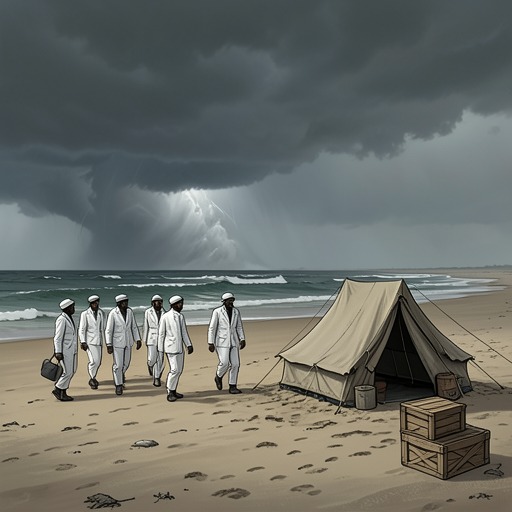
The narrator considers why the meeting between the colonists and Long Shot’s native cephalopods differed from humanity’s other encounters with native peoples. The natives lived mainly in the central highlands, while the colonists landed on the coast, hundreds of kilometers away. Shy and nearly invisible, the natives went unnoticed for the first twenty years after landfall; they had mastered their environment without developing the material technologies humans had relied on.
The histories, the narrator admits, do not explain why the encounter unfolded differently. The offered theory is narrower and more tentative: by the time the two peoples finally met, the colonists were established enough to stop living in constant fear. The expression gives this conjecture its emphasis, but not the status of settled historical fact. Time matters because it may have changed the colonists’ condition before contact, not because the passage claims that time alone resolved every difference between the peoples.
Repetition and Emphasis
The phrase arrives in three short beats: time is named, declared essential, then recast as something the colonists need. The clipped first assertion gives way to an explanatory pause, while the final sentence turns the idea into a shared requirement. Its plainness contrasts with the long history it tries to interpret: twenty years of separation, an eventual encounter, and the possibility that a settled community need not meet the unfamiliar in the same state of alarm as a frightened one.
That structure also marks the limits of the claim. The narrator calls it a theory, then insists on time rather than offering a fuller account of what the histories leave unexplained. The repetition lends conviction to the need for patience without removing the uncertainty about why this encounter proved different.
Echo of Uncertainty
Later, in a quiet exchange, the narrator says, “I think it’s both,” and adds, “I hope it’s both.” The nearby dialogue does not establish that this is a direct restatement of the earlier claim about Long Shot. It does, however, echo the expression’s combination of belief and uncertainty: hope can accompany an interpretation without turning it into certainty.
In that sense, the phrase is more than a comment on elapsed time. It identifies patience as a necessary opening for a less fearful relationship, while leaving the outcome dependent on what happens within that time. Its modest insistence—time is needed, not promised as a solution—preserves the difference between making coexistence possible and guaranteeing it.