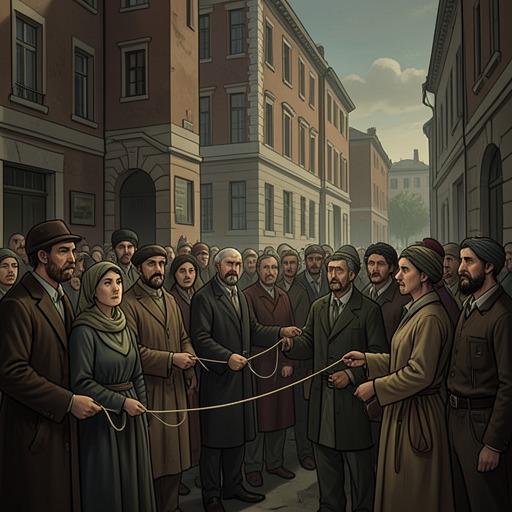
Fred Vincy's debt crisis and the Garths' sacrifice
MiddlemarchFred Vincy's debt crisis and the Garths' sacrifice marks a turn from Fred’s habitual confidence in luck toward an uncomfortable recognition of responsibility. The £160 owed to the horse-dealer Mr. Bambridge is not merely a private financial embarrassment: Fred has renewed the bill with Caleb Garth’s signature, and his inability to pay places the Garth family’s resources at risk. His confession exposes how easily his hopeful assumptions have shifted the consequences of his choices onto other people.
The debt and its assumptions
During university vacations, Fred incurred expenses for hiring horses, damaging a hunter, and covering losses at billiards. Mr. Bambridge extended credit and made a small advance; the resulting debt came to £160. Fred first signed the bill himself, then, three months later, renewed it with Caleb’s signature. On both occasions he expected to repay it, but that expectation rested less on available funds than on confidence that circumstances would somehow turn out favorably.
Fred imagined several possible rescues: a present from his uncle Peter Featherstone, a run of luck, or profit from exchanging horses. He also treated his father’s money as a last resort, assuming without much knowledge of the family’s finances that trade could make up any deficiency. The Vincy household’s easy, profuse habits had given its children little experience of economy. Fred disliked the angry scenes that followed disclosure of his extravagance, but had grown accustomed to believing that the domestic storm would pass.
That assumption became harder to sustain after Fred failed his examination. His father, Walter Vincy, had threatened that another such failure would mean Fred must leave home and earn his living; Fred had also said he did not want to continue toward the clergy. The family’s unspoken expectation that Peter Featherstone would provide for Fred had softened other people’s judgment of him, and Fred himself had treated his uncle’s support as a kind of reserve fortune. But the money Featherstone gave him could be measured against the bill, and it did not cover the whole amount.
A speculative attempt to pay
Fred had put £80 from Featherstone’s gift with his mother, keeping £20 for what he imagined might be a profitable venture. He hoped that “judgment” and luck would multiply it. The narrator distinguishes this habit from compulsive gambling: Fred enjoys play and risk, but his more pervasive tendency is to imagine that events will produce the outcome he desires, while overlooking the possible cost to others.
With payment approaching and no money beyond the £80 he had deposited, Fred resolved to sell the broken-winded horse he had received from Featherstone. At a horse fair in Houndsley, he persuaded himself that he could turn it into a better prospect. A farmer was selling a dappled gray hunter called Diamond and wanted a useful horse in exchange; Fred inferred from Mr. Bambridge’s criticism of Diamond, and from the farmer’s interest in Fred’s horse, that a profitable bargain was possible. He imagined that trading his horse and a modest additional payment would leave him with enough money to approach the bill, apart from a relatively small balance.
Fred obtained Diamond in exchange for his old horse and £30. The bargain seemed, at first, to validate the confidence with which he had read the other men’s remarks. But three days later Diamond caused trouble in the stable, nearly injured a groom, and badly lamed himself. Fred had hoped to sell the horse to Lord Medlicote’s man for £80; before that sale could be completed, the prospect disappeared. With only £50 in hand and the £160 bill due in five days, Fred could see no way to close the gap.
Confession and sacrifice
Fred expected his father to refuse help, especially if the request involved rescuing Caleb from the consequences of having guaranteed the bill. Rather than delay, he decided to tell Caleb the truth and then go to Stone Court to confess the full situation to Mary Garth, whom he loved. The narrator presents that attachment as a force strengthening Fred’s conscience: without Mary, Fred might have been less ready to face an unpleasant obligation directly.
At Caleb’s desk, Fred laid down the £50 and admitted that he could not keep his word or meet the bill. He described the failed attempt to raise the money and did not conceal the shortfall. Caleb’s wife, Susan, learned that her husband had signed for Fred’s £160 debt. Caleb explained that he would need the money in the bank, especially with Christmas approaching, and that the family was already short of funds.
Susan answered with a practical plan. She would give up the £92 she had saved for Alfred’s insurance premium, and she expected Mary to advance the £20 saved from her salary. Their decision makes the cost of Fred’s failure concrete: the family would use savings intended for other purposes to meet the obligation he could not discharge. Caleb had previously signed the bill in the belief that Fred could pay it himself; now his trust required the household to absorb the risk.
The moral turn
Fred had been chiefly troubled by the prospect of appearing dishonorable and losing the Garths’ good opinion. Susan’s response changed the scale of what he understood. As she focused on what had to be done rather than on reproach, Fred saw that his default would make two women surrender their savings. His remorse arose not simply from damage to his reputation but from recognizing the burden his conduct placed on the people who had trusted him.
Fred stammered that he would repay everything eventually. Susan rejected the comfort of that distant promise, insisting in effect that the family needed money when it was needed, not at some indefinite later time. The episode therefore brings Fred’s hopeful, speculative habits into collision with the immediate arithmetic of a £160 bill, £50 available, and savings set aside for the Garth household’s own needs. His candor is an important step toward responsibility, but it does not erase the sacrifice his failure has required of Caleb, Susan, and Mary.