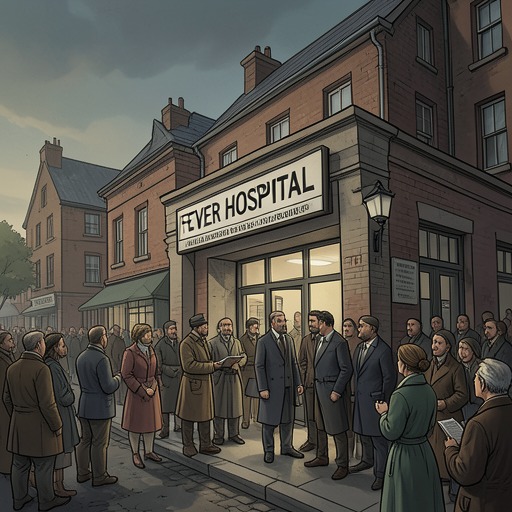
Middlemarch doctors refuse to serve at the new fever hospital
MiddlemarchThe collective refusal of Middlemarch’s doctors to serve at the new fever hospital exposes the conflict between medical reform and professional solidarity. Nicholas Bulstrode has financed a hospital intended for fever in all its forms and designed it to give Tertius Lydgate authority over treatment and investigation; the town’s practitioners, excluded from effective control, refuse to act as visitors. Their withdrawal leaves Lydgate to pursue his programme with a reduced staff, while the new institution becomes a focus for disputes about expertise, governance, professional etiquette, and who is entitled to direct medical practice.
Causes and Institutional Design
The hospital’s structure grows out of Bulstrode’s decision to finance it largely on his own. Apart from Lord Medlicote’s contribution of land and timber, the town’s other potential supporters had preferred to give to the Old Infirmary. The building consequently depended on Bulstrode’s money, and he came to regard that investment as a means of carrying out his own plans without the obstruction of what he considered prejudiced colleagues. He had spent large sums, and construction had proceeded slowly; Caleb Garth, who undertook the building, eventually withdrew from its management before the interior fittings were begun.
Bulstrode’s personal authority over the project shaped its proposed governance. The hospital was to treat fever in all its forms, with Lydgate as chief medical superintendent and free to pursue comparative investigations informed by his studies in Paris. Other medical visitors could advise, but could not overturn Lydgate’s final decisions. General management would belong to five directors associated with Bulstrode; their votes would be weighted according to their contributions, the board would fill vacancies itself, and small contributors would have no governing share. The arrangement paired clinical independence for Lydgate with concentrated financial and administrative control, rather than a broadly representative local institution.
The plan also reflected competing purposes on Bulstrode’s part. He wanted the hospital to advance what he regarded as medical improvement, but he also wanted substantial contributions toward its upkeep because he hoped to buy land near Middlemarch. Although he would have continued paying a large annual sum in order to govern the hospital without a board, he needed others to help maintain it. The resulting design was therefore not simply an expression of medical policy: it embodied a struggle over money, authority, and the conditions under which local practitioners might be invited to cooperate.
The Refusal and Lydgate’s Response
The doctors’ answer was immediate: every medical man in town refused to become a visitor at the Fever Hospital. Their action deprived Bulstrode and Lydgate of the cooperation that the plan needed from the existing profession. It was not a dispute about whether fever required attention alone; the refusal confronted a scheme in which outside practitioners had a consultative title but no power to countermand Lydgate, while the directors’ influence was secured through financial contributions.
Lydgate responded by assembling an alternative service rather than abandoning the hospital. He told Bulstrode that they had a capable house-surgeon and dispenser and proposed recruiting Webbe, a country practitioner from Crabsley, to visit twice a week. For an exceptional operation, Protheroe would come from Brassing. Lydgate accepted that he would have to work harder, and had already given up his position at the Infirmary. He nevertheless expected the plan to flourish and believed that medical reform would eventually make young practitioners glad to come and study there. His resolve made the refusal a practical obstacle, but also confirmed how much of the undertaking rested on a few people rather than the town’s medical establishment as a whole.
Bulstrode promised unfailing support while Lydgate pursued what he called high intentions. He also said that Mr. Brooke of Tipton had agreed to contribute yearly and would be useful on the board, although he had not specified the amount. The narrative pointedly suggests that a useful director might be one who originated nothing and voted with Bulstrode. This detail illuminates the asymmetry at the centre of the plan: Lydgate was granted latitude in clinical work, but the institution’s wider governance remained under Bulstrode’s direction.
Medical Reform and Professional Hostility
The doctors’ boycott belongs to a wider struggle over Lydgate’s methods. He had come to Middlemarch intent on strengthening the scientific basis of medicine, at a time when much practice still followed old paths. His interest in fever and the structure of the body made him impatient with routine, and he intended to practise without dispensing drugs or taking a percentage from druggists. To him, removing that financial temptation was part of practising honestly; to established practitioners, such innovations could appear as criticism of their own customs.
His clinical decisions could also unsettle professional etiquette and public understanding. When Fred Vincy fell ill, Lydgate recognized typhoid fever and judged that Fred had been given the wrong medicines; he insisted on bed, a regular nurse, and precautions. In another case, he corrected a diagnosis of tumor in Nancy Nash, treating what he identified as cramp and continuing to attend her at home for a fortnight until she recovered. Yet the neighborhood continued to circulate the story as a miraculous cure of a tumor, and Dr. Minchin resented Lydgate’s open contradiction of a physician’s diagnosis. The discrepancy between what Lydgate believed he had established and what public report celebrated shows how reform could gain prestige through misunderstanding even as it provoked professional resentment.
Lydgate’s use of expectant treatment with Borthrop Trumbull offered a further example of the gap between method and reception. He judged the auctioneer a robust patient and proposed observing the disease while leaving it as much as possible to itself, making Trumbull’s illness an example that might benefit medical science. Trumbull readily accepted the idea and took pride in participating in a rational procedure, sustained by the attention of the thermometer and by technical explanations. Such cases show why Lydgate regarded the hospital as a place for comparative investigation, but also why a programme built around his authority could be perceived by colleagues as an affront to their own expertise.
Consequences and Significance
The refusal did not close the hospital, but it narrowed the circle of practitioners willing to serve it and increased Lydgate’s workload. It also intensified the local professional aversion directed at him. Dr. Sprague and Dr. Minchin did not deny his knowledge or his desire to improve treatment; they described him as arrogant, insolent, pretentious, and recklessly innovative. The label of charlatan, once introduced into the conversation, became difficult to dislodge. Bulstrode’s prominent sponsorship added another complication: other doctors regarded Lydgate as willing to defer to Bulstrode, while his association with the banker made reform appear entangled with personal influence.
The episode thus places two kinds of authority in tension. Lydgate’s intended authority rests on clinical judgment and investigation, which he believes require freedom from obsolete habits and financial inducements. Bulstrode’s institutional authority rests on his financing of the building and a board structured to keep control among major contributors. The other doctors’ refusal asserts the power of professional cooperation: even without control over the board, they can withhold their participation. The hospital becomes a test of whether scientific innovation can be established by individual conviction and private patronage when the local profession distrusts both the reformer and the terms of his appointment.