Christmas
Moby-DickChristmas in Moby-Dick is both a calendar date and a threshold: on a short, cold Christmas, the Pequod leaves Nantucket, carrying its crew from the ordered world of the wharf into the frozen immensity of the ocean. The day’s Christian observances, comic labor, communal singing, and ceremonial command establish a pattern that the voyage repeatedly transforms, as religious language and ritual are redirected toward shipboard solidarity, danger, and the pursuit of the Sperm Whale.
Departure from Nantucket
Christmas is identified with the Pequod’s final departure from Nantucket. After the riggers are dismissed and the ship has been hauled from the wharf, Aunt Charity comes out in a whale-boat with a night-cap for Stubb and a spare Bible for the steward. Captain Peleg and Captain Bildad then emerge from the cabin and order Starbuck to muster all hands. The gifts, the Bible, the officers’ instructions, and the gathering of the crew place the voyage within a recognizable Christian and domestic framework, even as the ship is already becoming a self-contained maritime community.
The departure is marked by a sharp contrast between the two former captains. Captain Bildad objects to Peleg’s profanity and continues to lead the crew in psalmody, while Captain Peleg drives the men at the windlass with violent energy, using his leg to urge them forward. The anchor finally comes up, the sails are set, and the Pequod glides away. Christmas therefore begins not in quiet repose but in hurried preparation, shouted orders, religious song, and physical exertion.
Winter Threshold
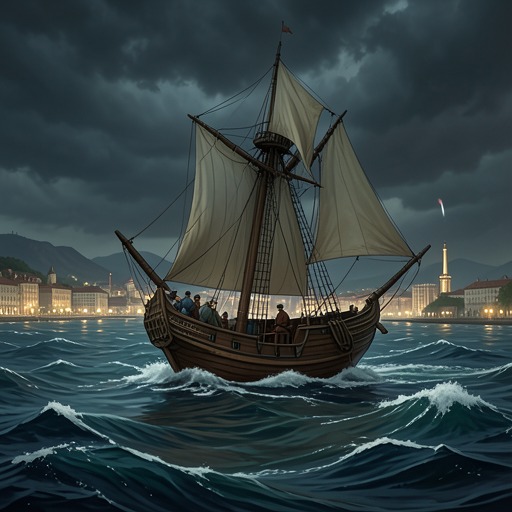
The voyage begins under punishing northern weather. As the short day becomes night, the Pequod enters the wintry ocean, where freezing spray encases the vessel in ice. Icicles hang from the bows like the white ivory tusks of a gigantic elephant, and the teeth along the bulwarks glitter in the moonlight. The Christmas setting thus functions as a literal seasonal boundary: the ship leaves land during winter and moves southward through cold toward the warmer but more dangerous waters of its appointed voyage.
The crew’s movement away from winter is also described as a movement away from the familiar. The officers continue their watches and command the ship, but the ocean quickly replaces the shore as the crew’s entire environment. Christmas gives the departure a conventional date; the surrounding cold turns that date into an initiation into isolation, exposure, and maritime uncertainty.
Sacred Practice at Sea
The book’s religious atmosphere around Christmas is not confined to formal Christianity. At the Whaleman’s Chapel, Father Mapple kneels in the pulpit and prays with such intensity that he seems to be praying at the bottom of the sea. He reads from Jonah, presenting the prophet’s story as a lesson in disobedience, fear, punishment, repentance, prayer, deliverance, and joy. The sermon’s central demand is that obedience to God requires disobedience to the self, a principle that casts the later conduct of the Pequod’s commander into ominous relief.
Ishmael’s friendship with Queequeg further complicates the meaning of Christmas religion. Queequeg divides his silver equally with Ishmael, performs his evening prayers before Yojo, and invites Ishmael into his worship. Ishmael resolves that worship consists in doing the will of God, and that the will of God is to treat a fellow human being as one wishes to be treated. He consequently joins Queequeg’s ritual, offering burnt biscuit and saluting the idol, while both men retire peacefully. The scene places fellowship above rigid denominational boundaries and makes shared ritual a means of forming intimate human community.
From Christian Date to Shipboard Ritual
Once the voyage is under way, ritual becomes a practical instrument for organizing the crew and concentrating collective emotion. Captain Ahab later assembles the men around the capstan, has the harpooneers bring forward their weapons, and invokes an ancestral custom of fishermen. He orders the crew to drink from a charged pewter flagon, makes the three mates cross their lances, and appoints them cupbearers to the harpooneers. The ceremony borrows the language of hierarchy, religion, and kinship while binding the ship’s heterogeneous company to Ahab’s purpose.
This later ritual does not simply continue Christmas Christianity; it exposes how readily sacred forms can be repurposed. Ahab’s ceremony turns weapons and drinking into instruments of allegiance, and the command structure of the Pequod becomes charged with a quasi-religious intensity. The Christian calendar supplies an initial frame for the voyage, but the ship’s own rituals increasingly authorize pursuit, violence, and devotion to a private objective.
Christmas in the Global Voyage
The date also stands at the beginning of a voyage presented as global in scale. The narrator defends whaling as a profession that explores unknown seas, opens harbors, connects distant peoples, and carries missionaries and commerce toward remote regions. He credits whale-ships with helping open routes around the world and links the fishery to the liberation of Peru, Chili, and Bolivia, the establishment of Australia, the development of Polynesian commerce, and the anticipated opening of Japan.
Ahab’s planned route makes this planetary reach concrete. The Pequod is to pass through the Sunda Strait into the Javan sea, cruise northward through waters frequented by the Sperm Whale, pass the Philippine Islands, reach Japan, and eventually descend upon the Line in the Pacific, where Ahab expects to meet Moby Dick. Christmas therefore initiates not merely a seasonal crossing but a circuit through maritime trade routes, colonial histories, whaling grounds, and competing religious and imperial visions.
Narrative Significance
Christmas holds together departure, danger, fellowship, and foreboding. It begins with gifts and a Bible, proceeds through psalmody and communal labor, and ends with the ship sheathed in ice beneath the winter moon. Its Christian associations recall Jonah’s warning about disobedience, while the Pequod’s later rituals show how spiritual forms may be redirected toward collective violence. The date is thus less a pause from the voyage than its first symbolic declaration: the ship leaves shore under the sign of religion, but enters a world in which faith, command, superstition, bodily peril, and the pursuit of the White Whale cannot be kept separate.