Season-on-the-Line
Moby-DickSeason-on-the-Line is the technical name for the particular time and place in the equatorial Pacific on which Captain Ahab concentrates his pursuit of Moby Dick. For several consecutive years, the White Whale has been periodically seen lingering there for a while, as the sun appears to loiter within a predicted sign of the Zodiac. The season is therefore both a recurring whaling opportunity and the decisive horizon of Ahab’s monomaniacal hunt.
Definition and Setting
Season-on-the-Line joins a set time to a set region rather than naming a simple calendar date. Moby Dick has appeared at various feeding grounds, including the Seychelle ground in the Indian Ocean and Volcano Bay on the Japanese Coast, but those places are treated as casual stopping-places rather than prolonged abodes. The equatorial Pacific is different: repeated sightings there create the strongest available pattern in the evidence, and the waves are said to be storied with the White Whale’s deeds.
The region also contains the tragic site where Ahab found the motive for his vengeance. Season-on-the-Line thus carries two kinds of significance at once. It is a practical coordinate derived from repeated observation, and it is the symbolic center of the injury that has organized Ahab’s life. The season converts memory into itinerary and turns the ocean into a field apparently capable of confirming his obsession.
Ahab’s Calculations
Ahab does not simply wait for the season. When the Pequod sails from Nantucket at the very beginning of Season-on-the-Line, the ship cannot possibly make the southward passage, double Cape Horn, and reach the equatorial Pacific in time to cruise there. Ahab must therefore wait for the next season, an interval of three hundred and sixty-five days and nights. His early departure is presented as deliberate: instead of enduring that year ashore, he will spend it in a miscellaneous hunt for the White Whale.
During the intervening voyage, Ahab plans to use every possible opportunity. If Moby Dick happens to leave his periodical grounds, the Pequod may encounter him off the Persian Gulf, in the Bay of Bengal, in the China Seas, or elsewhere in waters frequented by his kind. Winds such as the Monsoons, Pampas, Nor’-Westers, Harmattans, and Trades may carry the whale into the zigzag circle of the Pequod’s wake. The planned route consequently makes the ship’s circumnavigation serve a single purpose: every intermediate sea is treated as an extension of the search, while Season-on-the-Line remains the anticipated culmination.
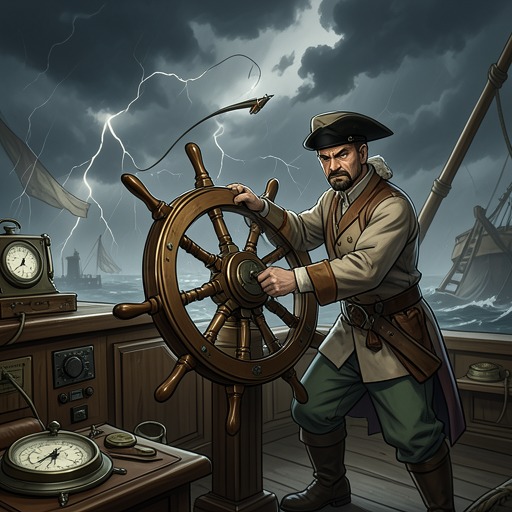
Ahab’s method is methodical without ceasing to be delirious. He studies charts long after midnight and believes that knowledge of the whale’s feeding grounds can turn possibility into probability and probability into near-certainty. Yet the narrative stresses that whales found in a particular latitude or longitude one year cannot generally be assumed to be the same herd the next year; even solitary mature whales do not necessarily return to the same places. The season is therefore founded on a real recurrence, but Ahab magnifies that recurrence into a guarantee his evidence cannot provide.
Relation to Moby Dick’s Pursuit
Season-on-the-Line is where Ahab expects the decisive encounter because many of the White Whale’s most deadly meetings have taken place there. The period gives his vengeance a schedule, but it does not make the whale controllable. The ocean remains too broad for a solitary animal to be found by ordinary certainty, and even individual recognition might seem impossible amid boundless water. Moby Dick’s snow-white brow and hump, however, make him unmistakable to Ahab, while his scarred and scalloped fins become additional marks by which the captain believes he has permanently identified his prey.
The season therefore binds empirical whaling knowledge to personal fixation. Ahab’s confidence arises from sightings, migration patterns, feeding grounds, and accumulated encounters, but these materials are absorbed into the logic of his vow. He refuses to let the season’s promise quiet his restless heart or postpone any intervening search. The anticipated period is not a limit upon his pursuit; it is the distant point around which every earlier action is arranged.
Narrative and Thematic Significance
The concept shows how the Pequod’s voyage is organized by both global movement and obsessive repetition. The ship ranges across the known Sperm Whale cruising grounds, passing through the Sunda Strait into the Javan sea, then northward toward the Philippine Islands and the Japanese coast, before descending toward the Line in the Pacific. Captain Ahab intends this sweeping route to cover nearly all major whaling waters before arriving at the place and time where Moby Dick is most reasonably expected.
In this structure, Season-on-the-Line is a convergence point between maritime knowledge and the limits of knowledge. Whaling depends on recurring seasons, mapped grounds, winds, and accumulated testimony, and the broader history of whaling presents the whale-ship as a force that explored remote seas, opened routes, and connected Europe, America, the Pacific, Australia, Japan, and Spanish colonies. Yet the same oceanic world that supports navigation and commerce defeats Ahab’s desire for perfect prediction. His season is real, his route is calculated, and his evidence is substantial; still, the White Whale can appear elsewhere, and recurrence cannot become destiny merely because Ahab wills it to do so.
The term also sharpens the tragedy of the Pequod’s voyage. Ahab turns a recurring ecological and navigational pattern into the appointed theater of a private war, drawing the crew through a global network of whaling grounds toward one anticipated confrontation. Season-on-the-Line promises order, but its promise is unstable: it gives the hunt a shape without granting its commander mastery over the living creature or the sea that carries both hunter and prey.