Fourth of July
Moby-DickFourth of July functions in Moby-Dick as a recurring image of public exhilaration: a day associated with noise, holiday freedom, collective festivity, and a distinctly American brightness. The reference is not developed as a narrated calendar event, but as a measure of energy against which the sea’s creatures and the Pequod’s sailors can be perceived. It therefore joins national celebration to the novel’s broader interest in democracy, race, labor, and the unstable boundary between joy and danger.
Holiday Image in the Sea
In the classification of the Huzza Porpoise, Ishmael compares the animals’ lively shoals to caps tossed heavenward in a Fourth-of-July crowd. The porpoises swim in cheerful masses, repeatedly throwing themselves upward from the windward waves, and their appearance is said to delight mariners. The holiday reference gives their movement a social rather than merely zoological character: the shoal resembles a crowd united by exuberance, while each porpoise contributes to a spectacle of shared motion. Their liveliness also carries practical value, since a well-fed animal yields oil, its jaw fluid is prized by jewellers and watchmakers, sailors use it on their hones, and its meat is edible.
The same passage complicates the festive image with close observation. The Huzza Porpoise is a small spouting creature whose blow is difficult to see, yet Ishmael presents it as a miniature version of the Sperm Whale. Fourth of July thus marks not only apparent merriment but also a form of animated natural life that demands attention beneath its surface display. The porpoise’s cheerfulness is compatible with its place within human extraction and classification, reminding the reader that celebration and utility coexist in the whaling world.
Pip and the Loss of Brightness
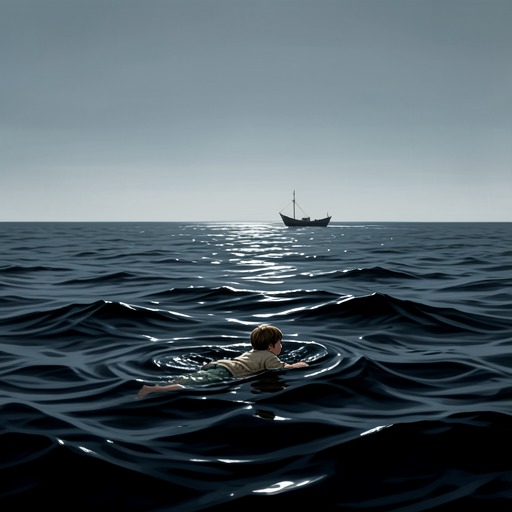
Fourth of July is also bound to Pip’s character. Ishmael describes Pip as naturally bright, genial, and jolly, declaring that the calendar of Black life should contain nothing but three hundred and sixty-five Fourth of Julys and New Year’s Days. The formulation presents the holiday as an intensified image of communal pleasure, while also revealing the narrator’s tendency to express racial difference through broad, romanticized generalization. Within that framing, Pip embodies a spontaneous capacity for festivity and peaceable enjoyment.
That brightness is damaged by the terrifying work into which Pip has become entrapped aboard the Pequod. Ishmael compares Pip’s altered condition to a diamond whose brilliance becomes most lurid when set against darkness and artificial fire. The holiday image therefore acquires a tragic counterpoint: the boy who once suggested perpetual celebration is exposed to a world of panic, danger, and psychological disfigurement. Fourth of July does not simply signify happiness; in Pip’s case, it measures the distance between a former liveliness and the strange, infernal illumination produced by suffering.
Festivity Against Violence
The holiday’s connotations also sharpen the contrast between communal joy and the violence of whaling. The Pequod’s labor includes the butchering of the Sperm Whale, the gathering of sharks around its carcass, and the dangerous stripping of blubber. During this work, a boarding-sword cuts into the suspended blubber, a blanket-piece swings clear, and men must avoid being struck or thrown overboard while the ship, windlass, tackles, whale, and crew move in coordinated strain. Against such scenes, the Fourth of July image of upward-thrown caps suggests a radically different collective motion: celebratory energy rather than industrial violence.
The contrast is not absolute. The shark massacre shows the sea as a realm of universal predation, while the porpoise passage presents even a joyous creature as a source of oil, valuable fluid, and food. The holiday ideal can therefore be read as a bright human vocabulary imposed upon a world governed by appetite, danger, and capture. Its force comes from that tension: the image of democratic festivity remains visible, but never outside the material conditions that sustain the ship’s life.
American and Oceanic Associations
The Fourth of July reference participates in the book’s larger account of whaling as an American and global enterprise. Ishmael argues that whaling is not a disreputable occupation but a powerful business whose vessels explore unknown waters, open routes into remote harbors, connect peoples, and contribute to the expansion of American and European influence. He attributes to whalemen a role in the history of the Pacific, Australia, Polynesia, and the Spanish colonies of South America, presenting the whale-ship as both commercial instrument and pioneer of global contact.
Within that argument, the holiday’s national associations are double-edged. Fourth of July suggests democratic dignity and American self-celebration, yet the history attached to the whale-ship also includes colonial penetration, resource extraction, and unequal encounters with other peoples and species. The phrase can thus illuminate the novel’s patriotic rhetoric without reducing it to uncomplicated praise. It evokes a national ideal of collective liberty while the surrounding narrative records the labor, violence, and imperial reach through which that ideal travels.
Narrative Significance
As a recurring comparison rather than a discrete episode, Fourth of July links the smallest marine animals, the vulnerable Pip, and Ishmael’s reflections on American whaling. It gives form to a particular kind of brightness: noisy, collective, upward-moving, and pleasurable. Yet the image becomes most significant when placed beside its inversions—Pip’s panic, the slaughter of the Sperm Whale, the feeding sharks, and the immense caravans of whales driven into new patterns by relentless hunting.
The holiday therefore serves as a compact emblem of joy under pressure. In the porpoise shoal it appears as living exuberance; in Pip it becomes a lost or darkened inheritance; in the account of whaling it gestures toward American democratic and commercial power. Its recurrence helps Moby-Dick hold together celebration and catastrophe, national promise and imperial violence, the spectacle of communal life and the predatory systems beneath it.