Fast-fish and loose-fish
Moby-DickFast-fish and loose-fish is the paired customary law governing disputed possession in the whale fishery. Its apparently narrow purpose is to settle conflicts when one ship strikes a whale and another later kills or secures it, but its larger significance is philosophical and political: the rule exposes how claims to property, territory, labor, liberty, and even thought can be made to rest on possession rather than justice.
Origin and Practical Purpose
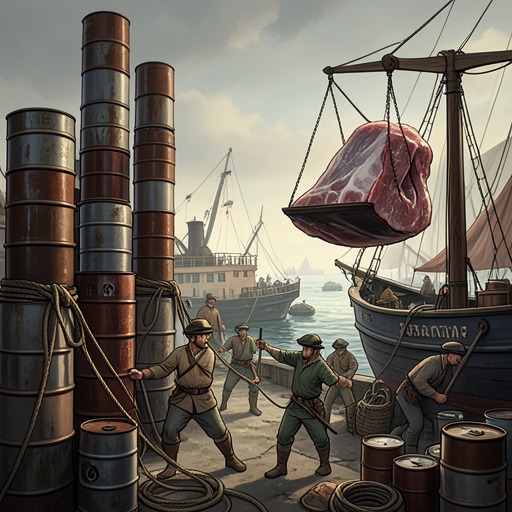
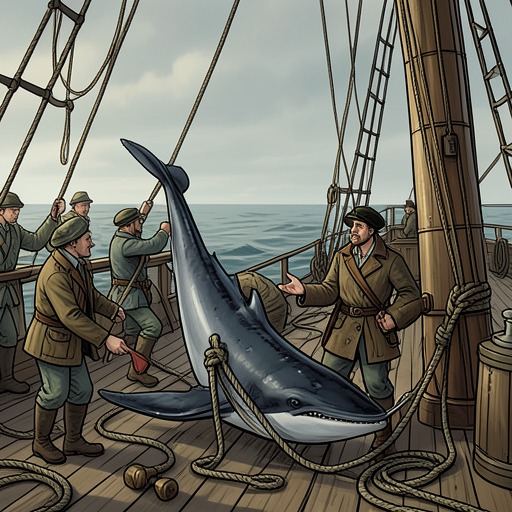
The rule is introduced after the discussion of the waif and waif-poles, which function as visible signs of a whaleman's claim. When several ships cruise together, one vessel may strike a whale only for the animal to escape and be captured by another. A storm may also tear a whale's body from the first ship, allowing a second whaler to tow it alongside in calmer conditions without risking the original chase, lines, or crew. Such cases could produce violent disputes unless the fishery recognized a common standard.
The text distinguishes this American customary system from the more formal legal arrangements of nations. Holland had enacted a whaling code through the States-General in 1695, but American fishermen acted as their own legislators and lawyers. Their rules are presented as extraordinarily compressed, capable of being engraved on a small coin or even on the barb of a harpoon. Their brevity gives them practical force while also requiring extensive interpretation, because almost every real capture raises questions about what counts as attachment, abandonment, control, or possession.
The Two Rules and Their Definitions
The first principle is stated directly: “A Fast-Fish belongs to the party fast to it.” A whale is technically fast when it is connected to an occupied ship or boat by any medium that the occupants can control. The connection may be a mast, an oar, a cable, a telegraph wire, or even a strand of cobweb; the physical form matters less than the continuing relation of control. A fish is also fast when it bears a waif or another recognized sign of possession, provided that the party displaying it demonstrates both the intention and the ability to bring the whale alongside.
The second principle is equally concise: “A Loose-Fish is fair game for anybody who can soonest catch it.” The rule therefore makes possession conditional rather than permanent. A prior pursuit does not by itself secure ownership if the pursuing party has lost the practical connection that marks possession. The difference between fast and loose is not simply a distinction between two kinds of whale; it is a legal status produced by an ongoing relation among animal, line, boat, crew, and capacity to recover the catch.
The paired rules are simple enough to sound absolute, but their application is complicated by necessity, danger, and competing claims. The whalemen's own commentaries can take the form of argument, violence, or both. More honorable fishermen allow exceptions where strict possession would produce an obvious moral injustice, while less scrupulous crews use the short code as a weapon for appropriation.
The English Whale-Trover Case
The law's harshness is illustrated by an English case from roughly fifty years earlier. A crew in the Northern seas had pursued and harpooned a whale, but the danger became so extreme that the men abandoned both their lines and their boat in order to save their lives. Another ship then reached the whale, struck and killed it, and took possession while the original crew watched. Its captain not only retained the whale but claimed the abandoned line, harpoons, and boat still attached to it.
The dispute reached court, with Mr. Erskine defending the second crew before Lord Ellenborough. Erskine offered a deliberately comic analogy: a woman once harpooned and held by one man, then abandoned after resisting him, could become a loose-fish available to a later man who re-harpooned her. The analogy makes the underlying principle unmistakable, even as it reveals the disturbing tendency of possessive law to treat persons through the language of capture and property.
The judgment separated the boat from the whale and fishing gear. The boat was awarded to the original plaintiffs because they had abandoned it only to preserve their lives. The whale, harpoons, and line, however, were awarded to the defendants. The whale had been loose when the final capture occurred, and the fish was held to have acquired a kind of property in the harpoons and line when it carried them away; whoever later captured the fish therefore acquired those objects as well. The decision demonstrates that the code can recognize the moral significance of survival in one part of a case while allowing possession to override prior labor and danger in another.
From Whaling Law to Human Jurisprudence
The discussion then enlarges the rules into a theory of law. Fast-fish and loose-fish are presented as the two fundamental supports of the legal temple, beneath the elaborate architecture of statutes and judicial reasoning. The familiar maxim that possession is half of the law is pushed further: in many social arrangements, possession becomes the whole of the law.
Under this interpretation, the fast-fish is not merely a whale attached to a line. It includes the labor and lives of Russian serfs and Republican slaves, the widow's last coin absorbed by a powerful landlord, the mansion whose door-plate marks an established claim, and the ruinous terms imposed by a lender on a bankrupt family. The incomes of ecclesiastical authorities extracted from impoverished workers, hereditary towns and hamlets, Ireland claimed by Britain, and Texas claimed by the United States are likewise redescribed as possessions secured by power. The analogy reveals how legal language can make domination appear natural by translating force, inheritance, debt, conquest, or institutional authority into ownership.
Loose-fish extends the argument even farther because it applies internationally and universally. America in 1492 is described as a loose-fish seized for Spain by Columbus; Poland becomes a possession of the Czar, Greece of the Turk, and India of England. Mexico is imagined as a future possession of the United States. The same category is then applied to the Rights of Man, the liberties of the world, human minds and opinions, religious belief, the thoughts of thinkers, and the globe itself. What has not been securely held can be claimed by whoever marks, occupies, or controls it first.
The final turn makes the reader part of the system: every person is both a loose-fish and a fast-fish. A person may be available to forces that seek to claim or define him, yet may also be attached to institutions, possessions, beliefs, or identities that present themselves as securely owned. The rule thus becomes a metaphor for the instability of human autonomy as well as for the aggressive logic of property.
Relation to Royal Fish and Imperial Possession
The paired law is complicated by the separate English doctrine of Royal fish. An older legal formula assigns the whale's head to the King and its tail to the Queen, dividing the animal without any intermediate remainder. The rule is treated as an anomaly beside fast-fish and loose-fish because royal entitlement overrides the ordinary question of who captured or retained the whale.
A recent case involving a whale seized and sold shows how that privilege operates. The Duke of Wellington received the proceeds under a right delegated by the Sovereign, and when a clergyman appealed on behalf of the unfortunate mariners, the Duke replied that he had already considered the matter and had received the money. The episode places ordinary whalemen's possession beneath a hierarchy of delegated royal ownership. The stated legal justification is the whale's “superior excellence,” an argument that exposes how prestige can be converted into a claim of property.
The contrast clarifies the rule's political reach. Among whalemen, a line, waif, boat, or successful capture can establish possession; under royal law, sovereignty itself can intervene and redirect the value of the catch. Fast-fish and loose-fish therefore describes not a neutral universal order but a contested field in which labor, risk, custom, state power, and imperial authority compete to define who has the right to own.
Significance
Fast-fish and loose-fish turns a technical dispute over whales into one of the book's most concentrated examinations of ownership. It begins with the practical hazards of the fishery, where a storm, a broken line, or the necessity of abandoning a boat can change the legal status of a living creature. It ends by applying the same vocabulary to slavery, landlordism, national conquest, political liberty, religious belief, intellectual independence, and the reader's own condition.
The rule's force lies in its double character. It is precise enough to regulate dangerous work at sea, yet elastic enough to expose the general principle by which societies convert possession into legitimacy. Its compressed formulas promise clarity, while the cases and analogies reveal how much violence and interpretation stand behind them. In that tension, the whale fishery becomes a model of human jurisprudence: elaborate institutions may rest on only a few elementary assumptions, and those assumptions may protect necessary order while simultaneously rationalizing appropriation.