Royal fish
Moby-DickRoyal fish is a prerogative rule of English law governing the ownership of certain exceptionally valued creatures, chiefly the whale and the sturgeon. Its most striking operation is to detach the whale from the ordinary logic of capture: although mariners pursue, kill, beach, and process the animal, the Crown may claim it by virtue of legal status. The rule therefore stands as a pointed counterpart to the whaling laws of Fast-Fish and Loose-Fish, revealing how supposedly universal principles of possession can be suspended when royal authority enters the case.
Definition and Legal Exception
The rule is introduced through an old legal formulation stating that, among whales captured on the English coast, the King is to receive the head and the Queen the tail. The division is presented as absolute, like cutting an apple in half, with no intermediate remainder. In this arrangement, the whale becomes a privileged object of property rather than an ordinary fish governed solely by the actions of the men who struck or secured it.
This privilege is treated as a continuing rule, not merely an obsolete curiosity. It survives in modified form in England and is discussed separately because it creates an anomaly within the general law of Fast-Fish and Loose-Fish. Under the ordinary whaling code, a Fast-Fish belongs to the party connected to it by a controllable line, boat, mast, cable, wire, or recognized waif; a Loose-Fish is available to whoever can first catch it. Royal fish interrupts both principles by allowing a superior political claimant to override the practical labor of capture.
The rule also belongs to a broader legal history of regulated possession. The whalers’ code is described as a compact system in which possession can decide ownership, even when the circumstances involve abandonment, salvage, or competing claims. Royal fish reveals that possession is not always the whole of the law: the Crown can transform a privately captured whale into delegated royal property through a jurisdictional claim.
The Cinque Ports Whale
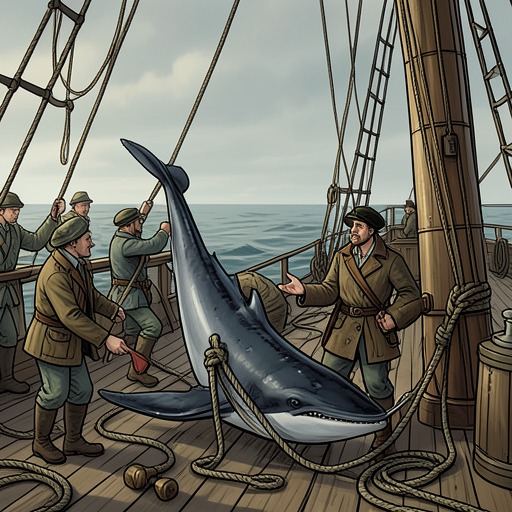
The rule’s practical force appears in the case of mariners from the Cinque Ports. After a difficult chase, they killed and hauled a whale ashore, expecting that its oil and bone would yield approximately £150. Their imagined reward included ordinary domestic pleasures financed by their shares: tea with their wives and ale with their companions. The whale represents not an abstraction but the accumulated value of their labor, danger, expense, and anticipated livelihood.
Their expectation is abruptly overturned when an educated official arrives carrying a copy of Blackstone. Placing the book on the whale’s head, he orders the mariners to keep their hands off the animal and declares that it is a Fast-Fish belonging to the Lord Warden. The gesture is deliberately theatrical: a legal volume is laid upon the body of the whale as if textual authority could physically displace the men who captured it.
When the mariners ask who the Lord Warden is, the answer is the Duke. They object that the Duke had nothing to do with taking the fish and protest that their trouble, peril, expense, and blisters will bring them no return. The answer remains that the whale is his. Their repeated challenge meets the same institutional formula, showing how the rule refuses to recognize effort as a sufficient ground of ownership once royal delegation has been invoked.
The whale is ultimately seized and sold, and the Duke of Wellington receives the money. A clergyman, concerned by the hardship imposed on the mariners, writes to the Duke and asks him to consider their case. The Duke replies that he has already considered it, has received the money, and asks that the clergyman refrain from interfering in other people’s business. The episode thus carries the legal principle beyond the courtroom: royal entitlement becomes an economic extraction from working sailors, while the language of jurisdiction protects the beneficiary from the moral consequences of the seizure.
Head, Tail, and the Logic of Royal Value
The allocation of the head to the King and the tail to the Queen is supported by competing legal explanations. One account holds that the whale belongs to the King and Queen because of its superior excellence. The animal’s exceptional size, rarity, and value are treated as the reason for its elevation into royal property. Excellence, however, is a principle of status rather than a measure of who performed the dangerous work, and it therefore rationalizes hierarchy without compensating the captors.
Another explanation claims that the Queen receives the tail so that her wardrobe may be supplied with whalebone. The reasoning is historically tied to the use of the black, flexible bone of the Greenland or Right whale in women’s bodices. Yet the account contains a pointed factual error: the whalebone is not in the tail but in the head. The mismatch makes the legal explanation appear both confident and unstable, exposing how inherited authority can preserve an arrangement even when its stated practical rationale is defective.
The division may also contain an allegorical suggestion. The Queen’s portion is literally a tail, and the text asks whether she is a mermaid, leaving the symbolism unresolved. The uncertainty matters because the law presents itself as rationally complete while inviting imaginative interpretations that its own categories cannot settle. Its apparent precision conceals a residue of ceremony, gendered symbolism, and inherited royal fantasy.
The whale is not alone in this category. English legal writers identify two royal fish: the whale and the sturgeon. Both are royal property under specified limitations and nominally contribute the tenth branch of the Crown’s ordinary revenue. By extending the same logic to the sturgeon, the rule turns biological distinction into a fiscal and political classification, treating certain animals as sources of sovereign income because of their perceived exceptional character.
Relation to Fast-Fish and Loose-Fish
Royal fish is best understood through its contrast with the whaling code’s two governing principles. A Fast-Fish belongs to the party fast to it; a Loose-Fish is fair game for whoever can catch it first. The distinction addresses the practical uncertainties of whale hunting, where a whale may escape one ship, drift free after a storm, or be captured by another crew. It attempts to prevent violent disputes by recognizing lines, waifs, and active control as signs of possession.
A notorious English whale-trover case tests those principles under extreme conditions. One crew chased and harpooned a whale but, facing danger to their lives, abandoned both their lines and their boat. Another crew later struck, killed, and appropriated the whale, along with the attached harpoons and line. The court awarded the boat to the first crew because it had been abandoned only to save life, but awarded the whale, harpoons, and line to the second crew because the whale had become a Loose-Fish when finally captured and had acquired the attached equipment as property of its own.
That decision shows how the ordinary code can distribute ownership according to changing physical relations between whale, line, boat, and crew. Royal fish introduces a different kind of claimant: not another pursuing vessel and not the person with the strongest immediate connection to the animal, but the Crown or an agent acting through royal jurisdiction. The contrast makes the hierarchy visible. Whalers may legislate for themselves in the absence of a comprehensive national code, yet their customary law remains subordinate to older political claims.
The broader implications are deliberately expansive. Fast-Fish and Loose-Fish become figures for systems in which possession may become the whole of the law, including forms of social domination, economic exploitation, imperial rule, and control over thought or territory. Royal fish sharpens that critique by showing a case in which possession by laboring men is formally displaced by a prior entitlement claimed from above. The whale is therefore both an animal and a test of how law converts power into ownership.
Significance in the Whaling World
The rule’s importance extends beyond a technical dispute over a carcass. Whaling is portrayed as a global industry whose lamps and candles consume the products of whale hunting, whose ships explore remote seas, and whose commerce helps connect Europe, America, the Pacific coast, Australia, Polynesia, and Japan. Against that expansive economic and exploratory background, Royal fish asks who receives the value produced by maritime labor and who has the authority to define the answer.
The case also complicates the industry’s claims to dignity. Whaling is defended as a dangerous and historically powerful vocation, supported by vast fleets, thousands of men, major investment, and international consequences. Yet the royal seizure of the Cinque Ports whale reveals a contradiction within that dignity: sailors may be celebrated as pioneers and risk-takers while their material reward is confiscated by an institution that contributed nothing to the capture. The legal rule thus places heroic labor beside institutional appropriation.
Finally, Royal fish exposes the instability of every apparently natural boundary between animal, commodity, and political emblem. The whale’s body is divided into royal portions; its oil and bone become revenue; its legal status overrides the mariners’ claim; and its physical excellence is invoked to justify the arrangement. What appears to be an ancient technical rule becomes a concentrated image of sovereignty: the power to declare that a creature, once taken from the sea, belongs not to those who faced the sea but to an authority whose claim precedes and defeats their possession.