Child Depots
MomoThe Child Depots turn adult claims of care, safety, and preparation for the future into a system for controlling children’s time and separating them from one another. Promoted by the Men in Gray and enforced across the city, the depots replace the children’s freely invented games with supervised, supposedly useful activities. Their most consequential effect is not simply confinement: the children gradually lose the capacity to play, take pleasure in small things, and dream.
Background and Rationale
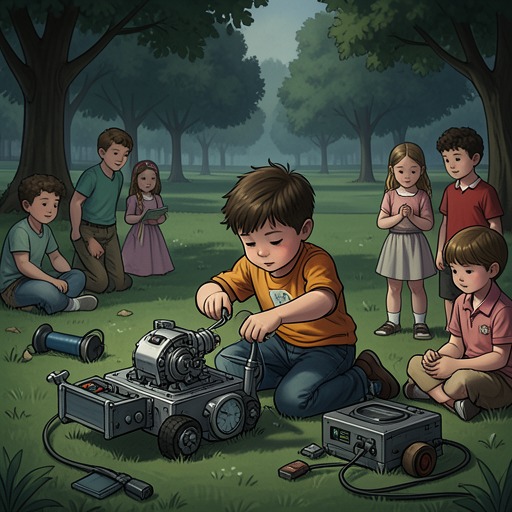
Before the depots appeared, children could make a game out of almost anything. At the Amphitheater, Momo’s presence helped ideas come readily; the children devised new games every day, often without needing her to supply suggestions. A proposed voyage could become a perilous expedition aboard the Argo, sailing toward the South Coral Sea and facing the legendary Travelling Tornado. The game depended on what the children imagined together, not on a finished apparatus dictating what they should see.
That distinction became more visible as expensive, highly detailed toys began arriving among the children: remote-controlled tanks that only trundled, rockets that circled on strings, and robots that waddled with flashing eyes. Their completeness left little for imagination to do. Children might watch, bored, and eventually return to simpler materials—a couple of cardboard boxes, a torn tablecloth, a molehill, or a handful of pebbles—to make a world of their own. The depot system would impose a more comprehensive version of the same narrowing: not merely a toy with a limited script, but an institution that prescribed how children spent their time.
The Men in Gray could not detach the children from Momo through direct control, so they used adults as intermediaries. Parents and other adults framed the problem as neglect: children were left alone because parents had no time, and authorities, they argued, should take responsibility. Other complaints presented children as nuisances who obstructed traffic and contributed to costly road accidents. Still others warned that unsupervised children would become unruly or criminal. The most ambitious justification recast childhood as preparation for a computer- and nuclear-powered future, in which children should be trained as experts and technicians rather than allowed to spend years in childish play.
Creation and Rules
The timesavers supported this program, and their growing influence helped persuade the authorities to act. Large buildings called child depots soon appeared in every neighbourhood. Children whose parents were too busy to look after them had to be deposited there and could be collected when convenient. The arrangement was presented as practical care, but it also transferred control of children’s everyday lives to institutions.
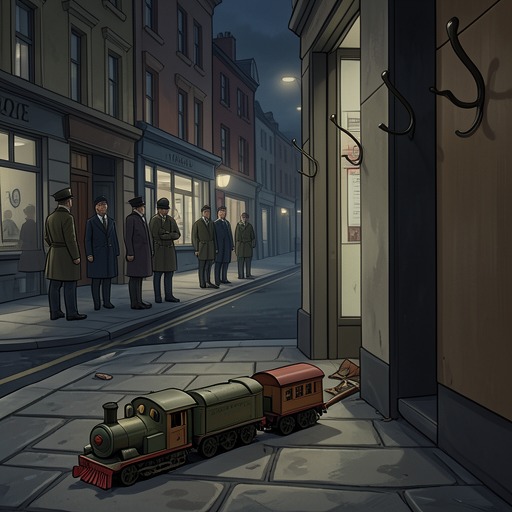
The rules extended beyond the buildings themselves. Children were forbidden to play in streets, parks, or anywhere else; a child caught playing outside could be taken immediately to the nearest depot, while the parents faced a heavy fine. This made the depots more than destinations for children lacking supervision. The prohibition on public play closed off the informal spaces where children had previously gathered and invented activities on their own.
Once inside, children were separated according to the districts they came from, including Momo’s friends, who were sent to different depots. Supervisors selected their games, and every game had to serve a useful, educational purpose. The children learned the prescribed activities, but this instruction came with a loss: they forgot how to be happy, how to enjoy little things, and how to dream. The institution’s stated aim of moulding efficient future citizens thus worked against the imaginative capacities that had made the children’s own play meaningful.
Life Inside and Its Effects
The change accumulated over weeks. The children began to resemble timesavers in miniature: sullen, bored, and resentful, they did as they were told. Even when left to themselves, they no longer knew what to do. Their remaining noise was angry and ill-tempered, not the lively hullabaloo of their former games. The depots therefore achieved a kind of compliance while diminishing the very initiative that self-directed play had exercised.
The system also broke up the social world around the Amphitheater. None of Momo’s friends escaped the regulations; district assignment scattered them among different institutions, and the Amphitheater became silent and deserted. The Men in Gray did not need to approach the children directly. A citywide mesh of rules and routines had made resistance difficult even for the brightest and most ingenious among them.
Momo’s Encounter with Former Playmates
When Momo later encountered Paolo, Franco, and Maria in the city, their changed appearance made the policy’s effects personal and immediate. She could hardly recognize them: they wore gray uniforms and had stiff, lifeless expressions, barely smiling when she greeted them. Her invitation to return to the Amphitheater and play met with a refusal. The children explained that they were going to their play class, where they were taught how to play.
One assigned activity, data retrieval, required the children to pretend to be punch cards carrying bits of information about themselves. Paolo explained its purpose in terms of usefulness for the future. The contrast with the Argo expedition is sharp: instead of collectively imagining a ship and its dangers, the children enacted a prescribed exercise that turned them into representations of stored information. Momo’s question about what the activity was for could not restore the former freedom of play; the answer repeated the institution’s own future-oriented justification.
The children were not simply free to leave. Franco whispered that he had tried escaping a couple of times at the beginning, but had always been caught again. Maria, by contrast, defended the arrangement as being taken care of. Their different responses show how the policy operated both through direct restriction and through the acceptance of institutional care as its rationale. As Momo asked whether they could take her inside because she was lonely, the children were abruptly whisked into the courtyard and the gates clanged shut. A Man in Gray then appeared between her and the entrance, saying that letting her in would run against the Men in Gray’s interests.
Narrative Significance
The Child Depots expose the coercion concealed inside the language of protection and education. Adults’ concerns about supervision, traffic, and children’s futures become the public rationale for a policy that prohibits play and divides children by district. The Men in Gray’s indirect method is central: rather than confront the children’s shared attachment to Momo, they enlist respectable anxieties and let civic authority carry out the separation.
The depots also reverse the novel’s earlier picture of children as active makers of a social world. In the Amphitheater, children gathered, proposed roles, argued, and developed imagined adventures together; Momo’s presence helped their ideas multiply. Under depot supervision, games remain in name but lose their self-directed character, and the children lose the ability to occupy their own time. The deserted Amphitheater and the uniformed, subdued children mark the same change from two sides: the suppression of play has weakened not only individual imagination but also the bonds through which the children once acted together.