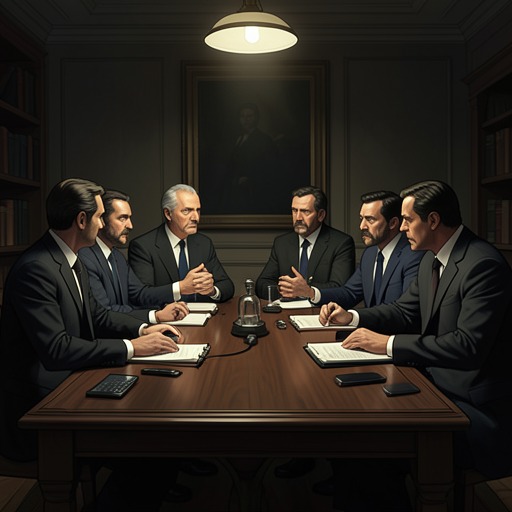
Timesaving Bank
MomoThe Timesaving Bank is the hidden organization behind the city’s movement to save time. It sells efficiency as a route to future freedom, but its recruitment steadily strips time from work, relationships, and ordinary experience. The bank’s central contradiction is visible both in the lives it reshapes and in its own accounting: the more people are induced to save, the less life they seem to have, while the institution treats time gathered from people as its vital capital.
Nature and Operating Doctrine
The bank’s business rests on a truth its agents understand and exploit: clocks can measure hours, but they cannot capture how differently an hour may be experienced. Time is not merely a quantity on a dial; it is life itself, residing in the human heart. The Men in Gray know the value of even a second, and their expertise is compared to that of leeches in blood. The image defines the organization’s practice as extraction rather than neutral stewardship.
Its operation begins in secrecy. The Men in Gray have installed themselves in the city without attracting notice and advance their plans gradually, entering inhabitants’ lives and taking them over. They identify people who may further those plans before the people themselves understand their significance, then wait for a moment when they can be trapped. This makes recruitment appear personal and timely, while concealing the organized design behind it.
The bank’s language recasts deprivation as prudent investment. It promises to look after the time a client saves and to pay interest, so that the eventual return will exceed the original contribution. Yet the promise has no transparent mechanism: when Mr Figaro asks where to deliver or store the time, the agent assures him that the bank will take care of it and that he will have none left over. The reassuring account thus contains the essential warning. The client is not shown receiving the saved hours; the organization claims custody of them.
Recruitment and the Reordering of Daily Life
The bank’s approach to Mr Figaro, a barber, demonstrates how its policy enters everyday routines. Its agent arrives at the barbershop already knowing Figaro’s name and presents the bank as an answer to the barber’s wish for more time. The sales pitch converts that wish into a calculation: by saving time over twenty years, Figaro is told, he could accumulate 105,120,000 seconds, available when he reaches sixty-two. The prospect of a future reserve makes present sacrifices seem measurable and worthwhile.
The recommended changes reach well beyond working faster. Figaro is urged to spend fifteen minutes rather than half an hour with each customer, shorten his visits with his mother, put her in an inexpensive old people’s home, sell his budgerigar, see Miss Daria less often, and give up his daily review of events. Singing, reading, and time with friends are also presented as waste. An accurate clock, meanwhile, should let him time his apprentice to the nearest minute. The bank’s doctrine therefore reorganizes both labor and intimacy: relationships and pleasures are recast as inefficient uses of a limited resource.
Figaro accepts the program believing its prescriptions are his own resolutions. After the agent’s visit, the figures on the mirror fade, and Figaro forgets the visitor, but the determination to save time remains. He makes customers sit for shorter appointments, hires two assistants, watches them closely, and places their movements under a precise timetable. He ends his relationship with Miss Daria by note, sells the budgerigar, and reduces visits to his mother to once a month. The bank’s influence persists even when its recruiter is no longer remembered; the client carries the discipline forward himself.
From Individual Discipline to Citywide Change
Figaro’s experience becomes part of a larger transformation. He finds that however much time he saves, none is left over. His days seem to contract: weeks, months, and years pass with increasing speed, yet the discrepancy does not prompt him or other timesavers to question where their time has gone. The practice reinforces itself as anxiety: when the passing days become frighteningly apparent, Figaro responds by trying still harder to save time.
The spread is social as well as personal. More inhabitants adopt the practice, while others follow because it seems they must. Radio, television, and newspapers praise time-saving devices as a path to a better kind of life, and billboards associate timesaving with prosperity, progress, and a promising future. Notices urging efficiency appear not only in workplaces but in boardrooms, medical offices, shops, restaurants, department stores, schools, and kindergartens. The pressure reaches nearly every part of civic life.
The visible promises conflict with the condition of the people who follow them. Timesavers may be better dressed and earn more than residents near the old amphitheater, but they appear tired, sour, and disgruntled. They have little patience for visits or conversation unless these can be fitted into a short allotment; even leisure is expected to yield maximum entertainment and relaxation with minimum delay. Daydreaming is treated as an offense, and silence becomes hard to bear because it leaves people face to face with what is happening to their lives. Work is valued for the amount completed quickly, not for enjoyment or pride.
The city’s built environment takes on the same logic. Older buildings are replaced by modern ones stripped of features deemed unnecessary. Instead of houses designed for different inhabitants, identical construction is chosen as cheaper and more efficient. On the northern outskirts, rows of multistorey tenements extend along long, straight streets toward the horizon, while the surrounding countryside becomes a disciplined landscape. As the buildings and streets grow alike, life itself is described as following a straight, carefully programmed course. People fail to notice that their supposed savings accompany a poorer, bleaker, more monotonous existence; children feel the loss particularly keenly because adults no longer have time for them.
The Momo Manhunt and the Bank’s Vulnerability
The organization’s secrecy and discipline do not prevent it from redirecting its entire workforce. When the Timesaving Bank launches a full-scale search for Momo, headquarters orders every agent in the city to abandon other tasks and concentrate on finding her. Gray figures spread across streets and stake out rooftops, sewers, the airport, railway stations, buses, and trams. The agents become ubiquitous, but the search fails: they do not find Momo.
At an emergency conference, the chairman quantifies the cost. The operation lasted six hours, thirteen minutes, and eight seconds. The bank counts both the time agents could not spend gathering time and the time they themselves spent on the hunt; together, these debit entries amount to 3,738,259,114 seconds. The chairman describes the deficit as greater than a whole human lifetime and directs attention to a huge steel door secured with combination locks and other safety devices. In the bank’s own terms, a campaign against one girl has become a financial crisis.
This calculation makes the organization’s dependence unmistakable. It treats time as capital so comprehensively that even the effort spent pursuing Momo is entered as a loss of revenue. The contrast with its recruitment of clients is sharp: individuals are taught to regard care, rest, pleasure, and conversation as waste, while the bank’s own agents are measured by their contribution to time-gathering. Its promise that saving will give people more life is undercut by the city’s exhaustion and uniformity, and the manhunt shows that the institution itself cannot set aside its collecting purpose without incurring an immense cost.