Make-believe and imaginative play
MomoMake-believe and imaginative play is the children’s self-directed art of creating a shared world from attention, invention, and whatever materials are at hand. In the Amphitheater, it flourishes not because Momo dictates games, but because her presence helps others generate ideas; later, the contrast with costly toys and compulsory educational play reveals imagination as a capacity that can be crowded out by entertainment and instruction alike.
A shared practice of invention
The children have a special reason to enjoy visiting the Amphitheater: with Momo there, they play better games than ever. She does not need to supply a stream of clever suggestions. She joins in, and, for reasons the narration leaves unexplained, bright ideas begin to occur to the others. They invent new games day after day, each improving on the last. Play is therefore not presented as a performance by one gifted leader, but as a collective activity that Momo’s participation helps set in motion.
One sultry afternoon, with black storm clouds gathering, around a dozen children wait on the stone steps while Momo takes a nearby stroll. A girl is ready to go home because thunder and lightning frighten her. The children try to find something to do; when one proposes that they make the Amphitheater a ship and sail into uncharted seas, the group cannot sustain the idea. The boy assigns himself captain, others the roles of mate, scientist, and sailors, and says the ship is from the future; when the girls ask what they will be, he makes them sailors too. The premise has promise, but the game dissolves into squabbling before it gets underway. Invention alone is not enough: the play also needs a shared imaginative commitment.
The Argo and the power of a common world
When Momo arrives, the game changes. The children’s make-believe carries them aboard the Argo, a research vessel travelling through the South Coral Sea, where shoals, reefs, sea monsters, and the fearsome Travelling Tornado threaten the crew. The imagined ship has concrete vulnerabilities and a danger with a recognizable consequence: anything caught in the waterspout’s embrace is reduced to matchwood. The children’s story gives each participant a place in a world whose perils they can face together.
The Argo is built to survive the threat, with a hull of adamantium cast in one piece without rivets or welded seams, yet its special construction does not by itself defeat the tornado. The turning point comes through a tune and words that are easy to remember. One by one, the crew joins in, until everyone is singing, clapping, and cavorting. Even the professor and the old sea dog Jim Ironside take part like children at play. In the adventure, the Travelling Tornado slows, stops, and sinks beneath the waves; the storm dies, the rain ceases, and the sea returns to calm. Captain Gordon credits the crew with succeeding and tells them he is proud of them.
This imagined victory depends on participation rather than a lone hero’s mastery. The music gives the crew a common action, and the fictional danger yields as the group joins in. Yet the ending is not simply triumphant for everyone: the boy with glasses regrets that the last surviving Teetotum elasticum has been sunk and wishes he could have examined it. His disappointment preserves a difference of interest inside the shared game. Even so, the children agree that the games they play with Momo are more fun than any others.
Finished toys and the shrinking of possibility
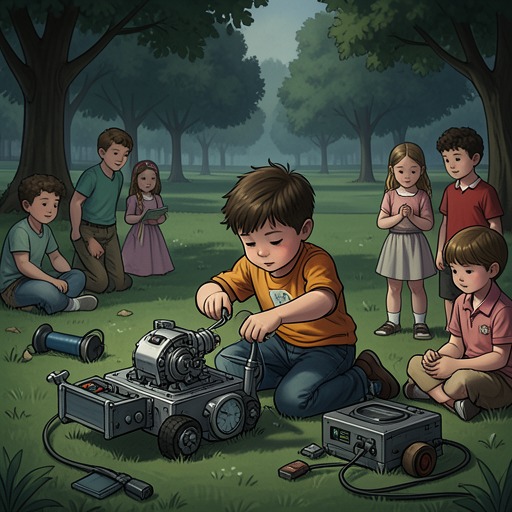
The novel later sets this open-ended play against expensive toys brought by new children. Remote-controlled tanks trundle back and forth, rockets run along strings, and model robots waddle, flash their eyes, and swivel their heads. Each toy performs its limited action, but the narration emphasizes that its owners can do little beyond watch. The toys are complete down to the smallest detail and leave nothing to the imagination; their elaborate movement can mesmerize without sustaining interest.
When that spectacle grows dull, the children return to older materials: a couple of cardboard boxes, a torn tablecloth, a molehill, or a handful of pebbles can conjure an entire world. The contrast is not simply between expensive and cheap objects. A finished toy supplies what it can do in advance, while loose, ordinary things leave the children free to decide what they mean and what may happen next. The transistor radio creates a related interruption: on an evening when the children gather around Guido Guide, hoping for a story, a newcomer’s radio blares advertisements, preventing the storytelling they had come to hear.
Regulation, utility, and the loss of play
The children’s imaginative play also supports their capacity to gather and act together. At a meeting in the Amphitheater, about fifty or sixty children arrive, from near and far, in a striking range of ages and circumstances; some bring younger siblings. After Momo has told them what happened, Guido Guide asks how many have the courage to join a campaign against the Men in Gray. The children’s assembly is not itself a make-believe game, but it shows the group moving from shared listening toward collective action, rather than remaining passive spectators.
The Men in Gray cannot detach the children from Momo by taking direct control, so they enlist adults and turn concern about children being left alone into a case for official intervention. Child depots soon appear in every neighbourhood. Children whose parents are too busy must be deposited there, and playing in streets, parks, or elsewhere is forbidden. Momo’s friends are separated by district and assigned to different depots. There, supervisors select games for them, each required to serve a useful educational purpose. The children learn those games, but the imposed program leaves them forgetting how to be happy, enjoy small things, and dream.
Weeks later, they are sullen, bored, and resentful; even when left on their own, they no longer know what to do. The Amphitheater, once animated by new games and the children’s collective invention, is silent and deserted. When Momo encounters Paolo, Franco, and Maria, they wear gray uniforms and have stiff, lifeless expressions. Franco explains that in play class they are playing data retrieval: they pretend to be punch cards carrying information. The language of play remains, but its imaginative openness has been replaced by a prescribed exercise. Across these contrasts, the book treats make-believe not as a decorative pastime but as a practice through which children create worlds, share agency, and discover possibilities that utility-bound activities leave out.