Time theft
MomoTime theft is the hidden extraction at the center of the Men in Gray’s campaign: people are induced to save time by cutting away parts of their lives, while the apparent savings are taken from them. The scheme turns an ordinary desire for efficiency into a means of control, and its final reversal makes the theft literal: stolen hours can be seen, stored, and returned to the people from whom they came.
Time as Life
The idea begins with a contrast between measured time and lived time. Calendars and clocks can count hours, but they cannot express why an hour sometimes seems to last indefinitely and at other times passes in a flash. The novel’s governing proposition is that time is life itself and that life resides in the human heart. From this perspective, time is not merely a resource outside a person, available to be deposited or saved; it is bound to the life that person is actually living.
The Men in Gray understand this connection and exploit it. They are described as experts in the value of an hour, a minute, and even a second, but their expertise is predatory: they know time as leeches know blood. Their plans are long-term and carefully laid, and their first advantage is that people do not recognize the theft. They have installed themselves secretly in the city and gradually enter its inhabitants’ lives, identifying people who may advance their plans and waiting until circumstances make them susceptible.
The Promise of Saving Time
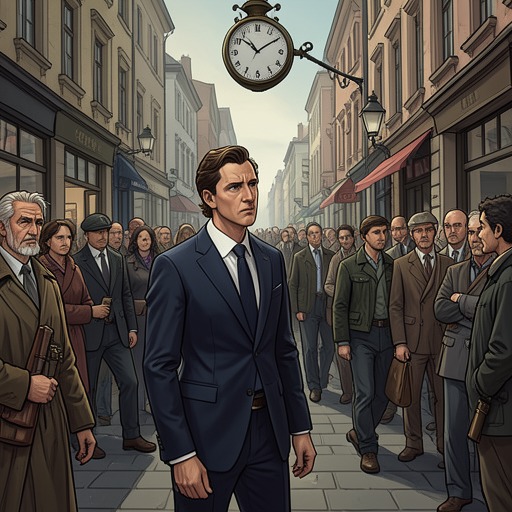
The theft works by changing everyday habits before its victims understand what is happening. The Men in Gray present saving time as a route to a better life in the future. Their advice to Mr Figaro makes the bargain concrete: he is told to shorten each customer’s appointment from half an hour to fifteen minutes, avoid conversation, spend less time with his mother, place her in a cheap old folks’ home, sell his budgerigar, see Miss Daria less often, and give up reading, singing, and time with friends. He is also urged to put an accurate clock on the barbershop wall so that his apprentice can be timed to the minute.
These instructions do not simply make a working day more efficient. They remove the activities and relationships that give the day its human content, while treating each one as an obstacle to future advantage. Mr Figaro accepts the plan and asks how the saved time is to be paid in or kept safe. His question shows how thoroughly the supposed savings have been made to seem like a private asset awaiting collection, although the actual system has been concealed from him.
Once the visitor has gone, Mr Figaro forgets the Man in Gray, but he retains the resolution and believes it is his own. He greets his first customer surlily and finishes the work in twenty minutes rather than the usual thirty; he then applies the same compressed routine to every customer. Although he no longer enjoys his work, he treats that loss as secondary. He hires two assistants as well as his apprentice and watches them closely to prevent wasted minutes. A notice on the shop wall declares that saved time is doubled, while his own conduct steadily narrows the life the promise was meant to improve.
The costs extend beyond the barbershop. Mr Figaro sends Miss Daria a brief, businesslike note ending their meetings, sells his budgerigar to a pet shop, and places his mother in an inexpensive home, visiting her only once a month. He carries out the recommendations as if they were his independent decisions. His story shows the method’s defining concealment: the victim may forget the agent but continue to act on the agent’s plan. More broadly, people fail to notice that saving time means losing something else. Life becomes poorer, bleaker, and more monotonous, and children feel the change especially because adults no longer have time for them. The apparent increase in saved time accompanies a real decrease in what people have of life.
Secrecy and Exposure
The Men in Gray depend on remaining unrecognized. When one of them speaks uncontrollably in front of Momo, he reveals that their business must go unnoticed: they make people forget them, drain away the time people save, hoard it, and need increasing quantities as their own numbers grow. The disclosure is not a planned explanation but a breach of the concealment on which their operation rests. Once the agent regains control, he tries to blame Momo, underscoring the gap between the truth he has exposed and the ignorance he needs to restore.
The danger of discovery becomes public when Guido tells the children that people are losing the time they intended to save and identifies the cause as organized theft. He asks for their help in stopping the gang and intends for Momo to describe her encounter with one of its members. Beppo warns that telling the story would endanger both Momo and the children. The Men in Gray’s own court later treats the children’s knowledge and public demonstration as a serious threat, confirming that exposure—not simply a reduction in efficiency—is dangerous to the system. The thieves’ secrecy is therefore part of the mechanism: if people understood who benefits from their sacrifices, they could challenge the arrangement.
The Stolen Time and Its Return
Professor Hora explains that the Men in Gray are not human, despite their human appearance. They feed on time taken from people, but that time dies once it has been separated from its rightful owners. The thieves exist because people give them the opportunity to gain a foothold in their lives; if they could no longer steal time, they would disappear. Their apparent power depends on human participation, even when the people involved do not know that they are participating.
The novel gives this extraction a physical form through the hour-lilies. Each person has a place in the heart where such flowers grow. When the Men in Gray gain a foothold there, they steal more and more of the flowers. Stolen flowers cannot die, because they have not truly withered, but they cannot live either while parted from their owners; they strive to return to the people to whom they belong. The Men in Gray keep them frozen in a vast underground store, where they are preserved like glass goblets. They pull off the petals, dry them, and roll them into cigars. The remaining life in the petals is harmful to the thieves, so they smoke them: only after the time has been converted into smoke is it fully dead, and that dead human time keeps the Men in Gray alive.
The return of the stolen flowers reverses the process. After the thieves have gone, the great vault is no longer cold, and its shelves hold innumerable blossoms containing hundreds of thousands, indeed millions, of stolen hours. As the temperature rises, the flowers leave their shelves and swirl through the vault. They drift down over the frozen earth and dissolve as they return to their true home in human hearts. Time begins again; ordinary city activity resumes, and people suddenly find that they have time to spare, without realizing that their own time has been restored.
Significance
Time theft links the novel’s moral argument to the details of work and daily routine. The clock, the shortened customer appointment, the timed apprentice, and the severed ties to family, affection, and leisure all make the demand to save time visible in ordinary life. The scheme’s irony is that people surrender the living parts of their days in order to accumulate a future benefit, while the actual beneficiary remains hidden. Against that accounting, the return of the hour-lilies insists that time belongs not in an abstract store but in the lives and hearts of the people who live it.