The City's Turn to Time-Saving
MomoThe City’s Turn to Time-Saving is the citywide spread of an efficiency regime that promises people a better life but progressively diminishes the life they actually experience. As more inhabitants reorganize work and private time around productivity, the change reaches beyond individual habits: it alters social expectations, the sound and appearance of the city, and the rhythms of childhood. The central reversal is that people save more time yet have less of it, because time, as the narrative insists, is not a commodity separate from life but life itself.
Background and the Promise of Efficiency
The turn begins against the book’s account of time as an everyday mystery: clocks and calendars can measure hours, but they cannot capture how those hours feel. The Gray Men understand the value people place on time and secretly make plans to take it. They have already established themselves in the city, quietly entering residents’ lives and waiting for the right moment to influence people who might advance their aims. Their method is not simply to demand time openly. They make saving it appear to be a person’s own sensible decision.
Mr Figaro’s conversion shows how that persuasion works at close range. A gray agent advises him to work faster, shorten customer appointments from half an hour to fifteen minutes, avoid conversation, cut the time spent with his mother, and restrict visits to Miss Daria. He is also urged to give up singing, reading, and time with friends, and to monitor his apprentice with an accurate clock. These recommendations translate an abstract promise into a practical schedule: relationships and pleasures become items to reduce, while work becomes something to measure and accelerate. Mr Figaro asks what he is supposed to do with the time he saves, but the question does not lead him to understand the system. He accepts its discipline instead.
From Individual Practice to Citywide Norm
After the gray visitor leaves, Mr Figaro forgets the encounter but retains the resolution to save time, believing it originated with him. He receives his first customer surlily and completes the work in twenty minutes rather than the usual thirty by doing only what is necessary and saying little. He applies the same treatment to every customer, hires two assistants in addition to his apprentice, and watches them closely for wasted time. A notice on the barbershop wall turns his new rule into a public motto: TIME SAVED IS TIME DOUBLED!
The changes reach beyond the shop. Mr Figaro sends Miss Daria a brief note saying work pressure will prevent future meetings, sells his budgerigar to a pet shop, and places his mother in an inexpensive old folks’ home, visiting her once a month. He carries out the gray agent’s recommendations as if they were his own choices. His example belongs to a broader movement: each day, more inhabitants begin saving time, and their behavior is copied even by people who do not genuinely want to join but feel obliged to keep pace.
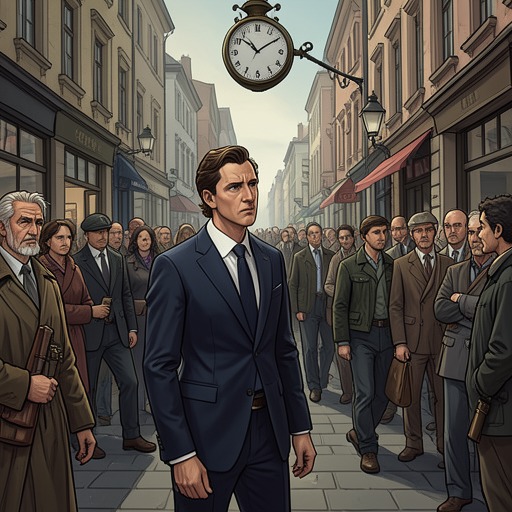
Publicity helps make the movement seem both desirable and inevitable. Radio, television, and newspapers promote time-saving devices as a path to a supposedly proper future, while walls and billboards display images of happiness and prosperity. Their slogans celebrate speed and promise that the future belongs to those who save time. At work, the same message becomes an instruction rather than an advertisement. Factories and offices display notices declaring that time is precious or money, and similar signs appear in executive offices, doctors’ consulting rooms, shops, restaurants, department stores, schools, and kindergartens. The reach of the notices makes clear that no sphere of life is meant to remain outside the new discipline.
The Cost in Work, Relationships, and Daily Life
The promised spare time never arrives for Mr Figaro. Though he works faster, feels increasingly restless and irritable, and keeps tightening the routine, the time he saves seems to vanish. His days grow shorter; weeks, months, and then years seem to pass with mounting speed. Because he no longer remembers the gray visitor, he does not ask where the time is going. When he does notice that his days are flying by, the alarm does not loosen his commitment: it intensifies his determination to save still more. The policy thus feeds on the very deprivation it creates.
Across the city, acceleration also changes what people expect from one another. Timesavers may earn more and spend more, and they are better dressed than people living near the Ancient Amphitheater, but they appear tired, disgruntled, and sour. They lack anyone who will listen to them in a way that might help them become reasonable, conciliatory, or happy. They have not even heard the suggestion to visit Momo; if they did, they would be unlikely to make such a visit unless it could be finished in five minutes. Leisure does not escape the same calculation: it too must deliver the greatest entertainment and relaxation with the least delay.
The resulting culture narrows the range of acceptable experience. Whether an occasion is solemn or joyful, people can no longer celebrate it properly. Daydreaming is treated almost as an offence, and silence becomes especially difficult to bear because it leaves people facing what is happening to their lives. They respond to the prospect of silence with noise, but this is not the happy hubbub of children at play; it is an angry, ill-tempered din that grows louder. Efficiency has not made social life more satisfying. It has made unhurried attention, reflection, and shared celebration harder to sustain.
A City Built to Match the Schedule
The transformation becomes visible in the city’s architecture. Old buildings are demolished and replaced by modern ones stripped of features regarded as unnecessary. Instead of designing homes for the people who will live in them, builders produce identical houses because standardization is cheaper and saves time. On the northern outskirts, huge developments spread into endless rows of multistoreyed tenements, alike as peas in a pod. The streets follow the same pattern: straight, steadily lengthening lines that run toward the horizon and turn the surrounding countryside into what the narrative calls a disciplined desert.
The uniform environment echoes the uniformity imposed on its inhabitants. People’s lives, like the roads, seem to run straight ahead, planned and programmed down to each move and each moment. This is more than a change in architectural taste: the city’s sameness gives physical form to a social order in which difference, conversation, and unplanned activity appear wasteful. The destruction of older buildings and the spread of standardized housing accompany the loss of richer, less managed ways of living.
Consequences and Significance
The people who adopt time-saving do not seem to notice what they are losing. Life becomes poorer, bleaker, and more monotonous even as the public campaign advertises prosperity and future freedom. Children feel the change especially keenly because adults no longer have time for them. Their neglected place in the new order exposes its cost in human terms: the city’s drive to free time for a future life takes attention away from lives and relationships in the present.
The episode’s governing paradox is that the more people save, the less they have. That reversal links Mr Figaro’s altered routine to the city’s advertisements, workplaces, social habits, and standardized outskirts. What first looks like an individual choice becomes a copied expectation, then a civic norm, until even leisure and childhood are measured against efficiency. The Gray Men’s quiet success lies in making this loss look like progress: residents participate in the taking of their own time while believing that a better life is waiting once the saving is done.