The magic mirror
MomoThe magic mirror is the silver, moon-like object through which Momo’s fairy-tale history turns on reflection, distance, and recognition. It travels over the world collecting images, but its most consequential image is Momo’s own: sending that reflection out costs her immortality, helps Guido recognize who she is, and becomes part of the rule by which the pair can regain immortality together.
Form and Operation
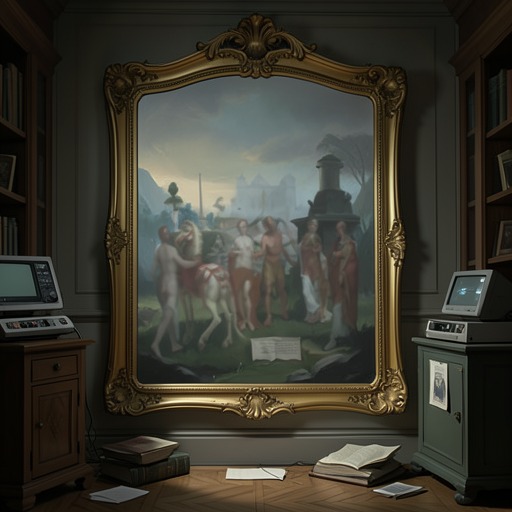
The mirror is described as big, round, and made of fine silver. Momo sends it out day and night over land and sea, towns and countryside. Those who see it take it for the moon, an ordinary-looking object passing overhead. That familiar misidentification lets the mirror move through the world without those who glimpse it understanding what it carries.
When it returns, the mirror releases the reflections gathered on its travels. Momo chooses the ones she likes and throws the others into a stream; the discarded images race back through the waterways to their owners. The tale uses this process to explain why a person’s reflection appears in a stream or pool. The mirror is therefore not simply a surface that gives an image back to whoever stands before it: it collects, transports, sorts, and returns reflections, connecting distant people to the images that belong to them.
This circulation also establishes the mirror’s reach and its limits. It can carry images over great distances, but the tale does not present it as a device that tells Momo the identity or whereabouts of the prince whose reflection she admires. She still does not know his name or where he lives. Its power makes contact imaginable, while leaving the characters dependent on chance and interpretation to understand what that contact means.
Momo’s Reflection and the Loss of Immortality
The mirror’s governing danger is tied to its unusual relation between an image and the person reflected. Momo remains immortal because she has never seen her own reflection in it. When the mirror brings her the image of a young prince, she longs to meet him face to face. Hoping her own image might reach him, she looks into the mirror and sends it around the world with her reflection. The act immediately ends her immortality.
The mirror’s journey makes that decision consequential beyond Momo’s private life. The prince looks up at the silver object and sees, in Momo’s reflection, that she is weeping; one of her tears falls on his hand. This sight reveals to him that the green-blooded fairy has deceived him and that Momo is his true love. The mirror has carried an image into the prince’s view, but the recognition depends on what he understands from it. Its function in the scene is at once practical and narrative: it brings the separated pair into relation and exposes the truth the fairy had obscured.
The prince’s response also shows that the mirror cannot prevent loss or guarantee a reunion. The fairy knots his heart, and he forgets his identity as ruler of Futuria. He leaves under the name Guido, carrying Momo’s reflection from the mirror, which is blank thereafter. The change from a travelling collector of many images to a blank mirror preserving one image gives the object a different role: it no longer displays an ongoing exchange with the world, but retains the trace of a connection that its bearer cannot yet understand.
The Blank Mirror and Recognition
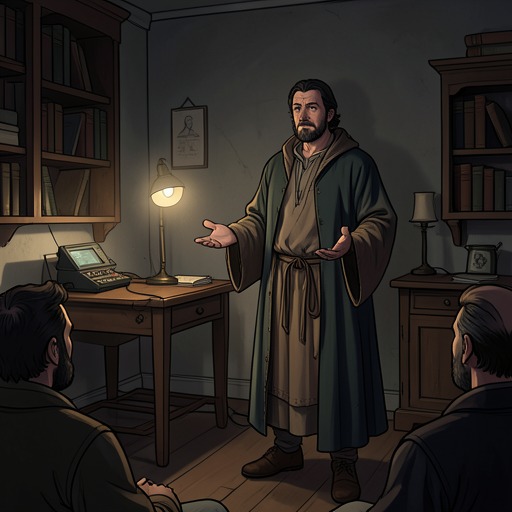
After Momo and Guido meet in an ancient ruin, neither recognizes the other. She no longer appears as a princess, and he does not remember being the prince. The mirror does not restore their identities merely by being present. One evening, Guido takes Momo’s reflection from it and shows it to her. Although the image is crumpled and faded, Momo recognizes it as the reflection she sent across the world. Looking more closely at Guido, she then understands that he is the prince for whom she gave up immortality.
The sequence makes recognition reciprocal but not simultaneous. The carried image first allows Momo to connect her present circumstances to her earlier choice; she then tells Guido their story. His memory remains blocked by the knot in his heart, so the mirror alone cannot complete the reunion. Momo unties the knot, and Guido remembers who he is and where he came from. The object brings the evidence of the past back into view, while the characters’ recognition and action are still necessary to make that evidence meaningful.
The Rule of Shared Looking
The tale gives the mirror a final rule that reverses the cost of Momo’s earlier choice. Looking into it alone makes a person mortal; when two people look into it together, they become immortal again. Guido states that the pair did this. At the end of the narrated episode, Momo and Guido sit side by side beneath the silver moon, looking upward and feeling certain that, for that enchanted moment, they are immortal.
The ending returns the mirror to its moon-like appearance, but changes the meaning of looking. At first, Momo’s solitary gaze exposed her to mortality; later, the mirror’s transported image enabled a recognition that neither could achieve alone. The final rule makes shared attention the condition for restoring what individual desire had put at risk. The mirror thus organizes the tale’s movement from distance to encounter, from an image mistaken or misunderstood to recognition, and from solitary looking to a shared sense of immortality.