Time Storage Vault
MomoThe Time Storage Vault is the hidden storehouse at the center of the Men in Gray’s theft of human time: an underground cold store holding the hour-lilies taken from people’s hearts. Its frozen flowers reveal what the gray men’s abstract promise of saving time actually means—human lives separated from their owners and turned into a reserve for the thieves. When Momo reaches it, the vault becomes both the mechanism sustaining their power and the place where that mechanism can be undone.
Purpose and Hidden Location
Time in the novel is not merely what clocks measure. An hour may feel long or pass quickly according to how it is lived; time is life itself, residing in the human heart. The Men in Gray understand this relation and secretly invade people’s lives, taking time while concealing their activity. The vault is the material center of that concealed system: it holds the stolen hours that the gray men have removed from their rightful owners.
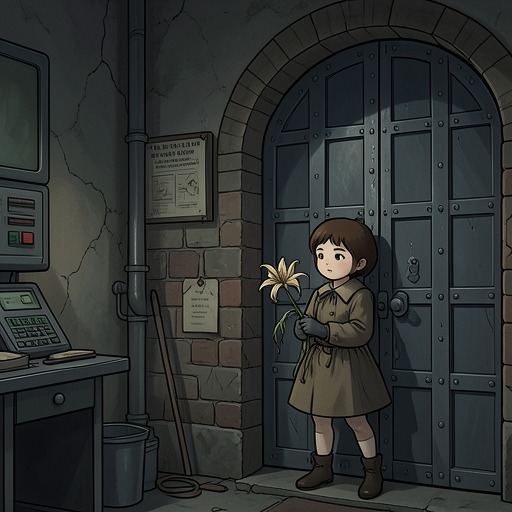
Professor Hora explains that an hour-lily taken from a person’s heart cannot truly wither, but cannot live while separated from its owner either. The flowers strive to return to the people they belong to. He does not know where the Men in Gray keep them, only that they freeze the blossoms until they are hard as glass goblets in a gigantic underground cold store. The vault’s exact location remains unknown to him; Momo later finds it behind a huge steel door in an underground chamber where the surviving gray men have gathered. The hidden architecture gives the theft a physical form, but does not make its workings fully visible until she enters.
What the Vault Preserves
Inside the vault, the hour-lilies are arranged on endless shelves like crystal goblets. They are innumerable, each flower different, and together represent hundreds of thousands, indeed millions, of hours stolen from people’s lives. The image turns an abstraction into an inventory: time appears as beautiful, individual blossoms, but their abundance records the scale of the loss. Their preservation is also a kind of suspension. They are neither returned to the hearts from which they came nor allowed to complete their lives while held in storage.
The Men in Gray draw their supplies from these stored flowers. They pull off the petals, let them dry until they are gray, and roll them into cigars. The petals retain remnants of life, which is harmful to the gray men; smoking the cigars converts that living time into smoke and makes it fully dead. The vault therefore supplies the material on which their continued existence depends. Its cold preserves what they have stolen until they can transform it into the dead time that sustains them.
The Open Door and the Crisis
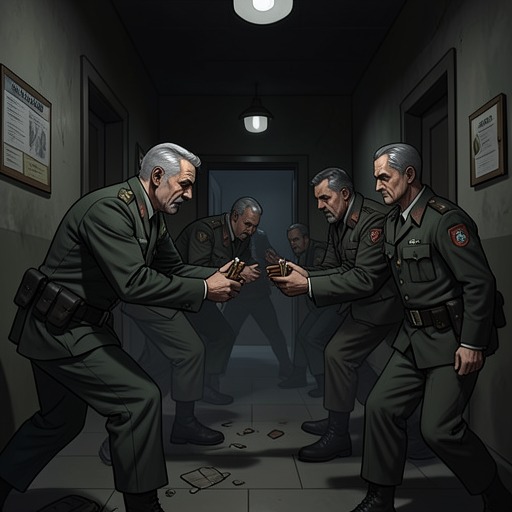
When Momo discovers the gray men’s conference chamber, the vault’s steel door stands ajar and cold escapes from beyond it. The surviving men are discussing how to economize their remaining reserves, even considering that only some of them may survive. Their argument exposes the instability of a system built on hoarding: the gray men treat one another as expendable while their supply is threatened. They recognize that an open door was fortunate when disaster struck, because a shut door could not now be opened by any power on earth. Yet the same opening lets the refrigeration plant’s cold escape.
The consequences are double-edged. If the Men in Gray disappear, the flowers will thaw by themselves, but the gray men remain able to exist while they can obtain fresh supplies of cigars. Momo understands that waiting would leave them access to the store. Cassiopeia nudges her and displays the instruction to shut the door on her shell. Momo believes she cannot move it, but she has an hour-lily with her. The vault’s vulnerability is not a conventional lock or key: the flower, itself a piece of living time, allows her to act where strength alone would not suffice.
Momo Closes the Door
Momo crawls unseen beneath the conference table toward the door, carrying the wilting flower. With its stem between her teeth, she reaches the opening, touches the door with the hour-lily, and pushes. The well-oiled hinges make no sound until the door swings shut with a clang that echoes through the underground passages. The Men in Gray, who believe that only they are exempt from the universal standstill, see Momo and stare in horror; she runs for the exit as they pursue her. Closing the door turns the vault from an accessible supply into a sealed store, cutting off the gray men from the flowers they use.
Later, Momo opens the door again with the last petal of her hour-lily. With the last of the time-thieves gone, the vault is no longer cold. As its temperature rises, the flowers leave the shelves in clouds and swirl around her. The change is not simply from storage to exposure: the hour-lilies are released from the condition that held them apart from their owners. The last petal falls as the other flowers rise, making the ending of Momo’s own flower coincide with the release of the vast store.
Narrative Significance
The Time Storage Vault gives the novel’s argument about time a striking physical shape. The Men in Gray’s methods begin in ordinary routines: Mr Figaro is urged to work faster, limit conversations, and measure his apprentice precisely; later, he reorganizes his shop around the notice that time saved is time doubled. Such economies make life poorer even as people believe they are saving something. The vault reveals where that apparently abstract loss goes: into a hidden stockpile of stolen hours, preserved for the thieves rather than lived by the people who lost them.
Its ending reverses the logic of accumulation. The flowers do not remain a reserve to be rationed, counted, or consumed; they stream out of the vault, released from captivity. Momo is carried away in the rising tempest, while the story connects the flowers’ return with time flowing back toward human life. The vault is thus both the most concentrated image of the gray men’s power and the site of its undoing: what they preserve by freezing can be freed, and what they have treated as dead stock can return to the living.