Gray cigars
MomoGray cigars are both a signature possession of the Men in Gray and the clearest visible clue to their fragile existence. First appearing as part of the agents’ uniform, they recur in Agent No. BLW/553/c’s encounter with Momo and in his trial, where the confiscation of his cigar is followed by his disappearance. An ordinary smoking object becomes the hinge between the gray men’s imposing public presence and the fact that they cannot survive without what sustains them.
Appearance and Recognition
The cigars belong to a carefully repeated visual scheme. The Men in Gray wear gray suits, gray bowler hats, and gray faces; each carries a steel-gray briefcase, and they smoke small gray cigars. Their appearance makes the cigar more than incidental decoration: it helps mark the agents as members of a group whose identity is expressed through sameness and whose presence is woven into the city’s everyday traffic.
The smallness of the cigar contrasts with the scale of the threat. The agents move about in limousines and haunt buildings and restaurants, yet one of their defining possessions is a little object they can hold and smoke. Its modest size gives it an unassuming place among the other gray accessories, while its later importance reveals that the agents’ power has a vulnerable material condition.
The Cigar in Momo’s Encounter
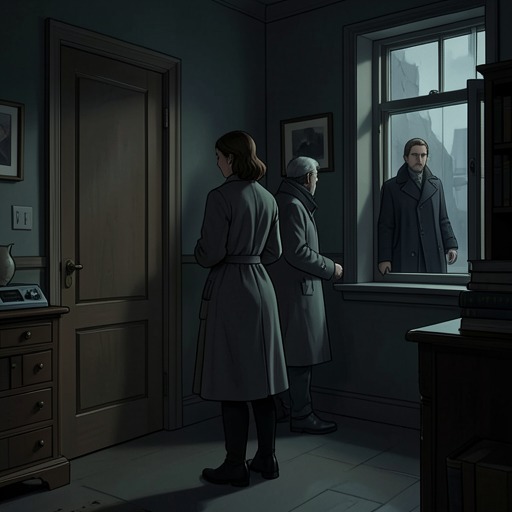
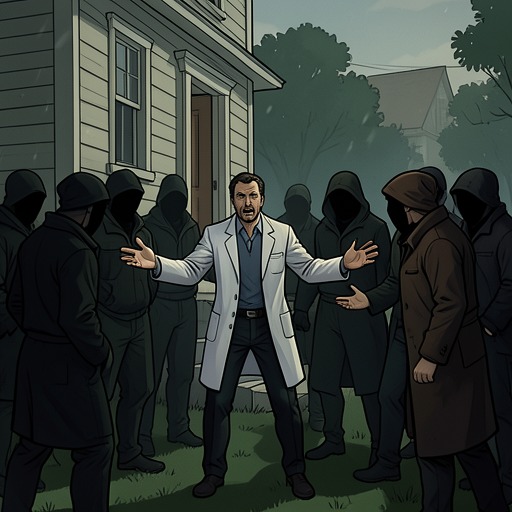
When Agent No. BLW/553/c meets Momo, he identifies himself as an agent of the Timesaving Bank and warns her that the organization is not to be trifled with. Momo recalls what Beppo Roadsweeper and Guido Guide have said about timesaving spreading like an infection, and suspects that the stranger is connected to it. As she gathers the courage to confront him, the narration shows him watching her from the corner of his eye. He lights a fresh cigar from the butt of the one he has been smoking.
The gesture gives the encounter a quiet, unsettling rhythm: even while Momo tries to understand the stranger’s concealed nature, he tends to his cigar. He answers her resistance with a sarcastic warning that she is no match for the gray men. Momo then asks whether anyone loves him. The question cuts across the agent’s claim of institutional power, shifting attention from the organization he represents to the possibility of a private human bond. The cigar remains a concrete marker of the gray agent in this exchange, but it does not answer the question Momo asks.
After the agent leaves, Momo sits for a long time trying to make sense of what she has heard. As the unnatural chill recedes and her thoughts grow clearer, she remembers everything. In front of her, the trampled butt of a small gray cigar smolders into ashes. The remnant is a physical trace of the encounter: the threatening figure has gone, but the discarded object makes his presence legible after the fact.
Confiscation and Dissolution
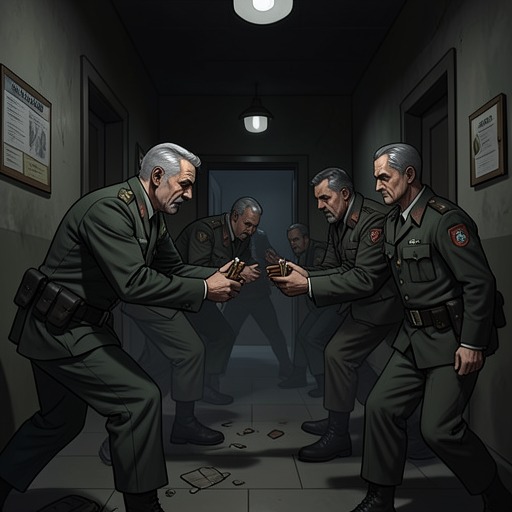
The cigar returns with decisive force at Agent No. BLW/553/c’s trial. After the judges announce that he is to be deprived of all time, two gray figures take away his steel-gray briefcase and small cigar. The sequence makes the removal of the cigar part of the sentence’s visible execution rather than a detail of courtroom dress. The condemned agent cries for mercy, but the object that had accompanied him in the city is already beyond his reach.
As soon as he loses the cigar, the agent becomes increasingly transparent. His screams grow fainter; he dissolves into thin air, and the last visible sign of him is a little eddy of ash that soon vanishes. The narrative places the confiscation immediately before the transformation, making the cigar’s connection to his continued existence unmistakable. It does not explain the object’s mechanism, but it shows that without it the agent cannot remain present in the world.
Function and Significance
Across these appearances, the cigar changes in significance without changing its basic physical form. Among the Men in Gray, it is one item in a uniform ensemble; in Momo’s encounter, it is a smoking object left behind as evidence; at the trial, its removal exposes the agent’s dependence. The shift from accessory to trace to condition of survival turns a familiar object into a measure of the gray men’s vulnerability.
The ending also sharpens the contrast between the agents’ apparent solidity and their actual precariousness. They patrol the city with notebooks, briefcases, and institutional authority, but the agent’s disappearance leaves only ash—and even that disappears. The cigars therefore help make the Men in Gray’s dependence on dead time materially visible: the power that lets them operate is not self-sustaining, and when its support is taken away, the figure who wielded it dwindles to nothing.