Butterfly Fairy’s house
MulanButterfly Fairy’s house is an abandoned refuge where Mulan and the Jade Rabbit wait out a storm and uncover the last trace of its owner. Its humble rooms and a fragmentary letter lead the Jade Rabbit to tell how the immortal Butterfly Fairy left to seek her missing husband, became known as the Waiting Wife, and was transformed into a stone. The house thus serves both as practical shelter and as the doorway to a story of devotion, absence, and irreversible change.
Discovery and Physical Setting
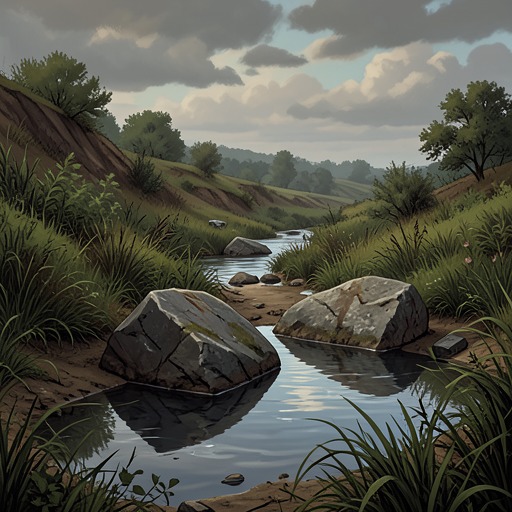
Mulan and the Jade Rabbit take shelter in a house already marked by long neglect. Dust coats the room, weeds climb through broken windows, and the surviving furnishings make abandonment seem uncertain: clothes remain in a cabinet and a blanket lies on the bed. Mulan wonders what happened to the owners and feels misgivings about using their possessions. The house is not presented as a grand immortal residence. Its plain, modest furnishing surprises Mulan, who had imagined an immortal living somewhere more splendid; the Jade Rabbit jokes that immortals do not all live in jade palaces.
The storm makes the house’s condition part of the immediate scene. Wind and rain beat against the closed windows, but inside, the ancient stillness muffles the storm. Mulan hangs her wet clothes near the fire. The Jade Rabbit notes that he had made Nuanhuo medicine for her before his bag was stolen, so she should not be cold. The house itself, however, is no conjured comfort: its dust, broken windows, and weeds register the years it has stood empty.
A Refuge Left for Travelers
The house contains supplies that let Mulan and the Jade Rabbit make use of it as shelter. The Jade Rabbit searches its storage containers and identifies vinegar, salt, probable rice, and tea. Mulan opens the tightly closed rice bin and finds rice inside. She sets empty bowls outside to catch the rain, then searches a deep pot covered with cloth and finds a grey, speckled preserved egg among what looked like dried mud. These small discoveries turn an abandoned room into a place where the travelers can eat and endure the storm.
A brittle scrap of paper gives their occupation of the house a different meaning. Its damaged lines say that the writer fears her husband has suffered a calamity and will return with him or not at all. If she does not return, she leaves the house as shelter for travelers, whether human or animal, hoping that the comfort it provides those in need will bring mercy on her own journey. The paper does not explain the whole history of the dwelling, but it makes clear that the shelter is a deliberate gift, not simply a place whose owners have forgotten it.
Mulan initially guesses that the house might belong to the White Fox. The Jade Rabbit rejects that idea, saying the dwelling would not be fine enough for even one of the White Fox’s whiskers. He then identifies its absent owner as an immortal and says she deserves to have her own story told. The contrast between the house’s ordinary stores and its owner’s immortal identity is central to Mulan’s surprise: the place makes immortality seem compatible with a humble home and a mortal act of hospitality.
The Waiting Wife and the House’s Absent Owner
The letter’s first-person fragment is the surviving trace of a departure. In the story the Jade Rabbit tells, the Butterfly Fairy’s husband leaves by boat in the summer sunset, assuring her that his spirit will not depart the earth unless she is with him. She nevertheless feels foreboding. As days become months and winter arrives, he does not return. When the days lengthen and the cold begins to recede, she packs traveling supplies, closes the house, and sets out for the port village where he had taken his boat.
At the port, she waits day after day in wind, rain, sunshine, and sleet. Her clothes grow torn and ragged as she watches the river for her husband. The villagers call her the Waiting Wife; those who meet her eyes are haunted by the sight. The story’s focus shifts from the closed house to the river’s edge, where her vigil continues while the surrounding world changes. Mountains turn green, the air warms, and boats arrive, but none brings her husband.
A fallen magnolia branch finally marks the moment she can no longer continue waiting. When a family hurries to greet a boat with flowers, one branch drops at the Waiting Wife’s feet. She reaches for it, sees the pink magnolia in full bloom, and drops it as if it were poisonous. No one sees the precise change that follows: the woman is simply gone, replaced by a large, bone-white rock with twisted layers, hollow eyes, and ragged holes resembling the tatters of her clothes. The house remains behind as the shelter she meant it to be, while its owner’s journey ends elsewhere in stone.
Narrative Function
The house joins Mulan’s present journey to an earlier one through an object too damaged to tell the whole story. The scrap of paper supplies the Butterfly Fairy’s fear and her promise of shelter; the Jade Rabbit supplies the identity and the larger history. That sequence makes the house a point of discovery rather than a complete record. Its material remains—the blanket, stored food, and old letter—preserve evidence of a life, but cannot explain what became of the husband.
The refuge also places Mulan’s immediate need beside the absent owner’s open-handed intention. Mulan begins by worrying that she is taking from people who may not have chosen to leave. The letter changes the moral shape of that encounter: the owner explicitly left the house for travelers in need. Later, once the storm has passed, the old room draws Mulan’s thoughts back to her own home and to Ma, Ba, and Xiu. The house is therefore both a temporary place of safety and a setting that intensifies her awareness of separation from her family. Its welcome is real, but the story attached to it is not a promise of reunion.