City of Rushing Water
MulanThe City of Rushing Water is a former port whose prosperity has been undone by its river: after the current turns dangerous and floods without warning, boats are wrecked, homes ruined, and most residents who can leave do so. When Mulan arrives seeking help from the Jade Rabbit’s old friend Lu Ting-Pin, the city’s visible decay gives way to a more immediate danger. Its people seize her and name her the River King’s bride, making the damaged riverfront the setting for a coercive attempt to answer the floods with a human sacrifice.
A Port Ruined by the River
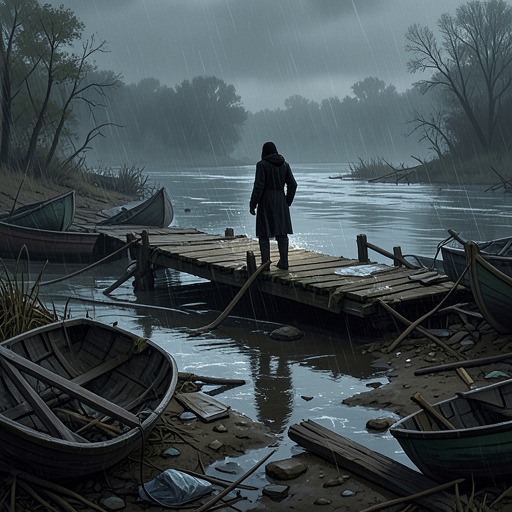
The Jade Rabbit recalls that the city was once thriving, with boats regularly docking at its port. Its name had described the river’s fast movement, but that familiar current became something more perilous: the water turned wild, forming dangerous rapids and flooding without warning. Boats attempting the river were smashed against rocks. The river is not merely the city’s backdrop; its changed behavior has directly reshaped the lives and prospects of the people who live beside it.
The consequences extend beyond shipping. Floods have ruined many homes, and those able to leave have already done so. The remaining area is poor and offers few prospects. Mulan has imagined a grand city, with elaborate roofs and carved windows, because she associates the destination with a meeting involving Lu Ting-Pin, once one of the Eight Immortals. The account she receives instead prepares her for a place marked by abandonment and material decline. The gap between her expectation and the city’s actual condition is part of the arrival: the promise of a famous destination contracts into a damaged community living with the consequences of its river.
The Road, Wall, and Gate
The deterioration appears before Mulan reaches the city proper. The road is broad enough for carts and horses, but overgrown brush and fallen branches have made it poorly maintained. Black Wind must sidestep the obstructions, and one large branch has to be moved out of the way. The broken route makes the loss of regular traffic tangible: this was once a passage serving a busy port, but now even the road shows signs of disuse.
The city wall is long and grey, stained by age and weather. Worn pillars stand along the approach, while the road’s broken, crumbling bricks suggest prosperity that belongs to the past. The gate retains an imposing design: it rises like a turret, with two curved roofs whose corners reach upward, and a large arched entrance echoed by a smaller opening above it. Mulan supposes that the upper level was a sentry lookout, but it is empty. The architecture still signals a once-substantial city; its neglected surfaces and vacant watch post make that former stature feel at odds with its present condition.
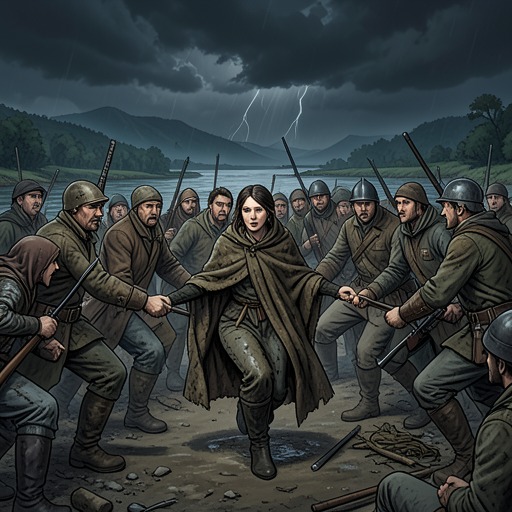
A crowd waits inside the gate, watching Mulan approach. The Jade Rabbit confirms that they appear to be waiting for her, but the welcome is not friendly. As soon as she passes through the entrance, the gathered people surround her amid menacing grumbling. Bamboo spearpoints press her back, and a leather-armored man grips her arm and announces that she is coming with him. The crowd takes control of Black Wind’s reins as Mulan is swept away. The threshold thus marks a sharp change in her situation: she has entered the city in search of an ally, but is immediately treated as a captive.
The Riverfront and the Bride Claim
The crowd leads Mulan through unkempt streets past ramshackle buildings, tattered paper windows, and rotting wooden beams. She repeatedly tries to get an explanation, but no one gives her one. Her route ends at the river, where a second crowd, larger than the first, waits by the landing. People make a path for her and stare. One bystander remarks that she is only a young girl; another urgently tells the speaker to be quiet and asks whether they want their own daughter taken instead. Their exchange reveals that Mulan’s capture is not simply a mistaken encounter. The people understand the danger to a girl, yet fear that resisting the arrangement could expose someone else to it.
The landing stands above the throng like a stage, set beside dark, turbid water that strikes the ancient dock. Its crumbling platform creaks, and the waves hit it with force. A large, oddly shaped rock stands at the landing like an usher: a hulking, twisted white form that seems to cringe away from the water. Through holes weathered into the stone, Mulan sees two figures waiting for her: a prosperous-looking Magistrate and a menacing Hag. The disrepair of the dock and the unruly river are not separate from the ceremony taking place there. The city’s public gathering, its officials, and the riverbank all converge at this exposed point beside the water.
The Magistrate acknowledges that Mulan matches the description the soldier has given: a girl on a black horse who rode through the gates. He concludes that the River King will have his bride. The Hag then declares that Mulan must join the River King at the bottom of the river or he will continue flooding the city and angering the waters. Mulan rejects the claim that she is anyone’s bride. The scene presents the proposed sacrifice as a civic response to a real disaster, but the people’s desperation does not make the forced choice hers: she is seized, transported without explanation, and told that she must drown for the city.
The Rock and the City’s Narrative Role
The strange boulder connects the riverfront’s ominous appearance to the next practical step in Mulan’s journey. Later, when Lu Ting-Pin considers what rock might be suitable for a boat, Mulan suggests the same misshapen stone she noticed at the landing. She recalls its top-heavy, crouching shape and weather-aged perforations, and sees in it not only something monstrous-looking but something sadly beautiful. Lu Ting-Pin judges it a good choice for the boat’s size and weight. In this way, a feature first encountered as part of the city’s threatening public setting becomes material for their attempt to travel on the river; the evidence establishes that choice without reducing the rock’s earlier unsettling presence to mere decoration.
The city also functions as the point where the Jade Rabbit’s practical directions and Mulan’s journey meet a larger local crisis. He directs her toward the City of Rushing Water because they need help and he hopes to find Lu Ting-Pin there. He does not know for certain whether his old friend will be present, but says Lu is always where the festivities are and that the largest crowd should lead them to him. Instead, the crowd that first draws attention to their arrival takes Mulan captive. The reversal turns a search for an ally into an encounter with the city’s attempt to manage its floods through sacrifice. The City of Rushing Water is therefore defined both by environmental damage and by the human response it provokes: a once-active port, a depleted settlement, and a riverfront where public fear is directed at an arriving girl.