Family Honor
MulanFamily Honor is the standard by which Mulan weighs her obligations to her parents, her sister, and her ancestors. It first appears as a rule about how a daughter should behave: Ma teaches that care, not boldness, brings honor. But when Xiu lies dangerously ill, Mulan must decide whether obedience means staying within that rule or acting boldly to protect her family. The story makes honor a lived conflict rather than a settled code, and lets Mulan’s urgent care for Xiu challenge the narrow distinction between dutifulness and daring.
Inherited Duty and Parental Example
Ba’s understanding of honor is shaped by sacrifice. He had fought after the defeat of Emperor Zhou, when the new emperor needed warriors against the invading Rouran. His leg was badly damaged in that service, and the bindings around it remain visible as Mulan quietly passes her sleeping parents. Ba had told her he would make the same sacrifice again because nothing was too much to bring honor to their ancestors. His injury gives the principle a bodily cost: honor is not merely a family claim or an aspiration, but something Ba has paid for through service and pain.
Ma gives Mulan a different, more domestic instruction. She insists that Mulan learn to care diligently for her family and teaches that a girl brings honor through care rather than boldness. The contrast is not simply between a father who values action and a mother who values passivity: both frame honor as service to family, but their examples leave Mulan to reconcile public sacrifice with daily responsibility. Ma’s emphasis also makes Mulan’s impulsiveness feel like a failure of character in her own eyes, even before she decides what to do.
Leaving Home as an Act of Care
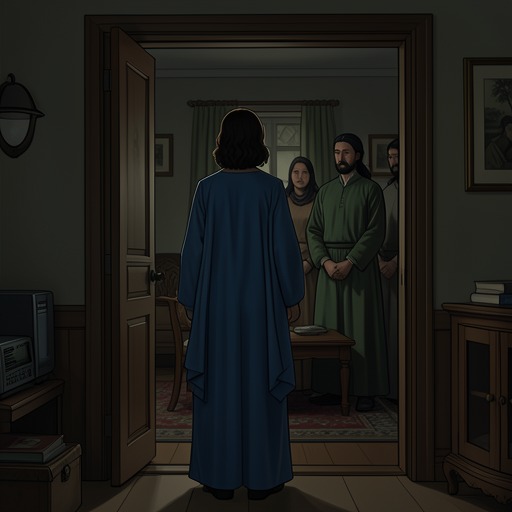
Mulan’s departure tests whether her journey violates family honor or fulfills its deeper demand. She enters the house while the village sleeps, gathers food, clothes, and blankets in a disorderly pack that would have horrified Ma, and passes her parents without waking them. The practical haste of the preparations conflicts with the orderly, attentive daughter Ma expects. Yet Mulan looks at Xiu’s cold, clammy cheeks and concludes that, whatever name others might give her choice, she has to go.
She addresses her sleeping parents as she leaves, saying she will get something to save Xiu and will not dishonor the family. Her words do not erase the uncertainty: she speaks with more hope than force, and her love, worry, and fear feel so full that her chest seems to crack. The scene places the family’s ideal beside its immediate need. Mulan cannot ask for approval, and she cannot know whether Ma would call her decision boldness or care. She acts because Xiu needs help, making responsibility—not permission—the measure of her choice.
The Xiu’s Stuffed Rabbit she takes with her makes that departure at once practical and intimate. Mulan touches its worn silk and delicate threads before pressing it to her chest; she intends it to remind her of home while she is away. The keepsake does not settle her doubts about how far the journey will take her. Instead, it carries the family bond with her, so that leaving home remains bound to the person she hopes to save.
Xiu, Prophecy, and Comparison
The prophecy intensifies Mulan’s sense that honor belongs more naturally to Xiu. When she understands that Xiu must live past the new moon to grow up and save the Emperor, Mulan interprets the prophecy as being about her sister. She pictures Xiu as conscientious, attentive, and obedient, qualities she contrasts with her own carelessness and headstrong nature. Memories of scoldings and of Ba’s worried expression weigh on her; she feels shame as if the air itself had become heavy.
That shame shifts when Mulan remembers Xiu’s gentle smile and kind heart. Pride replaces some of the self-reproach: Xiu could save the Emperor and serve their country, bringing honor to the family. Mulan’s response shows that her admiration for Xiu is genuine, but it also reveals how completely she has measured herself against her sister. She treats the prophecy as Xiu’s destiny and her own role as helping Xiu fulfill it. The Rabbit’s explanation adds urgency: the White Fox appears to believe that, if the Essence of Heavenly Majesty is in their hands by the night of the new moon, the prophecy will be set. Mulan therefore joins the effort to obtain both plants and save Xiu, connecting the family’s future to the perilous quest.
Shame, Resolve, and the Meaning of Honor
Mulan’s uncertainty persists even when she is alone. After the storm, in an old house that recalls home, she imagines Ma’s shocked rebuke of her behavior and hears again the warning that she will never bring honor to their ancestors if she continues as she is. She thinks that Xiu, quiet, attentive, neat, and graceful, will bring the family honor, while she herself may never be good enough to make it proud. These thoughts show that leaving home has not freed Mulan from Ma’s standard; she carries that judgment into the journey and uses it against herself.
At night she hugs Xiu’s stuffed toy and tells herself that, with her clumsiness and impulsiveness, she will never amount to much, but can at least make sure Xiu fulfills her destiny. She finds this consolation poor. Her sleeplessness leads her to think of the Waiting Wife and the nights she too must have spent awake in that same bed. By dawn, Mulan rises and slips outside, still acting on the task she has taken upon herself. Across these moments, Family Honor remains unsettled: it is at once the inherited demand to serve family and ancestors, Ma’s prescription for a daughter’s conduct, Ba’s costly example of sacrifice, and Mulan’s determination to save Xiu. Her journey begins not by resolving those competing meanings, but by choosing care even when she fears that the choice will be judged as boldness.