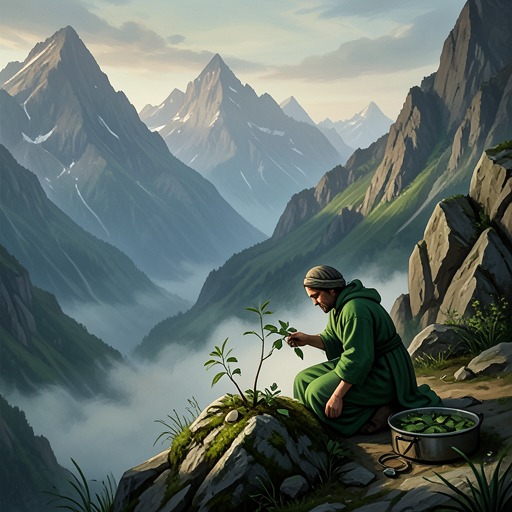
The peaceful heart of Green Island
MulanThe peaceful heart of Green Island is the island’s sustaining spirit, joined in the story to fertile soil, abundant growth, and the people’s responsibility to cherish peace. It is more than a poetic name: when the heart appears to fall into turmoil, the land becomes barren; when the island is restored, Dragon Beard Grass returns and the landscape turns green again. The story leaves the heart’s workings partly mysterious, but makes its condition legible in the life of the island.
Meaning and Origin
The Old Dragon describes Green Island as possessing a spirit of peace and urges its villagers to cherish it. His departure gives that idea a material legacy. As he rises away on a shimmering cloud, villagers reach toward him, but cannot keep him from leaving. They catch his beard instead; its hairs come loose, with tiny drops of red blood at their ends. Carried by the wind across the island, the hairs take root in rich soil created by the island’s peaceful heart.
Those roots grow into Dragon Beard Grass, and the island comes to be called Green Island. The account thus ties the grass’s origin to both the Old Dragon and the condition of the place where it grows: the hairs are his gift, while the peaceful heart supplies the fertile ground. When Mulan asks whether the grass is the Old Dragon’s hair and whether its roots are red because of his blood, the Jade Rabbit confirms her understanding. The origin story makes the grass a continuing trace of the departure, rather than simply one plant among others.
The villagers’ grief does not prevent them from carrying the Old Dragon’s counsel forward. After he disappears, they vow to heed his words and honor the island’s peaceful spirit. His departure therefore leaves two related legacies: a communal promise and a living one. The grass spreads over the island, while the people retain the instruction that gives the natural inheritance its ethical meaning.
The Island’s Decline
When Mulan later searches for Dragon Beard Grass, Green Island no longer resembles the place described in the Rabbit’s story. From above, she sees brown, rocky ground and a dark cave opening; the soil is dry and crumbling, and grass has stopped growing. A glint near the distant cave draws her attention and leads her to wonder whether something has happened to the spirit of the island. The question remains an inference at this point, prompted by the contrast between the story’s fertile island and the barren land before her.
The search across the hills, countryside, and much of the rocky shoreline yields no Dragon Beard Grass. The island has only a few scraggly evergreens, so its name seems almost mocking beside its present appearance. At the cave entrance Mulan sees a weathered statue, barely recognizable, which she suspects represents a long-forgotten island hero. The statue and the glint near the cave give her clues, but initially do not explain the missing grass or the altered soil.
Lu Ting-Pin later reports that a blight struck all the island’s plants about twenty years earlier and that the land has not recovered. The soil has changed and is no longer fertile, leaving very little able to grow. The island has managed because it has relied chiefly on fishing and trade, but that practical adaptation has not restored its vegetation. The Rabbit understands the broad significance of the change: if the soil across the island has altered, then, in his view, the heart of the island is in turmoil.
Mulan notices that the approximate time of the soil’s change also matches the appearance of the Stone Statue. She considers whether the two might be connected, but the evidence at this stage does not establish the connection for her. The story keeps the question open while linking the land’s prolonged barrenness to an unresolved change in the island’s history.
Recognition and Renewal
At dawn, Mulan returns to the Stone Statue and the Odd-Shaped Rock. They have changed since she last saw them: both have crumbled into piles of dust and dirt. When she reaches toward the remains, wind from the sea lifts the dust around her. In the morning light, the particles glint as they move; after another gust scatters them, she notices a thin layer left on the ground and sees fine green stalks emerging from it.
The new growth carries a distinctive sign of its identity. Mulan pulls up one sprout and finds crimson roots, recalling the story of the Old Dragon’s blood at the ends of the beard hairs. She gathers more of the slender plants and runs to show them to Lu Ting-Pin and the Jade Rabbit, announcing that she has found Dragon Beard Grass. The discovery answers the immediate search for the remedy they need, but it also gives visible form to the island’s renewal.
As Mulan rushes away, she does not notice the shimmering light spreading across the island as the dust scatters. The larger change becomes clear after the boat has sailed: Green Island, formerly a jagged brown mass, has softened beneath a yellow-green covering that spreads over its peaks and rocks toward the sea. Mulan understands the transformation as a sign that the heart of the island is at peace. The return of green growth is thus both a physical change in the landscape and the narrative confirmation of a restored condition.
Ecological and Narrative Significance
The island’s environment has agency in the story’s chain of events. The soil is not merely scenery behind Mulan’s search: its loss of fertility prevents the grass from growing, shapes the islanders’ reliance on fishing and trade, and directs Mulan toward the possibility that the land’s condition has a deeper cause. The absence of vegetation makes the name Green Island a visible contradiction; its eventual greening resolves that contradiction through change in the place itself.
The peaceful heart also joins communal conduct to ecological flourishing without reducing the land to a resource. The Old Dragon asks the villagers to cherish the island’s peaceful spirit, and they promise to do so after he leaves. The story does not say that a particular failure by the villagers caused the later blight. Instead, it presents the long decline as a mystery, lets the Rabbit interpret the altered soil as evidence of turmoil, and associates renewal with the crumbling of the two stone forms and the reappearance of the grass.
That structure gives the concept both continuity and change. Dragon Beard Grass preserves the Old Dragon’s departure in a form that can take root and spread; its disappearance shows that the gift depends on the island’s continuing condition. Its return, with crimson roots echoing its legendary origin, reconnects present events to the story of the island’s past. The peaceful heart is therefore the link between memory, land, and renewal: it makes the grass possible, its apparent disturbance is registered in barren soil, and its restoration is made visible as Green Island becomes green again.